Home About Contents Products Contact Disclaimer Privacy Policy
4 Mind 4 Life: Mental Health Tips
Mental Health Tips
Top 50 Geniuses Of All Time – [In A Random Order]
Created by Drew | : Boost Brain Power
1) Albert Einstein - Albert Einstein is a name that comes to mind first when thinking of geniuses. Einstein’s brain was found to be deficient in certain parts, but extraordinarily powerful in others. Another trait of Albert’s brain was the fact that he had a much larger corpus callosum than the average man. The corpus callosum connects the right and left hemispheres and allows them to successfully transfer information back and forth (communicate with one another). Einstein has received the Nobel Prize in physics, was named “Person Of The Century” by Time Magazine, and has contributed phenomenal theories to the world of science (i.e. theory of relativity, unique field theory, etc).
2) Leonardo Da Vinci - Leonardo Da Vinci is considered one of the best painters of all time and possibly the most multi-talented man to have ever lived! Two of his works include: The Last Super & The Mona Lisa. Da Vinci was truly ahead of his time with ideas such as: a helicopter, a tank, solar power, a calculator, and a theory of plate tectonics. Leonardo was a unique individual who exercised the curiosity of his powerful brain.
3) Nikola Tesla- Tesla was a renowned physicist, inventor, and engineer. He has made phenomenal contributions to science and has been classified as the “world’s greatest electrical engineer.” Nikola engaged in studying many works, memorizing complete books, and supposedly had a photographic memory. Tesla had above average brain power and was an advanced thinker when compared to others of his time.
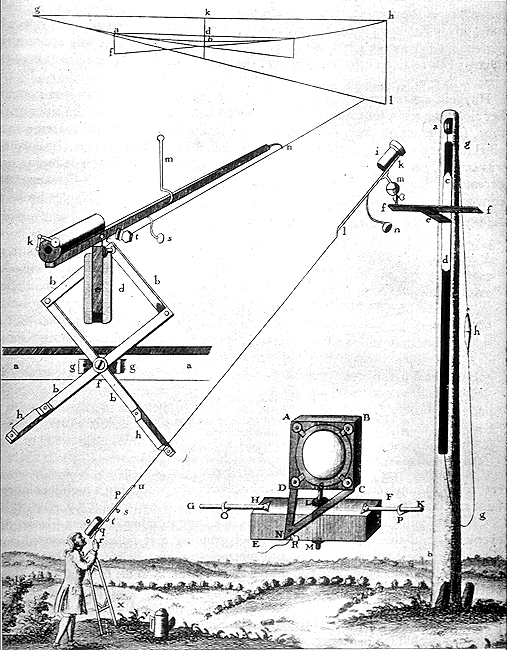
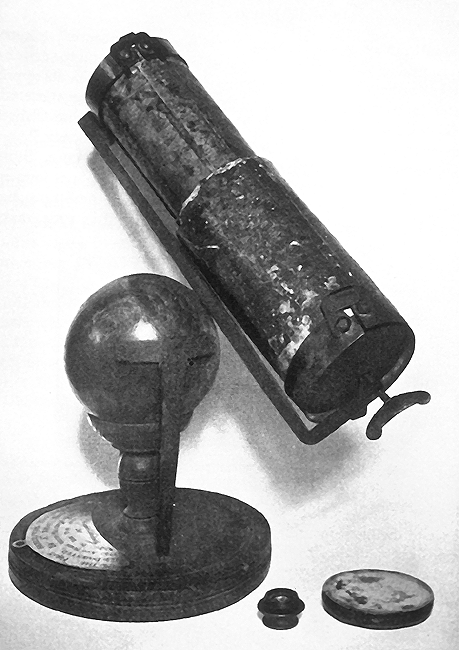
4) Sir Isaac Newton - Sir Isaac Newton was an astronomer astronomer, physicist, inventor, mathematician, and philosopher. In a 2005 poll, Newton was named more influential than Einstein in science. He has developed laws of motion, principles of momentum, and invented the reflecting telescope. Newton has had tons of great scientific achievements. His diverse list of scientific and mathematic accomplishments demonstrate the incredible ability of his brain.
5) Stephen Hawking - Hawking is known best for his theories of black holes, cosmology, and quantum gravity. He has also written several bestselling books such as: “A Brief History Of Time” and “The Universe In A Nutshell.” Though Stephen is currently bound to a wheelchair due to paralysis from Lou Gehrig’s disease (ALS). Hawking has been recognized as a revolutionary thinker and one who displays above average intelligence.
6) Michelangelo - Michelangelo was a phenomenal painter, sculptor, architect, and poet. His diverse interest in art and the world really showed. He sculpted the Pieta and the David before he was 30 years old! He painted the Sistine Chapel and worked on the dome of St. Peter’s Basilica. Michelangelo was a genius that was able to bring an entirely new artistic perspective from his mind to reality.
7) Archimedes - Archimedes was a Greek philosopher, engineer, inventor and astronomer. He is also considered one of the greatest mathematicians of all time. Though there isn’t a ton of documented information regarding his personal life, we do know that he has had a large impact on science and physics. Archimedes’ thoughts were clearly ahead of his time: not many would disagree that he was a genius.
8) Warren Buffet – Though Warren Buffet isn’t a big contributor to science like many other names listed, he does have a ton of knowledge about making money through investing. He is a known philanthropist (someone who donates their time & money for charitable causes) and Time Magazine has regarded Buffet as one of the Top 100 Most Influential People in the world. He was also ranked by Forbes in 2008 as the richest person in the world. His company [Berkshire Hathaway] has an estimated net worth of $62 billion dollars. Warren is a very intelligent man and a financial genius.
9) Swami Vivekananda - In the Eastern world, Swami Vivekananda is regarded as a genius by many. He was one of the most influential and spiritual leaders ever and was a highly-renowned thinker. Because of his insight and unique philosophy that he had contributed to eastern religions, his knowledge and intellect will continue to be admired.
10) Samuel Johnson - Samuel Johnson is regarded as one of the biggest literary influences of all time. He was a biographer, critic, and essayist. Johnson is the highest quoted author since William Shakespeare and was one of the most influential people in the 18th century. The man invented and compiled terms for what many consider the first official dictionary.
11) Immanuel Kant - Immanuel Kant was an 18th-century philosopher from Russia. He has been considered one of the most influential thinkers of all time in Europe. Kant brought forth a unique theory of perception and thought deeply about life. Many regard Kant as a genius of his time.
12) Aristotle - Aristotle was a Greek philosopher, student of Plato and one who taught Alexander the Great. Aristotle became a great writer and is regarded as one of the most important and influential figures towards shaping Western philosophy. His works were the first to ever study “logic” and he had a profound influence on others during his time.
13) Pablo Picasso - Though Picasso may not have been an amazing scientist, his revolutionary mind forever changed the way people looked at art. He was a master drawer, painter, and sculptor. He founded “cubism” – an art style which became a huge movement in the 20th century. Pablo Picasso’s unique perception, which he expressed through his art, caused many people to view reality from a different perspective.
14) Niles Bohr - Niels Bohr was a phenomenal physicist and a highly advanced thinker. He invented the Bohr Model which is regarded as a huge contribution to atomic physics. Bohr was heavily involved with post World War II scientific issues and carried a great head on his shoulders.
15) Thomas Jefferson - Thomas Jefferson was a very brilliant individual. He was the 3rd president of the United States, wrote The Declaration Of Independence, and was the most influential Founding Father for the U.S. He influenced the republican party and was a horticulturist, statesman, architect, author and inventor. Jefferson was the founder of the University of Virginia and understood that slavery was unethical in a time when most everyone else thought it was proper. Thomas Jefferson was definitely had an exceptional brain.
16) Plato - Plato was a Greek philosopher that was taught by Socrates, but taught Aristotle. Along with Socrates and Aristotle, Plato helped lay the groundwork for Western philosophy. He was known to be a mathematician, great writer, and founded “the Academy” or “institute of higher education and learning,” in Athens. His works in philosophy, logic, and mathematics, were studied and used by many teachers after his time. Not only was Plato a revolutionary thinker, he was a genius of his time.
17) Winston Churchill – Winston Churchill was a rightfully famous British politician during World War II. He is well-known for his abilities as a great leader, speaker, officer in the British Army, a historical writer, and an artist. Churchill became a hero of his time and is considered one of the most intelligent men of his time.
18) Benjamin Franklin - Benjamin Franklin was one of the Founding Fathers of the U.S., an author, and a printer. He was also a great politician, inventor, and scientist. Benjamin Franklin’s scientific contributions have shaped physics and the field of electricity. He invented the lightning rod, bifocals, the Franklin stove, the odometer, and the glass harmonica. Franklin created the first public lending library in the United States and first fire department in the city of Pennsylvania. Ben Franklin was a true genius of his time.
19) Thomas Edison – Thomas Edison was a great inventor and businessman who created many appliances that have had profound influence on life around the world. A couple of his inventions are: the phonograph and a long lasting light bulb. Jefferson was also one of the first inventors to apply the idea of “mass production” to the invention process. Many give Jefferson credit with creating the first ever industrial research lab. He is considered one of the most gifted inventors ever and holds over 1,000 United States patents. Edison truly added his touch of genius to the scientific community.
20) Daniel Tammet - Daniel Tammet is a high-functioning autistic savant. He has been gifted with a knack for mathematics, language learning, and above average memorization skills. He was featured on a discovery channel special that tested his abilities and showed his ability to learn arguably the toughest language, Icelandic, in less than 7 days to appear in an interview. Daniel has an incredible brain and was gifted with an above-average intellect.
21) William Shakespeare - William Shakespeare was a poet, playwright, and has been hailed “the greatest writer” in the English language and the worlds best dramatist. He has been deemed the national poet of England and his works include: nearly 40 plays, around 150 sonnets, and 2 long poems. Shakespeare’s plays have been translated into every language, and are performed more often than any other playwright. Shakespeare shed his genius-like thoughts through his complex storytelling.
22) Kim Peek - Though Kim Peek is a savant, he has some exceptional brain abilities. He is lacking a functional corpus callosum (which makes it impossible for his right and left brain hemispheres to exchange information) and has a damaged cerebellum. Without a corpus callosum, some develop above average memory abilities. In Kim Peek’s case, he can read a new book in about 1 hour and manages to retain over 98% of the information within the book! Impressive.
23) Ludwig van Beethoven - Beethoven was a German pianist and legendary musician. He was very influential in Western classical music and is thought of as the best composer of all time. Though Beethoven’s hearing began to cease in his early twenties, he was still able to create classical masterpieces. He was able to conduct, compose, and perform music even after he was completely deaf! Beethoven blessed the world with his musical genius and brilliant mind.
24) Srinivasa Ramanujan - Srinivasa was an Indian mathematician who was able to make huge contributions in the area of mathematical analysis and number theory. Srinivasa demonstrated an uncanny, natural ability to master mathematics. He had a complete math book mastered by 13, and even discovered theorems of his own. He won many awards by showing others his superior mathematical ability at his school. By age 17, this mathematical prodigy was doing his own research with mathematics and numbers. He compiled nearly 4,000 equations and identities in his short lifetime.
25) Johann Sebastian Bach - Bach was an exceptional composer and organist. He specialized in choir, orchestra, and solo instruments. He was able to enrich the German composing style with a full harmonic scale and was able to adapt rhythms from Italy and France. Though his music began early in the 19th century, he is now noted as one of the greatest composers in the Western tradition. Bach was yet another musical genius.
26) Wolfgang Amedeus Mozart - Mozart was a very influential composer during the classical era. He was able to create over 600 compositions that were widely accepted and acknowledged. His music specialties included symphony, chamber music, piano, opera, and choral music. Mozart is among the most popular of classical composers, and many of his works are still included in concerts today. Mozart clearly demonstrated his musical proficiency and level of genius.
27) Sir Francis Drake - Drake was a famous traveler, navigator, and politician from England. He managed to circumnavigate the world in 1577 and has been proclaimed a legend in England. Drake was an exceptionally smart individual and had an estimated I.Q. of 130. Sir Francis was a powerful man that happened to have an incredibly powerful brain.
28) George Berkeley - George Berkeley was an Irish philosopher and developed a famous theory of “immaterialism.” Berkeley also published a book called “The Analyst” that would critique calculus and influence common day mathematics. University Of California, Berkeley was named after George due to his intelligence and philosophical insight.
29) Ludwig Wittgenstein - Ludwig was an Austrian philosopher that developed theories involving logic. He contributed to the philosophy of mathematics, philosophy of language, and philosophy of the mind. He has had a huge influence on philosophy and is widely accepted as one of the twentieth century’s best philosophers. Wittengenstein published 2 books and both were highly influential in philosophy.
30) Socrates - Socrates is regarded as one of the best ancient greek philosophers of all time. As teacher of Plato, he has been associated with highly advanced thinking during his time. His work continues to form much of the foundation for the study of philosophy today. Socrates has made important contributions to the study of logic and writings, and has provided a lot of groundwork that much of the Western civilization has followed.
31) Linus Pauling – Linus Pauling was a peace activist, scientist, author, and teacher. Pauling is regarded as one of the most influential chemists in history and was one of the most important scientists of all time. He was one of the pioneers to work in the study of molecular biology and quantum chemistry. He has been awarded more than 1 Nobel Prize and is one of only 2 individuals to receive them for different fields.
32) Christopher Michael Langan - Christopher Langan is an American with an IQ was reported by “20/20″ and other media sources to have been measured at nearly 200. Though he used to work as a bouncer in Long Island, he rose to fame as “the smartest man in America” in 1999. Langan has developed “a theory of the relationship between mind and reality” which he calls the “Cognitive-Theoretic Model of the Universe and is still alive today. This man has one of the highest I.Q.’s ever on Earth.
33) Michael Faraday - Michael Faraday was a phenomenal chemist and physicist who contributed to the fields of electrochemistry and electromagnetics. His inventions of electromagnetic devices formed the foundation of electric motor technology, and it was largely due to his efforts that electricity became available for use in technology. Faraday was also the very first Professor of Chemistry at the Royal Institution of Great Britain.
34) Blaise Pascal – Blaise Pascal was a French physicist, religious philosopher, and great mathematician. Pascal was a child prodigy and was taught a lot by his father. Pascal’s contributions included: mechanical calculators, concepts of pressure, concepts of vacuum, and the study of fluids. In literature, Pascal is regarded as one of the most important authors of the French classical period. His name (Pascal) has been given to the SI unit of pressure, some programming language, and Pascal’s law.
35) Galileo Galilei - Galileo Galilei was a legendery astronomer, physicist, mathematician, and philosopher. He played a major role in the scientific revolution. His achievements include the first studies of uniformly accelerated motion, improvements to the telescope, and astronomical observations. Galileo has been called the “father of modern observational astronomy”, the “father of modern physics”, the “father of science”, and “the Father of Modern Science.” With his discoveries and studies, Galileo was able to display his brilliance.
36) Martin Luther - Martin Luther was a German professor, a monk, theologian, and church reformer. Luther’s theology challenged the authority of the church by stating that the Bible is the only infallible source of religious authority and that all baptized Christians are a priesthood of believers. According to Luther, salvation was attainable only by true repentance and faith in “Jesus as the Messiah.” His revolutionary ideas inspired the Protestant Reformation and changed the philosophy of Western civilization.
37) Robert Boyle - Was a natural philosopher, chemist, physicist, inventor, and early gentleman scientist. Boyle was largely known for his works in physics and chemistry. He is best known for the creation of “Boyle’s law.” Boyle is recognized today as one of the first modern chemists and one of the founding fathers of chemistry. One of his works, “The Sceptical Chymist” is viewed as a legendary book in the field of chemistry.
38) John Locke - John Locke was a phenomenal English philosopher. Locke’s ideas had a huge influence on the development of political philosophy and he is considered one of the most influential thinkers during the Enlightenment and one of the biggest contibutors to liberal theory. Locke’s influence is reflected in the American Declaration of Independence. Locke was the first philosopher to define the self through a continuity of “consciousness.” John Locke was an independent thinker and among the greatest philosophers.
39) Charles Darwin - Charles Darwin was a naturalist and geologist who proposed that all species of life have evolved over time. The fact that evolution occurs became accepted by the scientific community and the general public. Darwin’s scientific discovery remains the foundation of biology. Darwin is yet another great thinker of his time and his theories are still studied and discussed today.
40) Johannes Kepler - Kepler was a German mathematician, astronomer, and astrologer. He was a huge influence towards the astronomical revolution of the 17th century. Kepler is best known for his laws of planetary motion. His laws also provided one of the foundations for Isaac Newton’s theory of universal gravitation. Kepler is regarded as a man with revolutionary thoughts towards astronomy.
41) Napoleon Bonaparte - Napoleon Bonaparte was a political and French military leader who had a huge influence on European history. Napoleon was a general during the French Revolution, Emperor of France, King of Italy, and Mediator of the Swiss. Napoleon was a very intelligent military leader who used innovative tactics and strategy to help him win many battles.
42) Garry Kasparov – Garry Kasparov was a former World Chess Champion, writer, and political activist. Kasparov was a candidate for the Russian presidential race of 2008. Kasparov holds the all-time highest chess rating of 2851 and records for consecutive tournament victories.
43) John Stuart Mill – John Stuart Mill largely influenced British thought and politics in the 19th century. His large number of works include: texts in logic, economics, social and political philosophy, ethics, metaphysics, and religion. John Stuart Mill is recognized as one of the most intelligent men of his time and is regarded as one of the smartest men of all time.
44) Rene Descartes - Rene Descartes was an influential philosopher, mathematician, scientist, and writer. Descartes has been given the title “Father of Modern Philosophy,” and has contributed a lot to Western philosophy. His writings are still being studied today and he has had a huge influence in mathematics. Rene was a key figure in the scientific revolution and was able to share his incredible insights with others.
45) George Washington - George Washington was the first President of the United States, and lead the U.S. continental Army to defeat the British in the Revolutionary war. Washington is viewed as a symbol of the United States and republican party. He has been consistently ranked by citizens as one of the greatest presidents of the United States.
46) Miguel de Cervantes – Miguel de Cervantes was a Spanish novelist, poet, painter and playwright. He is one of the most influential and important people in literature and the leader of culture in 16th century Spain. Cervantes’ novel “Don Quixote” is considered a classic of Western literature and has been ranked among the best novels ever written. Miguel de Cervantes’ work is considered among the most important in all of literature!
47) Francois Marie-Arouet – Commonly known by the pen-name Voltaire, Francois Marie-Arouet was a French Enlightenment writer, essayist, and philosopher. He was known for his wit, defense of civil liberties, and philosophy. He was an outspoken supporter of social reform and was one of several Enlightenment figures whose works and ideas influenced important thinkers of both the American and French Revolutions.
48) Baruch de Spinoza - Baruch de Spinoza was a Dutch philosopher that was very proficient in science. Most of Spinoza’s work was not recognized until after his death. Today, Spinoza is regarded as one of the greatest 17th century philosophers. His work in philosophy laid the foundation for the 18th century Enlightenment.
49) Gottfried Wilhelm Leibniz - Leibniz was a German polymath who is regarded as one of the greatest philosophers. Liebniz invented calculus, and his version is widely used. He also discovered the binary system, the structure of modern computer architectures. He was, along with Rene Descartes and Baruch Spinoza, one of the 3 greatest 17th century philosophers. He also made major contributions to physics, technology, and made anticipations that surfaced much later in biology, medicine, geology, probability theory, psychology, and linguistics. Liebniz also wrote about politics, law, ethics, theology, and history.
50) Johann Wolfgang von Goethe - Johann Wolfgang von Goethe was a German writer whose works span the fields of poetry, drama, literature, theology, humanism, and science. Goethe was a key figure in German literature and the movement of Weimar Classicism in the late 18th and early 19th centuries. Goethe is the inventor of the concept of “world literature,” having taken great interest in the literatures of England, France, Italy, classical Greece, Persia, and Arabic literature. His influence on German philosophy is unparalleled and his influence has spread across Europe. Many of his works were a primary source of inspiration in music, drama, and poetry. Goethe is considered one of the most important thinkers in the Western culture and generally recognized as the most important writer in the German language.
4mind4life
No related posts.
102 Comments »
102 Responses to “Top 50 Geniuses Of All Time – [In A Random Order]”
on 01 Apr 2008 at 5:47 pm # Obi
Dude, I love this post and I think your Top 3 are spot on, but…
How the hell can you put Warren Buffett in the Top 10, and like 20 spots above Socrates?!
And where is Marcus Aurelius in all this madness!?!
You’ve got some explaining to do man…
on 02 Apr 2008 at 2:15 am # Drew
Hey Obi,
Glad to hear you enjoyed it. I didn’t put them in a “ranked” order. I’m planning another project where intelligence will be “ranked.”
Thanks for your comments :)
on 02 Apr 2008 at 2:21 am # Obi
Alright bro, you’re in the clear. :)
on 09 Jul 2008 at 1:25 pm # Ranjeet
hi..
I guess John Nash did an incredible job too… His mind was quoted as “A beautiful mind” indeed…
What say??
Ranjeet
on 07 Oct 2008 at 6:24 pm # stardust
Interesting list, I feel Rudolph Steiner should have appeared on it though!
Stardust
on 26 Nov 2008 at 6:41 am # Mark
Where’s Richard Feynman? He was a by far the most brilliant physicist — way beyond Hawking, just not as stereotypical.
on 29 Dec 2008 at 7:48 pm # sad
whats the point? all born geniuses what’s the point for losers to read about them. its not like you can get as good as these guys.
on 30 Dec 2008 at 6:37 am # Obi
Don’t be so sad, Sad.
Geniuses aren’t born, they’re created. And you have the power to be just as great, if not greater, if you decide to be.
on 06 Feb 2009 at 1:12 am # Bill
u r list is a little messed up…it only list people with magnificent achievement and a major influence to humankind. The definition of genius. 1.exceptional intellectual or creative power or other natural ability. 2 an exceptionally intelligent or able person. from oxford university dictionary. like i don’t understand why Winston Churchill is on there, he is not like insane smart.
Thanks
on 12 Feb 2009 at 6:14 pm # lawal mustapha oluwatosin
genetically ingenious
on 21 Feb 2009 at 5:39 am # Mimi
Where are the women? Are there no women geniuses?
Here’s my try at a list, in no particular order:
Marie Curie
Sor Juana Inez de la Cruz
Elizabeth I
Jane Addams
Lady Murasaki
Jane Austen
Charlotte Brontë
Joni Mitchell
Toni Morrison
Golda Meir
on 21 Feb 2009 at 5:34 pm # eq
there are no women on this list..
on 22 Feb 2009 at 7:35 pm # alaa
I cannot believe sigmund freud is not up there!
on 25 Feb 2009 at 11:07 pm # Jven
hey a friend told me about a book of the most brilliant minds in hstory where can I find it??
on 22 Mar 2009 at 8:42 pm # Martin
Very good list I must say,though I would add Salvador Dali to the list as well.
on 22 Apr 2009 at 1:22 pm # ilias
Well, it is subjective as who to put in this list. I mean Napoleaon was a great general, but was he really smarter than julius ceasar or alexander the great who expanded his empire to India? Philosopher Karl Marx is not on the list as well as Homer and Hippokrates father of medicine.
on 24 May 2009 at 12:39 am # tathiana
WHERES MARX!!!!???
on 28 Jun 2009 at 8:00 am # kristofferson
awesome lists dude.. notify me(if you can) when u get that “ranked” lists of brilliant people =)
on 13 Jul 2009 at 4:04 pm # ajit vadakayil
gentlemen,
NICOLA TESLA SHOULD HAVE BEEN NUMBER ONE!
von neumann should have come ahead of albert einstein.
does anybody know that einstein borrowed ideas, as he was working in the patents office?
like how marconi and edison borrowed tesla’s ideas!
CAPT AJIT VADAKAYIL
on 06 Aug 2009 at 2:15 pm # yasha
Kasparov doesn’t belong on this list.
I’d never put Picasso ahead of Van Gogh and Rembrandt.
Some so-called “geniuses” are noted here for their IQs and how quickly they can absorb information (such as Peek). I am not aware of the full range of Peek’s abilities, but true genius is not so much about absorbing information quickly (reading a book in under an hour, say), but is actually about creative potential, new ideas, etc…
Where is Dante and Chaucer here?
What about Rumi?
Dostoyevsky?
Julius Caesar?
William Blake?
Krishnamurti is a more interesting thinker than Vivekananda.
What about the spiritual geniuses, such as Buddha, Jesus, etc? Where are they?
This is far from a satisfactory list.
I don’t know about Samuel Johnson either. As admirable as he was, compared with the geniuses I listed here, he had mechanical talents.
Descartes – overrated. His statement “I think, therefore I am” is childish, something even the laziest Buddhist philosopher would never say. And Buddhists were around centuries before he lived. It would have been better had Hume been included instead, though I have my doubts about the inclusion of Hume…
on 06 Aug 2009 at 2:28 pm # yasha
I should have said: “Where are Dante and Chaucer here?”
Other serious candidates:
Li Po
Whitman
Hafez
Brahms
Wagner
Heifetz
Dickinson
King David
Nagarjuna
Ibsen
Nietzsche
on 20 Aug 2009 at 8:05 am # D Armor
Please do your research and include Richard Feynman. One of the most brilliant physics and mathematicians ever. The more you read about him the more you will put in in your top 50; I promise. He could replace Kim Peek who really did not do anything relavent.
on 17 Sep 2009 at 6:56 am # Amran
Hey what about Muhammad the prophet?
on 30 Sep 2009 at 1:54 pm # Cesar
Just one question to show you what is more important for mankind…..
Do you know who was the richest man of the world when Socrates was alive?
Did you notice in one documentary, that even the US military was involved trying to find Mozart’s DNA?
Can you imagine doing that trying to get the austrian’s emperor DNA or the DNA of a very wealthy man of that time?
The richest men tend to benefit THEMSELVES…..the work of the REAL genius of the mankind, tend to benefit HUMANS….think about it.
Socrates, Da Vinci, Newton, Darwin, Galileo, Bohr…..
Wich of them were the wealthiest of their time?
on 01 Oct 2009 at 4:53 am # Raymond
good list i like but imo if your going to put thomas jefferson and washington lincoln has to be there as well. he is considered the greatest president by a lot.
on 13 Oct 2009 at 6:19 am # SONNY
WHERE IS DR. JOSE RIZAL OF PHILIPPINES??HE’S A GENIUS MAN WHO IS VERY HUMBLE..HE KNOWS A LOT WHEN IT COMES TO ARTS,MEDICINE,POETRY,,HE IS AN EXCELLENT PAINTER,SCULPTOR,AUTHOR,MATHEMATICIAN,PHYSICIST,OPTHALMOLOGIST,NATIONAL HERO OF THE PHILIPPINES,PHILOSOPHER,THEOLOGIAN,EDUCATOR,CONVERSANT IN ALL LANGUAGES IN THE WORLD,POET,WRITER AND HE HAS A VERY UNIQUE TALENT WHICH ALBERT EINSTEIN CANNOT DO,HE MUST BE PUT AS NUMBER ONE…AND FOR YOUR INFO HE GOT AN EXCELLENT GRADES IN ALL SUBJECTS WHEN HE WAS STILL STUDYING
on 27 Oct 2009 at 10:57 am # acube
Why did Galileo Galilei ended up at top 30 only? He was like the founder of modern science! I was hoping to see James Clerk Maxwell and some strategic military geniuses like Alexander the Great and Julius Cesar who almost took over the world itself!
on 28 Oct 2009 at 8:56 pm # Pablo
I think we need more than one list, or else make an effort to look beyond the white male world.
on 29 Oct 2009 at 10:37 am # Genius
Obi got caught!
on 30 Oct 2009 at 12:15 am # ryan
besides many others mentioned before, i would put particular emphasis on adding nietsche
on 13 Nov 2009 at 10:09 am # lostto
I reviewed this list looking to solve a personal mystery thats plagued me for the last 10 yrs or so…I read a reference once that described a man living in the 5th or 6th century as the most brilliant and accomplished mind of all time. I was very surprised I’d never heard the name, since I read alot of history books.
My recollection of the bio was as follows: he was born in the 5th or 6th century in the south of France to a undistinguished, uneducated family; recognized as brilliant by church officials, he was placed in and educated by the church very early in his life, and spent the rest of his life in Italy. He was renowned in several fields, but especially mathematics and philosophy.
Several figures fit most parts of this bio (Pope Gregory, Gaspard Monge, and 1-2 others), but are way off for a major detail. Any help in id-ing this person is appreciated!
BTW…George Washington!? Do you mean Thomas Jefferson? Washington wrote next to nothing compared with his contemporaries, nor was he an intellectual or highly educated man. A brilliant military talent perhaps, but little else distinguished him. I’ve never understood anyone stating he was a great president. More like in the right place at the time, and a compromise, default pick for the first, based on his military heroism. It was Jefferson who was so renowned for his well-rounded genius, pursuit of knowledge, and brilliant writings.
on 16 Nov 2009 at 12:15 pm # Lenya
It seems that this list was created by one person, with his ideas and without anything other.
Of course most of first 20 are really geniuses, but it’s very strange that some living peoples did nothing genially and added in this list only after they high results on IQ test. Also strange that no women in list, i think here could be Curie at least.
Now we can’t rate geniuses of antique world in one list with living people; author tried to do it, but had not good result.
PS:I’m sorry for my bad english
on 16 Nov 2009 at 9:06 pm # Jimi
Where are the eskimos? Are there no esquimaux geniuses?
Hawking is a popular writer with a lot of time on his hands not Da Vinci. Same with Warren Buffett, right place at the right time.
Carl Jung, John Coltrane, and Milton Erickson had more sophisticated minds
on 17 Nov 2009 at 1:03 am # BOBALOO
What about Helen Keller??? I would call her one because she SURVIVED BEING DEAF AND BLIND! And I do believe that Dr. Jose Rizal should have been on the list. He is a very powerful person who changed the Phillipines. Lincoln maybe should be on there but IDK.
on 27 Nov 2009 at 7:25 am # deadman
please consider Henry Cavendish as he might be even at one of the top spots
on 12 Jan 2010 at 6:41 am # Alex
I agree with Mimi!
And, I believe Kate Bush should be added. I just think she is a “brilliant” musician. Brilliant! But, I am biased…a little.
on 19 Jan 2010 at 4:43 am # David
Nooo in no wayy is Einstein #1 they say his IQ was in the 160′s. At the age of eleven Ted Kaczynski had an IQ of 169
on 04 Feb 2010 at 11:12 am # jake
Muhammad the prophet should definitely be cosidered. I am a white male(trying not to be biased) and i think some women should be included (Mimi’s list has some good suggestions). Also more people beyond the western world should be considered. And yes it does seem like one person created this list. What about Adolf Hitler (even though we perceive him to be evil).
on 15 Feb 2010 at 7:58 am # Cindi
Only white men make the genius list? I must conclude the list-maker and applauders would certainly not make the list. And I am not asking for token names. But a measure that truly covers the range of genius.
on 18 Feb 2010 at 11:20 pm # dasma
An incomplete list, Wittgenstein as nro. 1 for me. And Plato over Socrates? But well done anyway, a good list for starters.
And yes there are no women geniuses, there never was and never will be, since genius is the highest form of masculinity there is.
on 21 Feb 2010 at 8:16 pm # IOAN COSMA
I cannot believe that Lagrange is not on the list.
on 12 Mar 2010 at 9:31 pm # Punchy
3 words: A Dolf Hitler
Oh, and Wayne Gretzky too.
on 26 Mar 2010 at 9:22 am # ashkara
haha..this list is clearly meaningless…no Muhammad included..if you could think logically, this guy have supergreat influenced and huge amounts of followers. now there around 1.4 billion muslim peoples which follow muhammad teaching. so there are so weird if this great guy havent listed.
on 15 Apr 2010 at 8:52 pm # IQ is subjective
Firstly , I would like to point out that the measurement of IQ and intelligence in general is subjective.Secondly , I think that a lot of the people on the list are not geniuses , but rather just individuals who did something important. Also a lot of physicists and mathematicians were missed out , in fact almost all of the list should have been filled with them.
on 26 May 2010 at 6:49 pm # nicolass vpn ahn
nikola tesla should rule
he is the best
smater then eistien and fuke george washington
on 08 Jun 2010 at 3:04 am # Fish
Punchy, Hitler may have been pretty smart at the beginning, but he let the power get the best of him, so that was pretty foolish right there. Besides, Goebbels was the real genius, with all of his work with the propaganda. And Gretzky is just plain awesome XD
on 24 Jun 2010 at 10:35 am # Anush
Few more must have’s..
Science: Fermi, Tsiolkovsky
Medicine: Pasteur, Fleming
Humanitarian: Gandhi, Mother Theresa
Sports: Pele, Maradona, Tal, Bradman
Economics: Caines, Marx, Chanakya
Film: Chaplin, Stanislavsky, Hitchcock
on 15 Aug 2010 at 12:08 pm # list is bollocks
Where are Euler, Gauss, Fermat, Chopin?
Warren Buffet? Are you kidding me?
on 16 Aug 2010 at 3:42 pm # TOM THOMAS
This list meaning less top genius man of all time is
OSHO RAJNEESH (indian mystic)
GAUTAM BUDDHA
Jain 24 Tirthankara MAHAVIR
LAO TZU (TAO)
KABIR (indian saint)
AND ALL ENLIGHTENMET MASTERS
on 07 Sep 2010 at 3:31 am # cusa
Where is Gauß?
on 07 Sep 2010 at 3:42 am # cusa
And, Immanuel Kant was not Russian, he was Prussian.
on 16 Sep 2010 at 10:34 pm # the K.A.P
Why top up ya list with whites, are u saying negroes have no influential men, what about imoteph (the first named Arch.), Hannibal (world’s great warrior who defeated roman empire) H. Macaulay, Mandela among others. Da list is not educative, xry 4 dat word. Try to renew ur list
on 15 Dec 2010 at 5:14 pm # Corinne Nelsen
I think we can all agree it would take a much longer list to name every genius or great intelligence in our world’s history. Just because someone is not on this particular list does not mean they are less intelligent than the individuals here.
That being said I would like to submit Ayn Rand as one of the greatest minds of our time.
on 25 Dec 2010 at 6:30 pm # Angela
You ought to include names like James Watt , who made significant impact in revolutionalizing the misteries behind DNA. Top on the list should be The wright Brothers, Philip Emeagwali, Ukemenam Angela …………
on 01 Jan 2011 at 11:35 am # baghlani
Faithfuully I think the most brilliant mind in all over the world & in all along the history is certainly karl friedrich gauss.Please rearange the above mentioned list accordingly.
on 04 Jan 2011 at 8:58 am # PLB
It’s sad to say that all modern thought/mathematics/philosophy came from the Egyptian and or Nubian cultue and that there isn’t any credit given. But white man has always done that. Wow. Sad and predictible.
on 16 Jan 2011 at 9:33 am # a
WHERE ON EARTH IS KARL FREDRICH GAUSS!!!!!!!!!! AND WHY THE HELL IS NAPOLEAN A HITLER SHAPED MANIAC ON THIS LIST OF GENIUSES??? IS THIS A CHILD PRODIHY LIST OR A GENIUS ONE ? IS THIS A GENIUS LIST OR A LIST OF RANDOM un(in)famous maniacs????????????? whhere is kim ung yong
on 26 Jan 2011 at 2:57 am # Name
Here is my top 5 list that i reccommend.
1.GAUSS
2.EULER
3.ERDOS
4.NEWTON
5.MAXWELL
mostly math and physiscs and people but that’s what i think takes the most genius.
and also i don’t think that these people should be called geniuses since the definition of a genius is VAUGE and all humans are pretty dumb.
on 26 Jan 2011 at 6:06 am # impersonator
I don’t think any of our modern day geniuses hshould have any chance to be on the top 10. maybe Torrence Tao. especailly steven hawkins has contributed little usefulness or proved anything impossinle for the world.
on 27 Jan 2011 at 12:12 am # Gauss
I don’t think einstein should be considerd the greatest genius of all time!!!! I think i have done much more than an d is much smarter than eulre and niudun combbin ed!!!!!!!
on 29 Jan 2011 at 4:54 am # Yeknomo
First off the list is very good it shows many geniuses but as always the order is debatable. The reason for the lack of women and African Americans is because for the majority of time they weren’t taken seriously in the workforce. In the US women and African Americans were discriminated against until the 20th century. I agree with Madam Currie being on the list though. secondly, people like Jesus and Mohammad and MLK Jr. shouldn’t be on the list because they were influential but not in science and math and thus are not geniuses. White men should dominate the list because until around 200years ago they ruled the world.
on 30 Jan 2011 at 9:02 am # THEGAME
I REALLY disagree with this list! WHERE is archemedis euclid and george bush!??? i think first place should definetly be oiler followed by kim ung yong! take out buffet and replace him with GATES. there both crazy rich peole but at lestt bill gatese is a nerd!
GAUSS????
on 03 Feb 2011 at 11:09 am # John
It makes sense that Einstein is 1st, but I would actually put Beethoven at one. But which is more impressive: figuring out that time is relative, or writing the greatest music in history while totally deaf?
on 06 Feb 2011 at 1:20 am # zzzp
IDIOS!!What a shame !!!: Alexander the Great ,Michel Angelo,Dostoyevsky
,Plato,Riemann,Gauss,Einstein
on 07 Feb 2011 at 12:36 pm # Amritesh
GOOD WORK!!! u should try making a new list reading all suggestions…try including john nash,madam curie and richard feynman..try including votes so many people can vote their top 50 and the list will be more relevant.
on 07 Feb 2011 at 8:35 pm # America
When you post a comment know your facts. Hannibal did not defeat the Roman Empire Carthage was defeated. He performed extremely well but in the end he lost. Definitely a brilliant perhaps the most brilliant general of all time but he still lost.
on 07 Feb 2011 at 8:37 pm # America
This list is somewhat biased but consider the American education system. It is largely based on European history therefore who appears on the list? White Males of course. People need to stop attacking the maker of the list he simply went by the people he/she could think of.
on 11 Feb 2011 at 7:12 pm # John Sanders
Iqbal Saleh Abba has the highest IQ tested in the world: so, the info here has to be latest and Chris Langdon is not the person. Why don’t you be accurate?
on 14 Feb 2011 at 5:30 am # Korey
Where is Bill Gates he is a huge part of the technological revolution.
on 26 Feb 2011 at 10:38 pm # Me
Tesla should be number 1. Da vinci is overrated.
on 18 Mar 2011 at 12:16 pm # David Koevoets
Tesla nr 1
or
Maxwell nr 1
No woman in the list, they should clean! :-p
on 22 Mar 2011 at 2:44 am # Bruz2r
Bach 2 the Future?
“25) Johann Sebastian Bach – Bach was an exceptional composer and organist… his music began early in the 19th century….”
on 22 Mar 2011 at 4:43 am # Zach
Speaking composers, I feel Brian Wilson should have made the list. His mind is so vast and so complicated, that the thoughts that go through his mind about music could be compared to those that went through Einstein’s concerning science. I can see why he didn’t amongst competition from composers like Mozart and Beethoven, but just a thought.
on 24 Mar 2011 at 5:46 pm # Dr guru
Good try.can b considerd as list of 50 geniuses instead of TOP.Read many suggessions to improve it
on 25 Mar 2011 at 9:21 am # whatthe
Tesla is the greatest by far!
on 29 Mar 2011 at 7:48 am # john
i agree einstein is number 1, but newton suppose to be number 2 or 3.. he have more contribution than tesla..
on 01 Apr 2011 at 1:36 am # lia
ilias,tathiana ,mimi -you nailed it!!! that’s what i’m asking myself? where the hell are the w0men, hippocrates,HOMER and especially KARL MARX!!!!!!!!!!!!!
on 08 Apr 2011 at 1:56 pm # Steve
AQUINAS…. AUGUSTINE… John Paul II…
You had Fr. Martin Luther but not his wife the ex-nun? If you wanted to pick a Protestant “Reformer” Zwingli or Calvin would have been better choices
on 02 May 2011 at 12:21 pm # platomk
notable missing
pythagoras mathematician
hero of alexandria – greatest inventor of all time
over rated.
leonardo – hardly ever finshed anything. notes and drawings that werte never made or published so had no influence. as all in the renaissance these figures rediscovered the greek ideas, never equalling them as Michaeangelo cried when he saw the sculpture Lacoon because as he put it he could never equal its magnigicance and told the pope he and no one else could ever reach the perfection of the greek artists almost 2000 years before.
science and its discipline was almost single handedly created by Aristotle. what he achieved was profound. ever one since has merely “stood on the shoulders fo giants and can see a little further” but could not see anything without the mental giants that proceeded them. whitehead said that all western philosophy is a footnote to Plato and many agree with him. Plato and socrates should top this list as without them the others dont exist.
archimedes revolutionsed war, catapults, bows so ahead of his time and the world that he kept Rome at bay from ravaging his city SYracuse for 50 years. all real world all working machines that changed the world as we know it. to put leonardo ahead of him is just .. well silly.
Euclids book on mathematics has been the text book for mathematics for most of the world for 2000 years with no changes or additions till the late 1920′s when new ideas were added. none of the other mathematics was changed or altered as it was all but perfection.
heros steam engine, hsi “car”, coin operated vending machines, nuematic doors, pipe organs and the list goes on..
Galens work in anatomy is still studied by Surgeons today. Hypocrates changed the myths and gods out of healing and paved the way for modern medicine.
phythogoras work in mathematics changed it from mere rules of thumb to become the language of science. somthing that today is regarded as possibly mans greatest achievement. and its attibuted to him. sciencists and physicians today owe a debt of grattitude to him.
aristotle work in all fields of knowledge has never been equelled and profound. he basically IS science. regarded to this day as knowing more than any human who has ever lived.
alexander never lost and gennerals today still study him and his plans, Shwartzcoff has stated that certain monueveures in Iraq were based on his tactics in India. Caesar wept as he was was just starting as a commander and at the same age Alexander had conquered the world.
Homers Illiad and the Odyssey are still influencing storytelling and the movies you watch today.
Platos writings changed the world, influencing drastically the christian world and theology, the middle east, creator fo the first university.
the list should have at the top about 20 greeks and then everyone else listed and which greek influenced their ideas.. but hey perhaps im biased but then again I got this from reading it form EInstein, Betrand Russell, Voltaire, THomas Aquinus, and a thousand others including msot fo the people on your list who said the same.
on 06 May 2011 at 5:04 am # Steven
Albert Einstein should be high on the list, but not number 1. He benefited from a lot work developed before him. Riemann was trying to develop a gravitational theory with curved space, which Einstein realized he should have been looking at space-time not space. Also, with Maxwell’s work Einstein would not have developed special relativity. Einstein great genius, but not greatest.
I would definitely put Newton above Einstein. He developed physics and calculus, during a time when most people during his time were still burning witches and thought plagues was punishment from God. When Newton didn’t have the mathematics required to his work in physics, HE INVENTED CALCULUS TO DO IT!
But, for the greatest genius ever, I would have to go with Archimedes. Archimedes was probably the greatest mathematician that has ever lived. His work was still being studied and deciphered by mathematicians over 1000 years after he was dead. At the time of his death, Archimedes was working on Limits and started developing Calculus. Let me repeat that, he was developing Calculus over 1500 years before Newton invented it. But, he was killed by Roman soldiers before he could complete it. If he had not been killed, physics and science would probably be ridiculously more advanced than it is today, because once you have Calculus (deals with things like rates of change) Newtonian Physics will soon start to poor out of it.
Archimedes did all of this when very little mathematical notation had been developed and pretty much only well known math was Euclid’s geometry. Archimedes was so far a head of his time that no one during his time could even understand what the hell he was doing. Only Newton seems the only one that has a chance to compare to this kind of genius.
on 11 May 2011 at 12:06 am # HIStory vetted
Tesla @ the top and argue about the other 49.
“He who seeks shall find”. If one cares to look.
@ Yekenomo – I DO agree with you about why Jesus, Mohammed and MLK Jr. should be excluded, but why prove your ignorance of black geniuses? True ingenuity and intelligence can’t be discriminated against.
But when I saw Sammel Jackson on the list, for a second there I thought….aw, never mind. :)
The names are for everyone. Their “serious” accomplishments are for Nomo!
Mark E. Dean
Do you know why you can Plug and Play any printer, keyboard, monitor or peripheral without programing your computer to work with it every time? Because of the ISA bus. Mark Dean was the computer scientist who led the team that developed the ISA bus, and he led the design team responsible for creating the first one-gigahertz computer processor chip too. He also contributed to the design of IBM’s first personal computer, holding three of the nine core patents upon which these machines were based. He holds some 25 patents with at least 10 more pending and has been honored with numerous awards including election to the National Academy of Engineers, membership in the American Academy of Arts and Science and being awarded with the Ronald H. Brown American Innovators Award. He’s an “IBM Fellow” (only 231 since 1962) which is the highest level of technical excellence at the company, and has held a variety of posts at IBM, including Vice President of Performance for the RS/6000 division; Director of the Austin Research Research Lab; and, as of 2004, Vice President of the IBM Almaden Research Center in San Jose, Calif., where he has lead the effort to develop tablet-style PCs. In 1997 he was inducted into the National Inventors Hall of Fame.
James West
He studied physics at Temple U. Specializing in microphones, West went on to author 200 patents and more than 60 technical and scientific publications. In 1962, with Gerhard Sessler, West developed the foil electret microphone, which became the industry standard. Approximately 90% of microphones in use today are based on this invention and almost all telephones utilize it, as well as tape recorders, camcorders, baby monitors and hearing aids. In 1999, West and Sessler were inducted into the National Inventors Hall of Fame for their invention of the “Electroacoustic Transducer/Electret Microphone”. West left Bell Labs in 2001 as a retired Distinguished Member of Technical Staff and Bell Labs Fellow. His numerous distinctions include Fellowship in the IEEE and membership in the National Academy of Engineering, National Patent Law Association, the Electrochemical Society of America, the Acoustical Society of America and the National Society of Black Engineers. In 1997, he was named president-elect of the Acoustical Society of America (ASA).
West has more than 40 U.S. and over 100 foreign patents and has authored or contributed to more than 100 technical papers and several books on acoustics, solid-state physics and materials science. He is especially active in programs designed to inspire minorities and women to enter fields in science, technology and engineering. As of 2003, he has served as a research professor at the Whiting School of Engineering at Johns Hopkins University in Baltimore. He was named Divisional Diversity Council of the Whiting School in the fall of that year.
Benjamin Banneker (1731-1806)
An internationally known almanac author, farmer, engineer, surveyor, city planner, astronomer, mathematician, inventor, author, and social critic. He taught himself advanced mathematics and astronomy. He is best known for successfully predicting an eclipse in 1789. His estimate made well in advance of the celestial event, contradicted predictions of better-known mathematicians and astronomers. From 1792 to 1802, Banneker published an annual Farmer’s Almanac based on his astronomical calculations. In 1753, when he was 22, using a pocket watch he had borrowed for a model, Banneker carved wooden replicas of each piece and used the parts to make the first striking clock to be made completely in America. Banneker’s clock was so precise it struck every hour, on the hour, for forty years. Banneker even helped Joseph Ellicott to build a complex clock.
Banneker became close friends with the Ellicott brothers. They lent him books on astronomy and mathematics as well as instruments for observing the stars. Banneker taught himself astronomy and advanced mathematics.
Banneker’s parents died, leaving him the farm since his two sisters had married and moved away. Banneker built a “work cabin” with a skylight to study the stars and make calculations. Working largely alone, with few visitors, he compiled results which he published in his Almanac.
Around this time, Major Andrew Ellicott, George Ellicott’s cousin, asked Banneker to help him survey the “Federal Territory”. Banneker and Ellicott worked closely with Pierre L’Enfant who was the architect in charge of planning Washington D.C. L’Enfant was suddenly dismissed from the project, due to his temper. When he left, he took the plans with him. Banneker recreated the plans from memory, saving the U.S. government the effort and expense of having someone else design the capital.
Daniel Hale Williams (1856-1931)
Performed the first SUCCESSFUL surgery on the heart in the 1800′s and his procedure was used as the standard for future internal surgeries because EVERY patient operated on prior to that (by white doctors, Yekenomo) died of infection.
Charles Henry Turner 1867-1923
Insects out number humans about 200 million to one, have 6-10mil different species and represent more than half of all known living organisms, so a major breakthrough in their study would be pretty significant, right?
This zoologist became the first person to prove that insects can hear and can distinguish pitch. In addition, he first discovered that cockroaches can learn by trial and error (those funny maze tests of his we still do) and that honeybees can see color. So, Yeknomo, white scientists actually thought insects didn’t hear, learn or see in color. Nkaay?
@ America (No excuse for missing this next one!)
George Washington? No. George Washington CARVER? Hells yeah!
Born into slavery (Ok, that means educating yourself or your children is VERY likely to be punishable by death), after AGRICULTURAL CHEMIST, George Washington CARVER, became Tuskegee Institute’s director of agricultural research in 1896, he devoted his time to research projects aimed at helping Southern agriculture, demonstrating ways that farmers could improve their economic situation. He conducted experiments in soil management and crop production and directed an experimental farm. At this time agriculture in the Deep South was in serious trouble because the unremitting single-crop cultivation of cotton had left the soil of many fields exhausted and WORTHLESS, and erosion had then taken its toll on areas that could no longer sustain any plant cover. As a remedy, Carver urged Southern farmers to plant peanuts and soybeans, which, since they belong to the legume family, could restore nitrogen to the soil while also providing the protein so badly needed in the diet of many Southerners. Carver found that Alabama’s soils were particularly well-suited to growing peanuts and sweet potatoes,
but when the state’s farmers began cultivating these crops instead of cotton, they found little demand for them on the market.
(and here’s the genius part IMHO, on a scientific AND socio-economic scale.)
In response to this problem, Carver set about enlarging the commercial possibilities of the peanut and sweet potato through a long and ingenious program of laboratory research. He ultimately developed 300 derivative products from peanuts—among them cheese, milk, coffee, flour, ink, dyes, plastics, wood stains, soap, linoleum, medicinal oils, and cosmetics—and 118 from sweet potatoes, including flour, vinegar, molasses, rubber, ink, a synthetic rubber, and postage stamp glue.
So those are my additions. Good enough?
And I don’t think George Washington, Napoleon, or Hannibal for that matter should be included solely because that’s just military planning. A big ol chess game. You just need to be 5% smarter than your enemy. Strategic military geniuses? Definitely. But to use one’s intellect to AVOID war and death, now THAT is genius.
on 11 May 2011 at 12:15 am # HIStory vetted
But everyone on the list was a great in their own way and reading about their lives and work would be nothing but beneficial. Good luck in your travels people. Mentally AND physically!
on 11 May 2011 at 6:48 pm # heyman231000
Great list, but I am disappointed that you left out Levi Boxell, a native of Zionsville, IN. At the age of 17, he has already contributed greatly to the string theory studies, and is currently poised to accept a job offer from NASA that would instantly place him in the upper-echelon of the most powerful scientific minds in the world. President Obama recently requested that Levi contribute to the war on terror in Afghanistan by helping the US intelligence develop new weapons, but Levi politely declined the offer due to his humanitarian interests. A great mind, but an even better person.
on 12 May 2011 at 3:54 pm # peter
All such lists tend to make people mad because of whom they leave out. I am happy to see Warren Buffett included, because he has succeeded by means of an approach that is very systematic and mathematical but blended with a great deal of ‘horse sense.’ Also, he has made so many good investments that there’s no way luck can account for it. Finally, I think he is one of our great economic thinkers. Read his letters to Berkshire shareholders for many nuggets of logical thinking about economic principles which economists get wrong.
I am surprised at the high placing of Tesla. When I was a kid nobody mentioned his name in the company of Newton and Einstein. I wonder what is behind the Tesla surge? Did they make a movie about him or something?
You left out most of the great mathematicians: Gauss, Euler, Riemann, Galois are a few. Was Bach on the list?
Actually, the problem is that there is a difference between brain power, on one hand, intellectual achievement, on the other, and fame, on the third hand, supposing the reader to have three hands …
on 20 May 2011 at 3:50 pm # buch
where are the Wright Brothers,without whom there would be no air travels ,Space,aviation or even airforce wing of the millitary or have you forgotten?
on 20 May 2011 at 3:57 pm # buch
Where are the women? Are there no women geniuses?
Here’s my try at a list, in no particular order:
Marie Curie
Sor Juana Inez de la Cruz
Elizabeth I
Jane Addams
Lady Murasaki
Jane Austen
Charlotte Brontë
Joni Mitchell
Toni Morrison
Golda Meir
on 21 Feb 2009 at 5:34 pm # eq
I agree with you on CURIE alone,others are just not geniuses,there are women,this not democracy remember?
on 20 May 2011 at 7:32 pm # Andrew
Rudolf Steiner is missing in action here.
Biodynamics, eurythmy, Steiner education,Weleda architecture, etc etc. 100 years ago he said the bees would be in trouble about now, so his genius transcends time. He has lectures across a huge range of subject areas, the relevance of many we are only just now beginning to be understood. Some one hit wonders in this list.
on 31 May 2011 at 9:23 am # Gibbs
Gibbs shudve been there, “the first chemical engineer!”
on 01 Jun 2011 at 2:53 pm # Lee Paxton
List is not accurate, for example, Buffett, who would not rate a slot on this list, nor would Langan or Washington. Where’s Werner Heisenbert, Max Planck, or Frege? There’s lots of books explaining genius and cultural contributions, something even more important. Should do your homework! One thing for sure, more genius has been concentrated in Europe than any other place; America is way down the line, whereas, Germany would lead.