Popular Posts

Popular Posts

Pages

Total Pageviews

Monday, August 22, 2011

FOUR GREAT CHINESE INVENTIONS...(Wikipaedia)

The following is a list of the Four Great Inventions of ancient China—as designated by Joseph Needham (1900–1995), a sinologist known for his research on the history of Chinese science—in the chronological order that they were established in China.
Fragments of hempwrapping paper dated to the reign of Emperor Wu of Han(141–87 BC)
The Diamond Sutra, the oldest printed book, published in AD 868 during the Tang Dynasty (618–907)

Paper

This sub-section is about papermaking; for the writing material first used in ancient Egypt, see papyrus.
Although it is recorded that the Han Dynasty (202 BC–AD 220) court eunuch Cai Lun (b.c.50–AD 121) invented the pulp papermaking process and established the use of new raw materials used in making paper, ancient padding and wrapping paper artifacts dating to the 2nd century BC have been found in China, the oldest example of pulp papermaking being a map from Fangmatan, Tianshui;[8] by the 3rd century, paper as a writing medium was in widespread use, replacing traditional but more expensive writing mediums such as strips of bamboo rolled into threaded scrolls, and strips of silk, wet clay tablets hardened later in a furnace, and wooden tablets.[9][10][11][12][13]The earliest known piece of paper with writing on it was discovered in the ruins of a Chinese watchtower at Tsakhortei, Alxa League, where Han Dynasty troops had deserted their position in AD 110 following a Xiongnu attack.[14] In the papermaking process established by Cai in 105, a boiled mixture of mulberry tree bark, hemp, old linens, and fish nets created a pulp that was pounded into paste and stirred with water; a wooden frame sieve with a mat of sewn reeds was then dunked into the mixture, which was then shaken and then dried into sheets of paper that were bleached under the exposure of sunlight; K.S. Tom says this process was gradually improved through leaching, polishing and glazing to produce a smooth, strong paper.[11][12]

Printing

Woodblock printing: The earliest specimen of woodblock printing is a single-sheet dharani sutra in Sanskrit that was printed on hemp paper between 650 and 670 AD; it was unearthed in 1974 from a Tang tomb near Xi'an.[15] A Korean miniature dharani Buddhist sutra discovered in 1966, bearing extinct Chinese writing characters used only during the reign of China's only self-ruling empress, Wu Zetian (r.690–705), is dated no earlier than 704 and preserved in a Silla Korean temple stupa built in 751.[16]The first printed periodical, the Kaiyuan Za Bao was made available in AD 713. However, the earliest known book printed at regular size is the Diamond Sutra made during the Tang Dynasty (618–907), a 5.18 m (17 ft) long scroll which bears the date 868 AD, or the "fifteenth day of the fourth moon of the ninth year" of Emperor Yizong's (859–873) Xiantong 咸通 reign period.[17] Joseph Needham and Tsien Tsuen-Hsuin write that the cutting and printing techniques used for the delicate calligraphy of the Diamond Sutra book are much more advanced and refined than the miniature dharani sutra printed earlier.[17] The two oldest printed Chinese calendars are dated 877 and 882; they were found at the Buddhist pilgrimage site of Dunhuang; Patricia Ebrey writes that it is no surprise that some of the earliest printed items were calendars, since the Chinese found it necessary to calculate and mark which days were auspicious and which were not.[17][18]
An illustration published in Wang Zhen's (fl. 1290–1333) book of AD 1313 showing movable type characters arranged by rhyme scheme in round table compartments
Movable type: The polymath scientist and official Shen Kuo (1031–1095) of the Song Dynasty (960–1279) was the first to describe the process of movable type printing in his Dream Pool Essays of 1088, attributing this innovation to a little-known artisan named Bi Sheng (990–1051).[19][20][21][22] With the use of fired clay characters, Shen described Bi's technical process of making the type, type-setting, printing, and breaking up the type for further use.[22][23] Bi had experimented with wooden type characters, but their use was not perfected until 1297 to 1298 with the model of the official Wang Zhen (fl. 1290–1333) of the Yuan Dynasty(1271–1368), who also arranged written characters by rhyme scheme on the surface of round table compartments.[20][24] It was not until 1490 with the printed works of Hua Sui (1439–1513) of the Ming Dynasty (1368–1644) that the Chinese perfected metal movable type characters, namely bronze.[25][26] The Qing Dynasty (1644–1912) scholar Xu Zhiding of Tai'an, Shandong developed vitreous enamel movable type printing in 1718.[27]
The earliest artistic depiction of a fire lance gunpowder weapon, a painting atDunhuang, dated Five Dynasties and Ten Kingdoms Period (907–960 AD)
Effects on bookbinding: The advent of printing in the 9th century revolutionized bookbinding. Late Tang Dynasty paper books evolved from rolled scrolls of paper into folded leaves like a pamphlet, which developed further in the Song Dynasty (960–1279) into 'butterfly' bindings with leaves of paper folded down the center like a common book. During the Yuan Dynasty (1271–1368) wrapped back bindings had two edges of the leaves attached to the spine and secured with a stiff paper cover on the back. Books of the Ming Dynasty (1368–1644) had a thread-stitched binding in the back.[28] It was not until the early 20th century that traditional Chinese thread-stitched bookbinding was replaced byWestern-style bookbinding, a parallel to the replacement of traditional Chinese print methods with the modern printing press, in the tradition of Johannes Gutenberg (c. 1400–1468).[29]

Gunpowder

Evidence of gunpowder's first use in China comes from the Five Dynasties and Ten Kingdoms Period (618–907).[30] The earliest known recorded recipes for gunpowder were written by Zeng Gongliang, Ding Du, and Yang Weide in the Wujing Zongyao, a military manuscript compiled in 1044 during the Song Dynasty (960–1279). Its gunpowder formulas describe the use of incendiary bombs lobbed from catapults, thrown down from defensive walls, or lowered down the wall by use of iron chains operated by a swape lever.[31][32][33] Bombs launched from trebuchet catapults mounted on forecastles of naval ships ensured the victory of Song over Jin forces at the Battle of Caishi in 1161, while the Mongol Yuan Dynasty (1271–1368) used gunpowder bombs during their failed invasion of Japan in 1274 and 1281.[32] During the 13th and 14th centuries, gunpowder formulas became more potent (with nitrate levels of up to 91%) and gunpowder weaponry more advanced and deadly, as evidenced in the Ming Dynasty (1368–1644) military manuscript Huolongjing compiled by Jiao Yu (fl. 14th to early 15th century) and Liu Ji (1311–1375). It was completed in 1412, before Liu's death, with a preface added by the Jiao in its Nanyang publication.[34]

Compass

A model in Kaifeng of a Chinese ladle-and-bowl type compass used for geomancyin the Han Dynasty (202 BC–220 AD); the historical authenticity of the model has been questioned by Li Shu-hua (1954).[35]
Although an ancient hematite artifact from the Olmec era in Mexico dating roughly 1000 BC indicates the possible use of the lodestone compass long before it was described in China, the Olmecs did not have iron which the Chinese would discover could be magnetized by contact with lodestone.[36] Descriptions of lodestone attracting iron were made in the Guanzi, Master Lu's Spring and Autumn Annals and Huainanzi.[37][38][39] The Chinese by the Han Dynasty (202 BC–220 AD) began using north-south oriented lodestone ladle-and-bowl shaped compasses for divination and geomancy and not yet for navigation.[40][41][42]The Lunheng, written by Wang Chong (27–c. 100 AD) stated in chapter 52: "This instrument resembles a spoon, and when it is placed on a plate on the ground, the handle points to the south".[43][44] There are, however, another two references under chapter 47 of the same text to the attractive power of a magnet according to Needham (1986),[45] but Li Shu-hua (1954) considers it to be lodestone, and states that there is no explicit mention of a magnet inLunheng.[35] Shen Kuo (1031–1095) of the Song Dynasty (960–1279) was the first to accurately describe both magnetic declination (in discerning true north) and the magnetic needle compass in his Dream Pool Essays of 1088, while the author Zhu Yu (fl. 12th century) was the first to mention use of the compass specifically for navigation at sea in his book published in 1119.[21][41][46][47][48][49][50] Even before this, however, the Wujing Zongyao military manuscript compiled by 1044 described a thermoremanence compass of heated iron or steel shaped as a fish and placed in a bowl of water which produced a weak magnetic force via remanence and induction; the Wujing Zongyao recorded that it was used as a pathfinder along with the mechanical South Pointing Chariot.[51][52][53]

Sunday, August 21, 2011

1–100 CE: Junk ship in China


Chinese Junk
By Zach
A junk is a boat used in China.  Junks usually have around two or three sails but sometimes have four.  Each mast is made of bamboo.  Bamboo is used because it is so strong that you don’t need very many ropes.  
Very large junks (about 150 meters or 492 feet long) are usually used for worldwide trips.  An average sized junk usually carries food from city to city.  
The first Chinese junks were built in the Song dynasty between 960-1270. Later, in 1271-1368 a Mongol emperor built the first Chinese imperial treasure fleets.  These junks sailed to Sumatra, Ceylon, and southern India.  The famous explorer, Marco Polo journeyed to the Mongol court and described seeing four-masted junks that had sixty cabins for merchants and crews of up to 300.  
About six centuries ago, the Chinese built huge armadas of junks that sailed to Ceylon, Arabia, and East Africa.  The fleet had huge nine-masted junks that were over 400 feet long and 150 feet wide or 122 meters long and 46 meters wide. There were 27,000 crew members and soldiers in the armada! These junks were escorted by water tankers, supply ships, ships for cavalry horses, and patrol boats.  The armada sailed to ports around the Indian Ocean and traded Chinese silk, porcelain, and lacquerware for spices, ivory, medicines, and pearls.  
Then between 1405-1433, treasure fleets sailed out seven times to trade with other countries.  They traded from Taiwan to the Persian Gulf. Historians believe that at this time the Chinese were ready to colonize the world.  However, all overseas trade was banned in the 1500s. 
Throughout China's history, junks were also used as war ships.
Believe it or not, today many families live on junks.  These families often use the junk as a way of making money. 

Saturday, August 20, 2011

Early Inventions...!st to 5th millenium


1st–5th centuries

[edit]6th–8th centuries

Ian Wilmut Headed team that produced the first cloned sheep - Dolly (1997)


Dolly the Sheep Creator Knighted2007 12 31

From: 
Professor Ian Wilmut, the scientist who created Dolly the sheep through genetic cloning, has been knighted in the New Year Honours list.
Prof Wilmut, 63, said he was "surprised and delighted" by his knighthood and stressed that it was a recognition to be shared by his research colleagues. 

As a boy, his early ambition was to go to sea - either in the Royal Navy or the merchant service.

But colour-blindness foiled his plan and led instead to a career in science.

Scotland's best known scientist, Prof Wilmut became interested in farming and began working on farms at weekends at the age of 14.

This led him to study agriculture at Nottingham University in anticipation of becoming a dairy farmer until a summer holiday working in a science laboratory led to a lifelong interest in embryology.

'Revolutionising biology'
Prof Wilmut and his team at the Roslin Institute, near Edinburgh, created Dolly in 1996 and unveiled her publicly early in 1997.

After she became a worldwide sensation, Prof Wilmut told the US Academy of Achievement website: "The fact that the whole animal comes from a single cell is really an extraordinary thing, and it's fascinating to try to understand it more.

"But back then it was simply wanting to understand how to improve milk production, how to improve fertility, and the collection of milk."

Last month, Prof Wilmut announced that he was abandoning the cloning of human embryos in stem cell research in favour of a new technique developed in Japan.

The citation for his knighthood credits Prof Wilmut with "revolutionising" biology through the cloning technique which underpins the science of stem cell technology.

The citation also says he has shown an "outstanding" commitment to bringing the benefits of basic science to medical treatment.

His role at the Roslin Institute in cloning Dolly the sheep, the world's first clone from an adult cell, led to an OBE in 1999 and he has been elected a fellow of five scientific academies worldwide.

Prof Wilmut now heads the Scottish Centre for Regenerative Medicine at Edinburgh University, which brings together experts from the Institute for Stem Cell Research and scientists and clinicians from Edinburgh University's medical school. 

Friday, August 19, 2011

Tim Berners-Lee Creator of the World Wide Web (1989)


Sir Timothy John Berners-Lee, is a British computer scientist and MIT professor credited with invention of the World Wide Web (otherwise known as WWW, W3, W3C, internet, web, net, and information superhighway).
Berners-Lee is a Apple Mac user. He describes UNIX based Mac OS X operating system as very similar to the NeXTStep operating system on which he developed the World Wide Web program originally.
Berners-Lee is the director of the World Wide Web Consortium (W3C), which oversees the Web’s continued development.
Conceptualized in March 1989, Tim Berners-Lee implemented the first successful communication between a HTTP client and server via the internet on December 25 of 1990, with the help of Robert Cailliau and a young student staff at CERN, the European Particle Physics Laboratory.
Describing his idea, Berners-Lee said “I just had to take the hypertext idea and connect it to the Transmission Control Protocol and domain name system ideas and — ta-da! — the World Wide Web.”
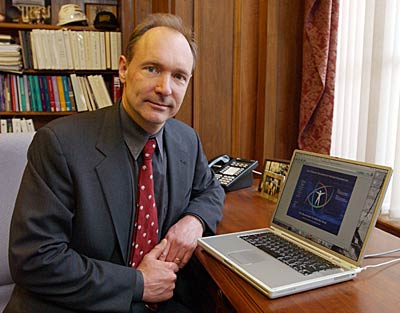
Tim Berners-Lee with Apple Mac laptop at CERN, where the World Wide Web was born / invented
The first World Wide Web server was developed and hosted on NeXT workstation computer. NeXT workstations are high tech computers developed by Steve Jobs’ NeXT Computer Inc. – the company Steve Jobs established while he was ousted from Apple Mac division from the late 80s to most of 90s.
First World Wide Web Server at CERN, made possible by Tim Berners-Lee, created and hosted on Steve Jobs NeXT workstation computer
First World Wide Web Server at CERN, made possible by Tim Berners-Lee, created and hosted on Steve Jobs creation NeXT workstation computer
With the first WWW internet server developed and hosted on a NeXT workstation computer, it’s not too far of a stretch say Steve Jobs has indirectly helped enabling the invention of the World Wide Web. NeXT was eventually bought by Apple and integrated into Mac OS X (More on Steve Jobs, Apple, NeXT, Pixar in a future article.)
Inventor of the World Wide Web, Tim Berners-Lee, with his Apple Mac laptop running OS X
In 1994, Berners-Lee founded the World Wide Web Consortium (W3C) at MIT. The World Wide Web Consortium decided that its standards should be based on royalty-free technology, so that they could easily be adopted by anyone. As part of the work with Wide Web Consortium (W3C), Berners-Lee made his idea available freely, with no patent and no royalties due.

Thursday, August 18, 2011

Akio Morita Inventor of the personal stereo (1979)


Today Sony announced that it would cease Japan-based production of one of the 20th Century’s most defining consumer appliances, the Walkman. While that may not be the last we hear of the Walkman it certainly marks the end of an era - that ended long ago. But the history of the Walkman’s amazing success and it’s even more amazing father, Sony co-founder Akio Morita, is worth remembering - for the lessons it teaches every innovator about the climb up and down the innovation summit. Here’s an excerpt about Sony and Akio from my latest book The Innovation Zone.

Morita’s personal chemistry of defiance and fearlessness in the absence of hard proof, in fact in the face of utter disbelief and ridicule by colleagues and competitors, is the raw material of innovation in its most basic form. Sony’s innovations were the foundation of not only an industry, but a movement that ultimately lead the way to globalization, innovation, and consumerism on a scale more massive than could ever have been conceived of by anyone before the Second World War.
In 1946, with his father’s $25,000 investment, Morita and Masaru Ibuka, a university colleague, partnered to form Tokyo Telecommunications Engineering Corporation (Tokyo Tsushin Kogyo K.K. Also known as TTK).
In what has to be one of the most brilliant product rollout campaigns of the 20th century consumer electronics industry, Akio allowed the market to shape itself. Over four years, TTK transformed itself into Sony and went through four generations of technology until it finally hit the market epicenter with its TR-63 in 1957. In the next two years, Sony created no less than eight additional generations of the pocket transistor radio, each one the embodiment of numerous lessons learned. By then, it had sold more than 1,000,000 pocket transistor radios. The breakthrough pace of Sony’s ability to innovate was unprecedented at the time, and it quickly became the hallmark of its agile brand.
Because of Morita’s ability to fail fast and abandon his ideas in favor of the market’s ideas, nothing Sony developed ever got stuck as an invention. Instead, Sony flooded the market with one innovation after another. It was an endless deluge of innovations, each slightly better than the last, each slightly less expensive, and each slightly more in tune with the buyer – call it relentless re-invention through failure.
One reason we get too wrapped up in the product side of innovation is that we see the end result (in Sony’s case the Walkman), and focus on the object as the innovation. In fact, the object is only the end result of an amazingly integrated and spontaneous organization. Sony was able to innovate not only because of Morita’s ethos, but more so because of the processes it had put into place to allow ideas to flourish in a climate of creation. The risk for Sony ultimately was not the risk of new ideas, but instead the risk of not having new ideas. Innovation is a very unforgiving, constantly accelerating treadmill. Once you jump on, you have little choice but to move faster with each step with no graceful way to get off.


Sunday, August 14, 2011

Herbert Boyer Pioneer of genetic engineering (1973)


Modern genetic engineering began in 1973 when Herbert Boyer and Stanley Cohen used enzymes to cut a bacteria plasmid and insert another strand of DNA in the gap.  Both bits of DNA were from the same type of bacteria, but this milestone, the invention of recombinant DNA technology, offered a window into the previously impossible -- the mixing of traits between totally dissimilar organisms.  To prove that this was possible, Cohen and Boyer used the same process to put a bit of frog DNA into a bacteria.
        Since 1973, this technology has been made more controllable by the discovery of new enzymes to cut the DNA differently and by mapping the genetic code of different organisms.  Now that we have a better idea of what part of the genetic code does what, we have been able to make bacteria that produce human insulin for diabetics (previously came from livestock), as well as EPO for people on kidney dialysis (previously came from urine of people in third world countries with ringworm).
        In 1990, a young child with an extremely poor immune system recieved genetic therapy.  Some of her white blood cells were genetically manipulated and re-introduced into her bloodstream while she watched Sesame Street.  These new cells have taken over for the original, weak white cells, and her immune system now works properly.  Although relatively few people have had their cells genetically altered, these advances have made the prospect of mainstream genetic medicine seem more likely.

Thursday, August 11, 2011

George Gray Invented the LCD and LED (1970)

George Gray: Liquid Perfection


We are surrounded by digital displays on our watches, clocks, calculators, televisions, CD and DVD players. The list goes on and on. But last time you glanced at one of those displays, did you take the time to thank Hull and Professor George Gray?

In a solid, molecules always maintain their orientation and stay in the same position with respect to one another. The molecules in liquids are just the opposite: they can change their orientation and move anywhere in the liquid. But there are some substances that can exist in an odd state, not quite solid, not quite liquid. When they are in this state their molecules tend to maintain their orientation like the molecules in a solid, but also move around to different positions like the molecules in a liquid. This means that liquid crystals are neither a solid nor a liquid, hence their seemingly contradictory name. 
An LCD displayLiquid crystals were discovered as early as 1888 but their structure and properties were first described by Charles Mauguin in 1911. Over in Hull, Sir Brynmor Jones initiated research in the field of liquid crystals in the 1930s. It was only when he became head of the Department of Chemistry that responsibility for this research passed to George Gray, which was to be a pivotal decision.

After the invention of the twisted nematic liquid crystal display in 1972, liquid crystal research suddenly became fashionable. Twisted nematic liquid crystals are naturally twisted. Applying an electric current to these liquid crystals will untwist them to varying degrees, depending on the current’s voltage. Their application however, proved impractical because of a lack of photo-chemically and chemically stable nematic materials that existed in the liquid-crystalline state at room temperature.
In 1973, George Gray changed all that. Alongside Ken Harrison and the Ministry of Defence, he developed cyano-biphenyl liquid crystals, which were found to possess stable nematic phases (meaning they have no spacial ordering of the molecules) at, or close to, room temperature. His invention became an overnight success and the marketplace was suddenly flooded with electronic devices containing small area liquid crystal displays (LCD’s), that for the most part contained Hull materials. LCD’s use these liquid crystals because they react predictably to electric current in such a way that controls the passage of light. The research group was awarded The Queen’s Award for Technological Achievement in 1979.

George Gray went on to be awarded the Fellowship of The Royal Society of Chemistry (FRS), the Fellowship of The Royal Society of Edinburgh (FRSE), honoured with a CBE and receive the Kyoto Laureate of 1995. He also remains an Emeritus Professor at the University of Hull.


LED’s vs. LCD’s 

LCD - Liquid Crystal Display - favoured display systems because they are thin, light and require very little power.

LED - Light Emitting Diode - an electronic device that lights up when electricity is passed through it. They are good for displaying images because they can be relatively small and they do not burn out. However, they require more power than LCD’s.