Popular Posts

Popular Posts

Pages

Total Pageviews

Tuesday, March 15, 2011

Who Invented the Computer Mouse?

Who Invented the Computer Mouse?

Have you ever wondered who invented the computer mouse? Here we talk about the history of the computer mouse. The first computer mouse was invented in 1963-64 by a man named Douglas Engelbartas. At the time, Douglas was experimenting with better ways to point and click on a display screen.

The first mouse was bulky, carved out of wood, and only had one button. It worked with two metal wheels which made contact with the working surface. He named it a computer mouse because the cord came out from behind it, resembling a mouse.

Then in 1972 the ball-mouse was invented by a man named Bill English. The ball-mouse was better than the older computer mouse that was invented before, because it contained a single ball instead of the two metal wheels. This ball could rotate in any direction.

Hopefully you have learned something about the history of the computer mouse.

Monday, March 14, 2011

Courage is not the absence of fear -

Courage is not the absence of fear -
it's inspiring others to move beyond it.
Nelson Mandela…Leadership lesson
In 1994, during the presidential-election campaign, Mandela got on a tiny propeller plane to fly down to the killing fields of Natal and give a speech to his Zulu supporters. I agreed to meet him at the airport, where we would continue our work after his speech. When the plane was 20 minutes from landing, one of its engines failed. Some on the plane began to panic. The only thing that calmed them was looking at Mandela, who quietly read his newspaper as if he were a commuter on his morning train to the office. The airport prepared for an emergency landing, and the pilot managed to land the plane safely. When Mandela and I got in the backseat of his bulletproof BMW that would take us to the rally, he turned to me and said, "Man, I was terrified up there!"


Mandela was often afraid during his time underground, during the Rivonia trial that led to his imprisonment, during his time on Robben Island. "Of course I was afraid!" he would tell me later. It would have been irrational, he suggested, not to be. "I can't pretend that I'm brave and that I can beat the whole world." But as a leader, you cannot let people know. "You must put up a front."
And that's precisely what he learned to do: pretend and, through the act of appearing fearless, inspire others. It was a pantomime Mandela perfected on Robben Island, where there was much to fear. Prisoners who were with him said watching Mandela walk across the courtyard, upright and proud, was enough to keep them going for days. He knew that he was a model for others, and that gave him the strength to triumph over his own fear.
General Knowledge:


Name Famous for No 10, Downing Street
Official residence of the British Prime Minister.
Abadan(Iran)
Famous for oil refinery
Buckingham Palace
London residence of the British monarch.
Sodom
In Israel, the lowest point on earth.
Potala
Dalai Lama's palace at Lhasa (Tibet).
Osaka (Japan)
Known as the Manchester of Japan. It is sometimes called the Venice of Japan.


What are the hardest words to translate into English?

What are the hardest words to translate into English? “Hyggelig” is just one on our list
March 8, 2011 65 Comments Share There’s a running debate among translators about what word is hardest to translate. Obviously, the challenges vary from language to language, with languages that have less in common creating more elusive word to word translations. Let’s acknowledge that determining the hardest word to translate is more of a game than any sort of realistic exercise. That said, here are a few contenders that make the hypothetical list.

Jayus is an Indonesian word that conveys the awkward humor behind a joke delivered so badly that you can’t help but laugh. In English, we sarcastically say, “That’s so funny I forgot to laugh.”

Tartle is a Scottish word for the hesitation one feels when introducing people but having forgotten someone’s name.

Prozvonit is a Czech word for “dropped call” but it refers to a mobile phone user who calls, lets the phone ring once then hangs up. The person who was called then dials the caller, saving the caller the cost of the call.

Saudade is a Portuguese word for longing for someone or something that someone has loved and lost. It is stronger than the sense of the English nostalgia.

(A Spanish word, duende, is considered difficult for similar reasons. Learn the exact story, here.)

Cafune is a Brazilian Portuguese verb for running your fingers through someone’s hair tenderly.

The Danish word Hyggelig literally translates as “cozy,” but the modern connotation has more to do with how Danes see themselves.

One of the hardest English words to translate into other tongues is gobbledygook, meaning “jargon-filled language that is difficult to read, maybe intentionally confusing.” It’s based on the onomatopoeic sound of a turkey’s gobble. Given the confusion that language learning students face when deciphering new words that would be a handy word to have available to describe what a poor translation looks like.

Shampoos

History:The word shampoo in English is derived from Hindi chāmpo (चाँपो [tʃãːpoː]),[1] and dates to 1762.[2] The Hindi word referred to head massage, usually with some form of hair oil.[3] Similar words also occur in other North Indian languages. The word and the service of head massage were introduced to Britain by a Bengali entrepreneur Sake Dean Mahomed. Dean Mahomed introduced the practice to Basil Cochrane's vapour baths while working there in London in the early 19th century, and later, together with his Irish wife, opened "Mahomed's Steam and Vapour Sea Water Medicated Baths" in Brighton, England. His baths were like Turkish baths where clients received an Indian treatment of champi (shampooing), meaning therapeutic massage. He was appointed ‘Shampooing Surgeon’ to both George IV and William IV.[4]


During the early stages of shampoo, English hair stylists boiled shaved soap in water and added herbs to give the hair shine and fragrance. Kasey Hebert was the first known maker of shampoo, and the origin is currently attributed to him. Commercially made shampoo was available from the turn of the 20th century. A 1914 ad for Canthrox Shampoo in American Magazine showed young women at camp washing their hair with Canthrox in a lake; magazine ads in 1914 by Rexall featured Harmony Hair Beautifier and Shampoo.


Originally, soap and shampoo were very similar products; both containing the same naturally-derived surfactants, a type of detergent. Modern shampoo as it is known today was first introduced in the 1930s with Drene, the first shampoo with synthetic surfactants.

CompositionShampoo is generally made by combining a surfactant, most often sodium lauryl sulfate and/or sodium laureth sulfate with a co-surfactant, most often cocamidopropyl betaine in water to form a thick, viscous liquid. Other essential ingredients include salt (sodium chloride), which is used to adjust the viscosity, a preservative and fragrance.Other ingredients are generally included in shampoo formulations to maximize the following qualities:

Pleasing foam


Easy rinsing


Minimal skin/eye irritation


Feels thick and/or creamy


Pleasant fragrance


Low toxicity


Good biodegradability


Slightly acidic (pH less than 7), since a basic environment weakens the hair by breaking the disulfide bonds in hair keratin.


No damage to hair


Many shampoos are pearlescent. This effect is achieved by addition of tiny flakes of suitable materials, e.g. glycol distearate, chemically derived from stearic acid, which may have either animal or vegetable origins. Glycol distearate is a wax. Many shampoos also include silicone to provide conditioning benefits.


Commonly used ingredientsAmmonium chloride


Ammonium lauryl sulfate


Glycol


Sodium laureth sulfate is derived from coconut oils and is used to soften water and create a lather. There was some concern over this particular ingredient circa 1998 about this chemical being a carcinogen, but that has been disproved.


Sodium lauryl sulfate


Sodium Lauroamphoacetate is naturally derived from coconut oils and is used as a cleanser and counter-irritant. This is the ingredient that makes the product tear-free.


Polysorbate 20 is a mild surfactant that is used to solubilize fragrance oils and essential oils; meaning it causes liquid to spread across and penetrate the surface of a solid (i.e. your hair).


Polysorbate 80 (or Glycol) is used to emulsify (or disperse) oils in water (so the oils don’t float on top like Italian salad dressing).


PEG-150 Distearate is a simple thickener.


Citric Acid is naturally derived from citrus fruits and is used as an antioxidant to preserve the oils in the product. While it is a severe eye-irritant, the Sodium Lauroamphoacetate counteracts that property. Citric acid is used to adjust the pH down to approximately 5.5. It is a fairly weak acid which makes the adjustment easier. Shampoos usually are at pH 5.5 because at slightly acidic pH the scales on a hair follicle lay flat making the hair feel smooth and look shiny. it also has a small amount of preservative action. Citric acid as opposed to any other acid will prevent bacterial growth.


Quaternium-15 is used as a bacterial/fungicidal preservative.


Polyquaternium-10 is a totally different chemical than Quaternium-15. This chemical acts as the conditioning ingredient, providing moisture and fullness to the hair.


Di-PPG-2 myreth-10 adipate is a water-dispersible emollient that forms clear solutions with surfactant systems


Vitamins and amino acidsThe effectiveness of vitamins, amino acids and "pro-vitamins" to shampoo is also largely debatable. Vitamins are substances that are essential for chemical processes that occur within the body, chiefly inside living cells and in the bloodstream. They cannot have the same beneficial effects on dead tissues like grown hair. However, the physical properties of some vitamins (like vitamin E oil or panthenol) would have a temporary cosmetic effect on the hair shaft while not having any bioactivity.

The proteins that make up the strand are chains of amino acids connected in very specific sequences, and are tightly packed in interlocking arrangements. Proteins are unable to penetrate the skin or the hair, and even if they stick to the outside of the hair they will not help strengthen it. Amino acids cannot penetrate cells through the skin, either; they may be able to enter the dead strands, but without the complex protein-building machinery of the living cells they will not actually return damaged hair proteins to their undamaged state

Shampoos


HistoryThe word shampoo in English is derived from Hindi chāmpo (चाँपो [tʃãːpoː]), and dates to 1762. The Hindi word referred to head massage, usually with some form of hair oil Similar words also occur in other North Indian languages. The word and the service of head massage were introduced to Britain by a Bengali entrepreneur Sake Dean Mahomed. Dean Mahomed introduced the practice to Basil Cochrane's vapour baths while working there in London in the early 19th century, and later, together with his Irish wife, opened "Mahomed's Steam and Vapour Sea Water Medicated Baths" in Brighton, England. His baths were like Turkish baths where clients received an Indian treatment of champi (shampooing), meaning therapeutic massage. He was appointed ‘Shampooing Surgeon’ to both George IV and William IV.

In the 1860s, the meaning of the word shifted from the sense of massage to that of applying soap to the hair.[5] Earlier, ordinary soap had been used for washing hair.[6] However, the dull film soap left on the hair made it uncomfortable, irritating, and unhealthy looking.

During the early stages of shampoo, English hair stylists boiled shaved soap in water and added herbs to give the hair shine and fragrance. Kasey Hebert was the first known maker of shampoo, and the origin is currently attributed to him. Commercially made shampoo was available from the turn of the 20th century. A 1914 ad for Canthrox Shampoo in American Magazine showed young women at camp washing their hair with Canthrox in a lake; magazine ads in 1914 by Rexall featured Harmony Hair Beautifier and Shampoo.

Originally, soap and shampoo were very similar products; both containing the same naturally-derived surfactants, a type of detergent. Modern shampoo as it is known today was first introduced in the 1930s with Drene, the first shampoo with synthetic surfactants.

CompositionShampoo is generally made by combining a surfactant, most often sodium lauryl sulfate and/or sodium laureth sulfate with a co-surfactant, most often cocamidopropyl betaine in water to form a thick, viscous liquid. Other essential ingredients include salt (sodium chloride), which is used to adjust the viscosity, a preservative and fragrance.[9] Other ingredients are generally included in shampoo formulations to maximize the following qualities:

Pleasing foam


Easy rinsing


Minimal skin/eye irritation


Feels thick and/or creamy


Pleasant fragrance


Low toxicity


Good biodegradability


Slightly acidic (pH less than 7), since a basic environment weakens the hair by breaking the disulfide bonds in hair keratin.


No damage to hair


Many shampoos are pearlescent. This effect is achieved by addition of tiny flakes of suitable materials, e.g. glycol distearate, chemically derived from stearic acid, which may have either animal or vegetable origins. Glycol distearate is a wax. Many shampoos also include silicone to provide conditioning benefits.

Commonly used ingredientsAmmonium chloride


Ammonium lauryl sulfate


Glycol


Sodium laureth sulfate is derived from coconut oils and is used to soften water and create a lather. There was some concern over this particular ingredient circa 1998 about this chemical being a carcinogen, but that has been disproved.


Sodium lauryl sulfate


Sodium Lauroamphoacetate is naturally derived from coconut oils and is used as a cleanser and counter-irritant. This is the ingredient that makes the product tear-free.


Polysorbate 20 is a mild surfactant that is used to solubilize fragrance oils and essential oils; meaning it causes liquid to spread across and penetrate the surface of a solid (i.e. your hair).


Polysorbate 80 (or Glycol) is used to emulsify (or disperse) oils in water (so the oils don’t float on top like Italian salad dressing).


PEG-150 Distearate is a simple thickener.


Citric Acid is naturally derived from citrus fruits and is used as an antioxidant to preserve the oils in the product. While it is a severe eye-irritant, the Sodium Lauroamphoacetate counteracts that property. Citric acid is used to adjust the pH down to approximately 5.5. It is a fairly weak acid which makes the adjustment easier. Shampoos usually are at pH 5.5 because at slightly acidic pH the scales on a hair follicle lay flat making the hair feel smooth and look shiny. it also has a small amount of preservative action. Citric acid as opposed to any other acid will prevent bacterial growth.


Quaternium-15 is used as a bacterial/fungicidal preservative.


Polyquaternium-10 is a totally different chemical than Quaternium-15. This chemical acts as the conditioning ingredient, providing moisture and fullness to the hair.


Di-PPG-2 myreth-10 adipate is a water-dispersible emollient that forms clear solutions with surfactant systems

Sunday, March 13, 2011

Quiz with the Answers.

Who directed the movies "Jaws", "Schindler's List" and "Jurassic Park"?


Steven Spielberg

What is the largest country, by area, in the European Union?

France

Aboard which US warship did the Japanese sign their surrender in World War II?


USS Missouri

What is the minimum number of points required to win a tennis tie-break?


7(Seven)

How many stars are on the flag of the European Union?

12 (Twelve)

Which two countries have only won the football World Cup only once?

England and France


What was the name of the theatre where US president Abraham Lincoln was assassinated?

Fords

What do the initials FBI stand for?

Federal Bureau of Investigation


How Soap Cleans


Soap is an Emulsifier


A soap micelle has a hydrophilic head that is in contact with the water and a center of hydrophobic tails, which can be used to isolate grime.

Soaps are sodium or potassium fatty acids salts, produced from the hydrolysis of fats in a chemical reaction called saponification. Each soap molecule has a long hydrocarbon chain, sometimes called its 'tail', with a carboxylate 'head'. In water, the sodium or potassium ions float free, leaving a negatively-charged head.


Soap is an excellent cleanser because of its ability to act as an emulsifying agent. An emulsifier is capable of dispersing one liquid into another immiscible liquid. This means that while oil (which attracts dirt) doesn't naturally mix with water, soap can suspend oil/dirt in such a way that it can be removed.

The organic part of a natural soap is a negatively-charged, polar molecule. Its hydrophilic (water-loving) carboxylate group (-CO2) interacts with water molecules via ion-dipole interactions and hydrogen bonding. The hydrophobic (water-fearing) part of a soap molecule, its long, nonpolar hydrocarbon chain, does not interact with water molecules. The hydrocarbon chains are attracted to each other by dispersion forces and cluster together, forming structures called micelles. In these micelles, the carboxylate groups form a negatively-charged spherical surface, with the hydrocarbon chains inside the sphere. Because they are negatively charged, soap micelles repel each other and remain dispersed in water.

Grease and oil are nonpolar and insoluble in water. When soap and soiling oils are mixed, the nonpolar hydrocarbon portion of the micelles break up the nonpolar oil molecules. A different type of micelle then forms, with nonpolar soiling molecules in the center. Thus, grease and oil and the 'dirt' attached to them are caught inside the micelle and can be rinsed away.

Although soaps are excellent cleansers, they do have disadvantages. As salts of weak acids, they are converted by mineral acids into free fatty acids:

CH3(CH2)16CO2-Na+ + HCl → CH3(CH2)16CO2H + Na+ + Cl-
These fatty acids are less soluble than the sodium or potassium salts and form a precipitate or soap scum. Because of this, soaps are ineffective in acidic water. Also, soaps form insoluble salts in hard water, such as water containing magnesium, calcium, or iron.

2 CH3(CH2)16CO2-Na+ + Mg2+ → [CH3(CH2)16CO2-]2Mg2+ + 2 Na+

The insoluble salts form bathtub rings, leave films that reduce hair luster, and gray/roughen textiles after repeated washings. Synthetic detergents, however, may be soluble in both acidic and alkaline solutions and don't form insoluble precipitates in hard water. But that is a different story...

What is a Tsunami and What Causes Them?

What is a Tsunami and What Causes Them?

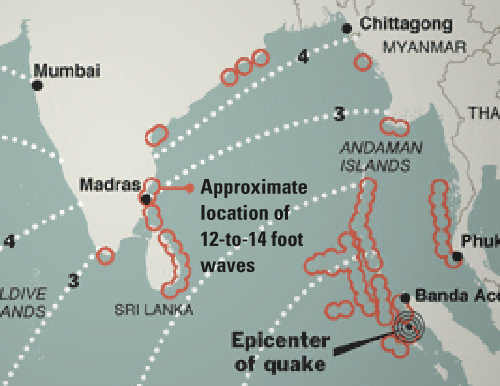
Tsunami, which is a Japanese word translated through English into “harbor wave,” is an enormous and destructive wave that scientists referred to as “seismic sea waves.” Many people may know tsunamis by their layman term, “tidal wave” (Dudley, p.28; Cook). Tsunamis are most common in the Pacific Ocean, specifically near Japan where they frequently wreak havoc on its harbors and coastal villages (Dudley, p.28). Tsunamis are in fact a series of extremely long waves that are primarily associated with earthquakes and coastal regions. However, landslides, volcanic eruptions, and even impacts of objects from outer space like asteroids and meteors can cause tsunamis. Tsunamis can reach speeds exceeding 600 mph and even in shallow waters reach heights of over 100 feet (NOAA). Tsunamis have in fact been reported since ancient times, with the first recorded tsunami occurring off the coast of Syria in 2000 B.C. (Lander, 1)

Tsunamis are caused by violent movement on the seafloor. Their generation is due to the ocean’s bottom rising or dropping, which displaces the column of water directly above it. This is most common in large subduction zones, where the collision of two tectonic plates causes the oceanic plate to dip beneath the continental crust (Lander, p.2). This movement on the seafloor can be caused by three different types of geologic activity. The first and most common is submarine faulting (as mentioned above), which actually causes earthquakes and tsunamis. It was originally believed that the earthquakes themselves were the cause of tsunamis, but that hypothesis has been revised (Dudley, p.33). The second most common geologic activity is a landslide. If a landslide were to start out above sea level and plunge into the sea a tsunami might occur. Also, tsunamis can be generated if a landslide occurs underwater. The third cause of tsunamis is volcanic activity. The production of tsunamis in this circumstance is quite similar to that of tsunamis caused by submarine faulting. An explosion of a submarine or shoreline volcano can generate a tsunami, as evidenced by the explosion of the island volcano Krakatoa in 1883 that killed over 36,000 people in Java and Sumatra (Dudley, p.34).

It should come as no surprise than that the Pacific Ocean is a source of the vast majority of tsunamis. This area is one of the most geologically active in the world, as the Pacific Ocean basin is surrounded by deep ocean trenches, explosive volcanic islands, and mountain ranges as well as the frequent earthquakes and volcanic eruptions that occur nearby 


Now that you know what a tsunami is, it’s time to scare you with the terrifying results of what happens when a tsunami hits land!


Three types of Tsunami


Saturday, March 12, 2011

Volcanoes..What causes them?

When a part of the earth's upper mantle or lower crust melts, magma forms. A volcano is essentially an opening or a vent through which this magma and the dissolved gases it contains are discharged. Although there are several factors triggering a volcanic eruption, three predominate: the buoyancy of the magma, the pressure from the exsolved gases in the magma and the injection of a new batch of magma into an already filled magma chamber. What follows is a brief description of these processes.

As rock inside the earth melts, its mass remains the same while its volume increases--producing a melt that is less dense than the surrounding rock. This lighter magma then rises toward the surface by virtue of its buoyancy. If the density of the magma between the zone of its generation and the surface is less than that of the surrounding and overlying rocks, the magma reaches the surface and erupts.

Magmas of so-called andesitic and rhyolitic compositions also contain dissolved volatiles such as water, sulfur dioxide and carbon dioxide. Experiments have shown that the amount of a dissolved gas in magma (its solubility) at atmospheric pressure is zero, but rises with increasing pressure.

For example, in an andesitic magma saturated with water and six kilometers below the surface, about 5 percent of its weight is dissolved water. As this magma moves toward the surface, the solubility of the water in the magma decreases, and so the excess water separates from the magma in the form of bubbles. As the magma moves closer to the surface, more and more water exsolves from the magma, thereby increasing the gas/magma ratio in the conduit. When the volume of bubbles reaches about 75 percent, the magma disintegrates to pyroclasts (partially molten and solid fragments) and erupts explosively.

LAVA TEMPERATURE is one of several indicators that volcanologists regularly monitor in hopes of forecasting major eruptions.

The third process that causes volcanic eruptions is an injection of new magma into a chamber that is already filled with magma of similar or different composition. This injection forces some of the magma in the chamber to move up in the conduit and erupt at the surface.

Although volcanologists are well aware of these three processes, they cannot yet predict a volcanic eruption. But they have made significant advances in forecasting volcanic eruptions. Forecasting involves probable character and time of an eruption in a monitored volcano. The character of an eruption is based on the prehistoric and historic record of the volcano in question and its volcanic products. For example, a violently erupting volcano that has produced ash fall, ash flow and volcanic mudflows (or lahars) is likely to do the same in the future.

Determining the timing of an eruption in a monitored volcano depends on measuring a number of parameters, including, but not limited to, seismic activity at the volcano (especially depth and frequency of volcanic earthquakes), ground deformations (determined using a tiltmeter and/or GPS, and satellite interferometry), and gas emissions (sampling the amount of sulfur dioxide gas emitted by correlation spectrometer, or COSPEC). An excellent example of successful forecasting occurred in 1991. Volcanologists from the U.S. Geological Survey accurately predicted the June 15 eruption of the Pinatubo Volcano in the Philippines, allowing for the timely evacuation of the Clark Air Base and saving thousands of lives.


What causes an Eartquake?

What Causes An Earthquake ?
An Earthquake is a sudden tremor or movement of the earth's crust, which originates naturally at or below the surface. The word natural is important here, since it excludes shock waves caused by French nuclear tests, man made explosions and landslides caused by building work.
There are two main causes of earthquakes.
Firstly, they can be linked to explosive volcanic eruptions; they are in fact very common in areas of volcanic activity where they either proceed or accompany eruptions.
Secondly, they can be triggered by Tectonic activity associated with plate margins and faults. The majority of earthquakes world wide are of this type.
Terminology
An earthquake can be likened to the effect observed when a stone is thrown into water. After the stone hits the water a series of concentric waves will move outwards from the center. The same events occur in an earthquake. There is a sudden movement within the crust or mantle, and concentric shock waves move out from that point. Geologists and Geographers call the origin of the earthquake the focus. Since this is often deep below the surface and difficult to map, the location of the earthquake is often referred to as the point on the Earth surface directly above the focus. This point is called the epicentre.
The strength, or magnitude, of the shockwaves determines the extent of the damage caused. Two main scales exist for defining the strength, the Mercalli Scale and the Richter Scale.
Earthquakes are three dimensional events, the waves move outwards from the focus, but can travel in both the horizontal and vertical plains. This produces three different types of waves which have their own distinct characteristics and can only move through certain layers within the Earth. Lets take a look at these three forms of shock waves.
Types of shockwaves
P-Waves
Primary Waves (P-Waves) are identical in character to sound waves. They are high frequency, short-wavelength, longitudinal waves which can pass through both solids and liquids. The ground is forced to move forwards and backwards as it is compressed and decompressed. This produces relatively small displacements of the ground.
P Waves can be reflected and refracted, and under certain circumstances can change into S-Waves.
Particles are compressed and expanded in the wave's direction.


S-Waves
Secondary Waves (S-Waves) travel more slowly than P-Waves and arrive at any given point after the P-Waves. Like P-Waves they are high frequency, short-wavelength waves, but instead of being longitudinal they are transverse. They move in all directions away from their source, at speeds which depend upon the density of the rocks through which they are moving. They cannot move through liquids. On the surface of the Earth, S-Waves are responsible for the sideways displacement of walls and fences, leaving them 'S' shaped.
S-waves move particles at 90° to the wave's direction.
L-Waves
Surface Waves (L-Waves) are low frequency transverse vibrations with a long wavelength. They are created close to the epicentre and can only travel through the outer part of the crust. They are responsible for the majority of the building damage caused by earthquakes. This is because L Waves have a motion similar to that of waves in the sea. The ground is made to move in a circular motion, causing it to rise and fall as visible waves move across the ground. Together with secondary effects such as landslides, fires and tsunami these waves account for the loss of approximately 10,000 lives and over $100 million per year.
L-waves move particles in a circular path.
2):Tectonic Earthquakes
Tectonic earthquakes are triggered when the crust becomes subjected to strain, and eventually moves. The theory of plate tectonics explains how the crust of the Earth is made of several plates, large areas of crust which float on the Mantle. Since these plates are free to slowly move, they can either drift towards each other, away from each other or slide past each other. Many of the earthquakes which we feel are located in the areas where plates collide or try to slide past each other.
The process which explains these earthquakes, known as Elastic Rebound Theory can be demonstrated with a green twig or branch. Holding both ends, the twig can be slowly bent. As it is bent, energy is built up within it. A point will be reached where the twig suddenly snaps. At this moment the energy within the twig has exceeded the Elastic Limit of the twig. As it snaps the energy is released, causing the twig to vibrate and to produce sound waves.
Perhaps the most famous example of plates sliding past each other is the San Andreas Fault in California. Here, two plates, the Pacific Plate and the North American Plate, are both moving in a roughly northwesterly direction, but one is moving faster than the other. The San Francisco area is subjected to hundreds of small earthquakes every year as the two plates grind against each other. Occasionally, as in 1989, a much larger movement occurs, triggering a far more violent 'quake'.
Major earthquakes are sometimes preceded by a period of changed activity. This might take the form of more frequent minor shocks as the rocks begin to move,called foreshocks , or a period of less frequent shocks as the two rock masses temporarily 'stick' and become locked together. Detailed surveys in San Francisco have shown that railway lines, fences and other longitudinal features very slowly become deformed as the pressure builds up in the rocks, then become noticeably offset when a movement occurs along the fault. Following the main shock, there may be further movements, called aftershocks, which occur as the rock masses 'settle down' in their new positions. Such aftershocks cause problems for rescue services, bringing down buildings already weakened by the main earthquake.
Volcanic Earthquakes
Volcanic earthquakes are far less common than Tectonic ones. They are triggered by the explosive eruption of a volcano. Given that not all volcanoes are prone to violent eruption, and that most are 'quiet' for the majority of the time, it is not surprising to find that they are comparatively rare.

When a volcano explodes, it is likely that the associated earthquake effects will be confined to an area 10 to 20 miles around its base, where as a tectonic earthquake may be felt around the globe.
The volcanoes which are most likely to explode violently are those which produce acidic lava. Acidic lava cools and sets very quickly upon contact with the air. This tends to chock the volcanic vent and block the further escape of pressure. For example, in the case of Mt Pelee, the lava solidified before it could flow down the sides of the volcano. Instead it formed a spine of solid rock within the volcano vent. The only way in which such a blockage can be removed is by the build up of pressure to the point at which the blockage is literally exploded out of the way. In reality, the weakest part of the volcano will be the part which gives way, sometimes leading to a sideways explosion as in the Mt St.Helens eruption.
When extraordinary levels of pressure develop, the resultant explosion can be devastating, producing an earthquake of considerable magnitude. When Krakatoa ( Indonesia, between Java and Sumatra ) exploded in 1883, the explosion was heard over 5000 km away in Australia. The shockwaves produced a series of tsunami ( large sea waves ), one of which was over 36m high; that's the same as four, two story houses stacked on top of each other. These swept over the coastal areas of Java and Sumatra killing over 36,000 people.

By contrast, volcanoes producing free flowing basic lava rarely cause earthquakes. The lava flows freely out of the vent and down the sides of the volcano, releasing pressure evenly and constantly. Since pressure doesn't build up, violent explosions do not occur.