Popular Posts

Popular Posts

Pages

Total Pageviews

Friday, May 4, 2012

Invention of the microscope

History of the Microscope

During that historic period known as the Renaissance, after the "dark" Middle Ages, there occurred the inventions of printing, gunpowder and the mariner's compass, followed by the discovery of America. Equally remarkable was the invention of the light microscope: an instrument that enables the human eye, by means of a lens or combinations of lenses, to observe enlarged images of tiny objects. It made visible the fascinating details of worlds within worlds.


Invention of Glass Lenses


Long before, in the hazy unrecorded past, someone picked up a piece of transparent crystal thicker in the middle than at the edges, looked through it, and discovered that it made things look larger. Someone also found that such a crystal would focus the sun's rays and set fire to a piece of parchment or cloth. Magnifiers and "burning glasses" or "magnifying glasses" are mentioned in the writings of Seneca and Pliny the Elder, Roman philosophers during the first century A. D., but apparently they were not used much until the invention of spectacles, toward the end of the 13th century. They were named lenses because they are shaped like the seeds of a lentil.


The earliest simple microscope was merely a tube with a plate for the object at one end and, at the other, a lens which gave a magnification less than ten diameters -- ten times the actual size. These excited general wonder when used to view fleas or tiny creeping things and so were dubbed "flea glasses."


Birth of the Light Microscope


About 1590, two Dutch spectacle makers, Zaccharias Janssen and his son Hans, while experimenting with several lenses in a tube, discovered that nearby objects appeared greatly


enlarged. That was the forerunner of the compound microscope and of the telescope. In 1609, Galileo, father of modern physics and astronomy, heard of these early experiments, worked out the principles of lenses, and made a much better instrument with a focusing device.


Anton van Leeuwenhoek (1632-1723)


The father of microscopy, Anton van Leeuwenhoek of Holland, started as an apprentice in a dry goods store where magnifying glasses were used to count the threads in cloth. He taught himself new methods for grinding and polishing tiny lenses of great curvature which gave magnifications up to 270 diameters, the finest known at that time. These led to the building of his microscopes and the biological discoveries for which he is famous. He was the first to see and describe bacteria, yeast plants, the teeming life in a drop of water, and the circulation of blood corpuscles in capillaries. During a long life he used his lenses to make pioneer studies on an extraordinary variety of things, both living and non living, and reported his findings in over a hundred letters to the Royal Society of England and the French Academy.


Robert Hooke


Robert Hooke, the English father of microscopy, re-confirmed Anton van Leeuwenhoek's discoveries of the existence of tiny living organisms in a drop of water. Hooke made a copy of Leeuwenhoek's light microscope and then improved upon his design.


Charles A. Spencer


Later, few major improvements were made until the middle of the 19th century. Then several European countries began to manufacture fine optical equipment but none finer than the marvelous instruments built by the American, Charles A. Spencer, and the industry he founded. Present day instruments, changed but little, give magnifications up to 1250 diameters with ordinary light and up to 5000 with blue light.


Beyond the Light Microscope


A light microscope, even one with perfect lenses and perfect illumination, simply cannot be used to distinguish objects that are smaller than half the wavelength of light. White light has an average wavelength of 0.55 micrometers, half of which is 0.275 micrometers. (One micrometer is a thousandth of a millimeter, and there are about 25,000 micrometers to an inch. Micrometers are also called microns.) Any two lines that are closer together than 0.275 micrometers will be seen as a single line, and any object with a diameter smaller than 0.275 micrometers will be invisible or, at best, show up as a blur. To see tiny particles under a microscope, scientists must bypass light altogether and use a different sort of "illumination," one with a shorter wavelength.


Thursday, May 3, 2012

What Is Hip Replacement?

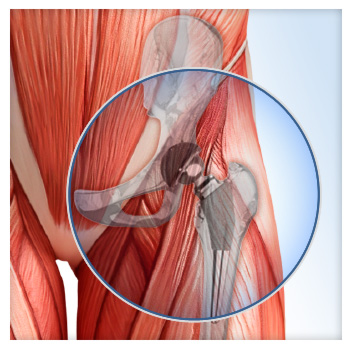
A hip replacement is a surgical procedure that replaces the painful hip joint with an artificial hip joint.


In a hip replacement, the head of the femur (the bone that extends from the hip to the knee) is removed along with the surface layer of the socket in which it rests (called the acetabulum).


The head of the femur, which is situated within the pelvis socket, is replaced with a metal ball and stem. This stem fits into the shaft of the femur.


The socket is replaced with a plastic or a metal and plastic cup.


Recently there has been a return to the earlier version of the operation when the hip was 'resurfaced'. Rather than remove the head of the femur it is covered by a metal cover. The socket is replaced with a metal socket.


For nearly a century, doctors have been putting various materials into diseased and painful hip joints to relieve pain. Up until the 1960s, outcomes had been unreliable. At that time, the metal ball and plastic socket for the replacement of the hip joint was introduced. Today, the artificial components used in a hip replacement are stronger and more designs are available.


There are many different shapes, sizes, and designs of artificial components of the hip joint. For the most part these are composed of chrome, cobalt, titanium, or ceramic materials. Some surgeons are also using custom-made components to improve the fit in the femur.
 

Facts About Total Hip Replacement


There are approximately 150,000 artificial hip joints implanted annually in the United States, with the success rate over 90%.


The majority of individuals in need of hip replacement are in their 60s and 70s.


Depending on the condition, people in their late teens and in their 90s can possibly be candidates for a hip replacement.


New materials used in total hip replacement are very durable and are expected to last more than 10 years in 90% of individuals receiving total hips.


The "Normal" Hip


The hip is a ball-and-socket joint comprised of the following structures:


Head of the femur


Acetabulum of the pelvis


Ligaments of the hip joint


The head of the femur or "ball" of the hip joint articulates or moves within the cup-like "socket" called the acetabulum of the pelvic bone. Together, these structures are referred to as a "ball and socket" joint. The femoral head and acetabulum are covered by a specialized surface called articular cartilage. This allows smooth and painless motion of the hip joint. The joint is held together by several strong ligaments and a strong dense tissue called the capsule which enevelops the joint.


Wednesday, May 2, 2012

Differance betweeb fruits and vegetables


Wikipedia defines Fruit and Vegetables as follows:


"There are three definitions relating to fruits and vegetables:


Fruit (scientific): the ovary of a seed-bearing plant,


Fruit (culinary): any edible part of a plant with a sweet flavor,


Vegetable: any edible part of a plant with a savory flavor."
 
A fruit is actually the sweet, ripened ovary or ovaries of a seed-bearing plant. A vegetable, in contrast, is an herbaceous plant cultivated for an edible part (seeds, roots, stems, leaves, bulbs, tubers, or nonsweet fruits). So, to be really nitpicky, a fruit could be a vegetable, but a vegetable could not be a fruit.


The Nutriquest team offers a similar answer, adding that most fruits are sweet because they contain a simple sugar called fructose, while most vegetables are less sweet because they have much less fructose. The sweetness of fruit encourages animals to eat it and thereby spread the seeds. The site also presents an interesting list of fruits that are often thought to be vegetables:


tomatoes


cucumbers


squashes and zucchini


avocados


green, red, and yellow peppers


peapods


pumpkins


But hey, what about the nut? Well, according to our friends at The Straight Dope, a nut is actually a "a dry, one-seeded, usually oily fruit."


Potato potahto, tomato tomahto, let's call the whole thing off.


Tuesday, May 1, 2012

DNA Finger Printing.

DNA


DNA (Deoxyribonucleic acid) is a chemical structure that forms chromosomes. A piece of a chromosome that dictates a particular trait is called a gene.


Structurally, DNA is a double helix: two strands of genetic material spiraled around each other. Each strand contains a sequence of bases (also called nucleotides). A base is one of four chemicals (adenine, guanine, cytosine and thymine).


The two strands of DNA are connected at each base. Each base will only bond with one other base, as follows: Adenine (A) will only bond with thymine (T), and guanine (G) will only bond with cytosine (C).


What is DNA Fingerprinting?


The chemical structure of everyone’s DNA is the same. The only difference between people (or any animal) is the order of the base pairs. There are so many millions of base pairs in each person’s DNA that every person has a different sequence.


Using these sequences, every person could be identified solely by the sequence of their base pairs. However, because there are so many millions of base pairs, the task would be very time-consuming. Instead, scientists are able to use a shorter method, because of repeating patterns in DNA.


These patterns do not, however, give an individual “fingerprint,” but they are able to determine whether two DNA samples are from the same person, related people, or non-related people. Scientists use a small number of sequences of DNA that are known to vary among individuals a great deal, and analyze those to get a certain probability of a match.


Applications


1. Paternity and Maternity


Because a person inherits his or her VNTRs (Variable number tandem repeats) from his or her parents, VNTR patterns can be used to establish paternity and maternity. The patterns are so specific that a parental VNTR pattern can be reconstructed even if only the children’s VNTR patterns are known (the more children produced, the more reliable the reconstruction). Parent-child VNTR pattern analysis has been used to solve standard father-identification cases as well as more complicated cases of confirming legal nationality and, in instances of adoption, biological parenthood.


2. Criminal Identification and Forensics


DNA isolated from blood, hair, skin cells, or other genetic evidence left at the scene of a crime can be compared, through VNTR patterns, with the DNA of a criminal suspect to determine guilt or innocence. VNTR patterns are also useful in establishing the identity of a homicide victim, either from DNA found as evidence or from the body itself.


3. Personal Identification


The notion of using DNA fingerprints as a sort of genetic bar code to identify individuals has been discussed, but this is not likely to happen anytime in the foreseeable future. The technology required to isolate, keep on file, and then analyze millions of very specified VNTR patterns is both expensive and impractical. Social security numbers, picture ID, and other more mundane methods are much more likely to remain the prevalent ways to establish personal identification.


PROCESS


1. Isolating the DNA in question from the rest of the cellular material in the nucleus. This can be done either chemically, by using a detergent to wash the extra material from the DNA,or mechanically, by applying a large amount of pressure in order to “squeeze out” the DNA.


2. Cutting the DNA into several pieces of different sizes. This is done using one or more restriction enzymes.


3. Sorting the DNA pieces by size. The process by which the size separation, “size fractionation,” is done is called gel electrophoresis. The DNA is poured into a gel, such as agarose, and an electrical charge is applied to the gel, with the positive charge at the bottom and the negative charge at the top. Because DNA has a slightly negative charge, the pieces of DNA will be attracted towards the bottom of the gel; the smaller pieces, however, will be able to move more quickly and thus further towards the bottom than the larger pieces. The different-sized pieces of DNA will therefore be separated by size, with the smaller pieces towards the bottom and the larger pieces towards the top.


4. Denaturing the DNA, so that all of the DNA is rendered single-stranded. This can be done either by heating or chemically treating the DNA in the gel.


5. Blotting the DNA. The gel with the size-fractionated DNA is applied to a sheet of nitrocellulose paper, and then baked to permanently attach the DNA to the sheet. The Southern Blot is now ready to be analyzed.


In order to analyze a Southern Blot, a radioactive genetic probe is used in a hybridization reaction with the DNA in question. If an X-ray is taken of the Southern Blot after a radioactive probe has been allowed to bond with the denatured DNA on the paper, only the areas where the radioactive probe binds [red] will show up on the film. This allows researchers to identify, in a particular person’s DNA, the occurrence and frequency of the particular genetic pattern contained in the probe.


VNTRS


Every strand of DNA has pieces that contain genetic information which informs an organism’s development (exons) and pieces that, apparently, supply no relevant genetic information at all (introns). Although the introns may seem useless, it has been found that they contain repeated sequences of base pairs. These sequences, called Variable Number Tandem Repeats (VNTRs), can contain anywhere from twenty to one hundred base pairs.


Every human being has some VNTRs. To determine if a person has a particular VNTR, a Southern Blot is performed, and then the Southern Blot is probed, through a hybridization reaction, with a radioactive version of the VNTR in question. The pattern which results from this process is what is often referred to as a DNA fingerprint.


A given person’s VNTRs come from the genetic information donated by his or her parents; he or she could have VNTRs inherited from his or her mother or father, or a combination, but never a VNTR either of his or her parents do not have. Shown below are the VNTR patterns for Mrs. Nguyen [blue], Mr. Nguyen [yellow], and their four children: D1 (the Nguyens’ biological daughter), D2 (Mr. Nguyen’s step-daughter, child of Mrs. Nguyen and her former husband [red]), S1 (the Nguyens’ biological son), and S2 (the Nguyens’ adopted son, not biologically related [his parents are light and dark green]).


Because VNTR patterns are inherited genetically, a given person’s VNTR pattern is more or less unique. The more VNTR probes used to analyze a person’s VNTR pattern, the more distinctive and individualized that pattern, or DNA fingerprint, will be.


Problems In DNA Fingerprinting


Like nearly everything else in the scientific world, nothing about DNA fingerprinting is 100% assured. The term DNA fingerprint is, in one sense, a misnomer: it implies that, like a fingerprint, the VNTR pattern for a given person is utterly and completely unique to that person. Actually, all that a VNTR pattern can do is present a probability that the person in question is indeed the person to whom the VNTR pattern (of the child, the criminal evidence, or whatever else) belongs. Given, that probability might be 1 in 20 billion, which would indicate that the person can be reasonably matched with the DNA fingerprint; then again, that probability might only be 1 in 20, leaving a large amount of doubt regarding the specific identity of the VNTR pattern’s owner.


1. Generating a High Probability


The probability of a DNA fingerprint belonging to a specific person needs to be reasonably high–especially in criminal cases, where the association helps establish a suspect’s guilt or innocence. Using certain rare VNTRs or combinations of VNTRs to create the VNTR pattern increases the probability that the two DNA samples do indeed match (as opposed to look alike, but not actually come from the same person) or correlate (in the case of parents and children).


2. Problems with Determining Probability


A. Population Genetics


VNTRs, because they are results of genetic inheritance, are not distributed evenly across all of human population. A given VNTR cannot, therefore, have a stable probability of occurrence; it will vary depending on an individual’s genetic background. The difference in probabilities is particularly visible across racial lines. Some VNTRs that occur very frequently among Hispanics will occur very rarely among Caucasians or African-Americans. Currently, not enough is known about the VNTR frequency distributions among ethnic groups to determine accurate probabilities for individuals within those groups; the heterogeneous genetic composition of interracial individuals, who are growing in number, presents an entirely new set of questions. Further experimentation in this area, known as population genetics, has been surrounded with and hindered by controversy, because the idea of identifying people through genetic anomalies along racial lines comes alarmingly close to the eugenics and ethnic purification movements of the recent past, and, some argue, could provide a scientific basis for racial discrimination.


B. Technical Difficulties


Errors in the hybridization and probing process must also be figured into the probability, and often the idea of error is simply not acceptable. Most people will agree that an innocent person should not be sent to jail, a guilty person allowed to walk free, or a biological mother denied her legal right to custody of her children, simply because a lab technician did not conduct an experiment accurately. When the DNA sample available is minuscule, this is an important consideration, because there is not much room for error, especially if the analysis of the DNA sample involves amplification of the sample (creating a much larger sample of genetically identical DNA from what little material is available), because if the wrong DNA is amplified (i.e. a skin cell from the lab technician) the consequences can be profoundly detrimental. Until recently, the standards for determining DNA fingerprinting matches, and for laboratory security and accuracy which would minimize error, were neither stringent nor universally codified, causing a great deal of public outcry.


Monday, April 30, 2012

Small but significant inventions.

13 Little-Known Inventors of Common Things


1. MARGARET KNIGHT - FLAT-BOTTOMED PAPER BAG (1869)


A grade school dropout who lived in Springfield, Mass., Margaret Knight loved mechanical devices and machinery. From 1867 to 1869, she devised the heavy machinery necessary to produce the modern flat-bottomed bag. The practicality of Knight's paper bag was far superior to the existing paper bag, whose origin is unknown. For the paper bag and dozens of other inventions, she received very little compensation. At her death, her estate was valued at a mere $275.05.


2. JOSEPH GLIDDEN - BARBED WIRE (1874)


A resident of De Kalb, Ill., Joseph Glidden took a rudimentary version of barbed wire-first patented by Henry M. Rose-and changed it into a new type that became a commercial success. Glidden's wire, patented in 1874, featured a new way of holding the barbs securely in place. The improved wire allowed cattle ranchers in the Great Plains area to fence off cheaply and effectively large tracts of land. Glidden, who grew up on a farm in New York, disliked traveling and never visited the west, where his invention was most widely used.


3. WILLIAM PAINTER - CROWN BOTTLE CAP (1892)


A Quaker who lived in Baltimore, Maryland, William Painter invented the bottle cap, the machinery to manufacture it, and the method to attach it to bottles. Painter, an engineer, formed the Crown Cork and Seal Company to exploit his invention, which eventually made him a millionaire. Painter's bottle cap was the only one used for decades, until the appearance of the twist-off cap in the 1960s.


4. WHITCOMB L. JUDSON - ZIPPER (1893)


On August 29, 1893, Whitcomb Judson of Chicago patented the zipper-two thin metal chains that could be fastened together by pulling a metal slider up between them. Intended for use on boots and shoes, Judson's zipper was marketed in 1896 as the "universal fastener." However, the zipper as we know it today was designed by a Swedish engineer from Hoboken, N.J., Gideon Sundback. In 1913 Sundback patented his "seperable fastener," the first zipper with identical units mounted on parallel tapes.


5. JACQUES BRANDENBERGER - CELLOPHANE (1908)


As a hobby, aristocratic Swiss chemist and businessman Jacques Brandenberger spent nearly 10 years experimenting with the machinery needed to mass-produce cellophane, a material he had invented. In 1908 he patented the manufacturing process, and three years later he began to sell his product. At first the transparent sheets were expensive and used only as wrapping paper for luxurious gifts. Today cellophane is produced cheaply and is used primarily by the food industries. The enormous success of cellophane enabled Brandenberger to retire comfortably and collect Louis XV antiques.


6. ROSE CECIL O'NEILL - KEWPIE DOLL (1909)


Born in Pennsylvania, Rose O'Neill was educated in convents in Omaha, Nebraska and New York, NY. At age 15 she began looking for work as a magazine illustrator and by age 30 she was earning a sizable income. In December, 1909, the Ladies Home Journal printed one of O'Neill's poems with illustrations about a band of Kewpies (Cupid-like imps with tiny wings and curliques of hair on their foreheads) who stole a wealthy child's Christmas toys. She patented the dolls in 1913 and went on to write and illustrate four successful books that featured Kewpies.


7. GEORGES CLAUDE - NEON SIGN (1910)


French chemist and physicist Georges Claude invented an electric discharge tube containing neon, which resulted in the first neon sign in 1910. In the late 1920s Claude tried, unsuccessfully, to use seawater to generate electricity. During WWII, he believed that Germany would be victorious and collaborated with the Nazis. After the war, Claude was charged with treason, found guilty, and sentenced to life imprisonment.


8. WALLACE HUME CAROTHERS - NYLON (1934)


An extremely emotional, shy and humorless man, Wallace Hume Carothers worked as a research chemist for E.I. Du Pont de Nemours & Company. At Du Pont, Carothers invented the first nylon thread by squeezing a chemical solution through a hypodermic needle in 1934. Originally known as Polymer 66, nylon was first used for stockings and toothbrushes. Depressed over the death of his sister and feeling himself a failure as a scientist, even though he had been elected to the National Academy of Sciences, Carothers committed suicide in 1937. He never realized the full potential of his creation.


9-10. CARLSON MAGEE and GERALD HALE - PARKING METER (1935)


In the late 1920s, Carlson Magee, a newspaperman and member of the Oklahoma City Chamber of Commerce, asked mechanical engineering professor Gerald Hale to devise a timing mechanism to regulate parking. Fascinated with the project, Hale invented the parking meter. In 1935, 150 were installed on streets in Oklahoma City. People disliked the new invention, and when similar meters were put on streets in Mobile, Ala. that same year, a group of concerned citizens chopped them down with axes.


11. SYLVAN GOLDMAN - SHOPPING CART (1937)


Oklahoma City supermarket owner Sylvan Goodman looked at a pair of folding chairs in his office and was inspired to invent the shopping cart. On June 4, 1937, he utilized the first shopping carts in his own Standard Supermarkets. Today there are 30 to 35 million shopping carts in the U.S. and 1.25 million new ones are manufactured each year. Goldman became a millionaire.


12. CHESTER CARLSON - XEROGRAPHIC COPIER (1938)


The son of a Swedish immigrant barber, physicist Chester Carlson invented the dry, or xerographic method of copying in the back room of his mother-in-law's beauty salon in the Queens borough of New York. The patent royalties on the invention, which was bought by the Haloid Company (later Xerox) in 1947, made Carlson a multi-millionaire. His first copier is now on display at the Smithsonian Institution in Washington, D.C.


13. ROBERT ABPLANALP - AEROSOL VALVE (1949)


A 27-year-old mechanical engineer and machine shop owner, Robert Abplanalp revolutionized the aerosol spray can industry in 1949 with his 7-part leakproof valve. Abplanalp started the Precision Valve Corporation to manufacture, market and sell the valve which has since earned him well over $100 million. Every year Precision Valve manufactures one billion aerosol valves in the U.S. and one-half billion in ten foreign countries. Abplanalp, one of ex-president Richard Nixon's closest friends, commented on his success: "Edison said genius was 99% perspiration and 1% inspiration. I say it's 2% inspiration, 8% work and 90% luck. I'm a lucky guy." But the world may not be so lucky. Many scientists believe that the fluorocarbons, which were used in spray cans for almost 30 years, are destroying the earth's protective ozone layer.