Popular Posts

Popular Posts

Pages

Total Pageviews

Wednesday, February 8, 2012

Doppler..explained.


Doppler effect
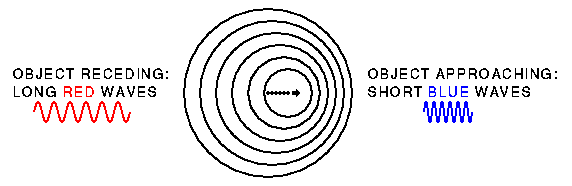
The difference between the frequency of a wave (as of sound or light) as measured at its source and as measured by an observer in relative motion. The Doppler effect can be used to determine the relative speed of an object by bouncing a wave (usually a radar wave) off the object and measuring the shift in the frequency of the wave. This technique is the basis of Doppler radar, as used in traffic control and navigation systems. The Doppler effect is also known as the Doppler shift.  If the source and the observer are getting farther apart, the observed frequency is lower than the source frequency. In the case of light waves, the phenomenon is known as red shift. The amount of red shift in the spectra of stars is used in astronomy to determine how quickly the Earth and those stars are moving apart.  If the source and the observer are getting closer together, the observed frequency is higher than the source frequency. In the case of light waves, the phenomenon is known as blue shift.
A Closer Look The whistle of an approaching train has a higher pitch as the train approaches than when it recedes, even though that same whistle, heard by a passenger on the train, maintains a constant pitch. This is an example of the Doppler effect, common to all wave phenomena (in this case, a sound wave). Motion toward the source of a wave (or, equivalently, motion of the source toward the observer) entails that the peaks and troughs of the wave are encountered more quickly than if there were no motion, so the frequency of the wave is higher for the moving observer (hence the higher whistle pitch). Similarly, motion away from the source entails following the wave's motion, so the peaks and troughs are encountered less often, and the frequency is lower for the moving observer (hence the lower whistle pitch). The Doppler effect on light waves has enabled scientists to determine that the universe is expanding. The frequencies of light given off by various substances (such as the burning of hydrogen in the fusion reactions of most stars) has been found to be lower in distant galaxies and other celestial objects, a phenomenon called red shift, since the visible light is shifted toward the red, low-frequency end of the spectrum. Astronomer Edwin Hubble reasoned that the red shift was due to the Doppler effect. As galaxies speed away from us, the frequency of the light emitted appears lower. Doppler radar and sonar use the Doppler effect on reflected radio and sound waves to distinguish between stationary and moving objects and to determine the velocity of moving ones; theecholocation of bats and some whales also exploits the Doppler effect on reflected sound waves for navigating and catching prey.

Doppler diagram


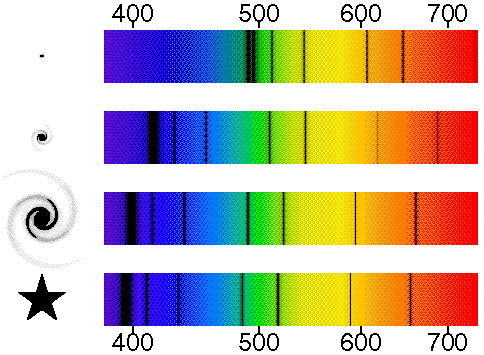
The schematic diagram below shows a galactic star at the bottom left with its spectrum on the bottom right. The spectrum shows the dark absorption lines first seen by Fraunhofer. These lines can be used to identify the chemical elements in distant stars, but they also tell us the radial velocity. The other three spectra and pictures from bottom to top show a nearby galaxy, a medium distance galaxy, and a distant galaxy. The pictures on the left are negatives, of course, so the brightest parts of the galaxies are black. Notice how the pattern of absorption lines shifts to the red as the galaxies get fainter. The numbers above and below the spectra are the measured wavelengths in nm [nanometers]. 
redshift diagram

Doppler effect images

Doppler effect
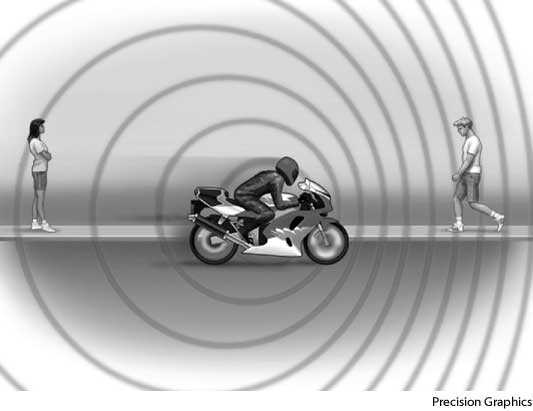
Doppler effect
As a motorcycle speeds forward, the frequency (and pitch) of the sound waves in front of the motorcycle become higher, and the frequency (and pitch) of the sound waves behind it become lower.

Doppler shift


The change in position of spectral lines due to the Doppler effect; named after Christian Doppler. If an object is approaching, its light is compressed and any lines in its spectrum appear at shorter wavelengths than if the object were at rest (see blue shift). If the object is receding, the opposite effect occurs and the spectral lines are shifted toward the longer wavelength or red end of the spectrum (see red shift). 


TYPES OF DOPPLER:
• Color Doppler uses a computer to convert 
Doppler measurements into an array of colors 
to visualize the speed and direction of blood 
flow through a blood vessel. 
• Power Doppler is a newer technique that is 
more sensitive than color Doppler and capable 
of providing greater detail of blood flow, 
especially when blood flow is little or 
minimal. Power Doppler, however, does not 
help the radiologist determine the direction 
of blood flow, which may be important in 
some situations. 
• Spectral Doppler. Instead of displaying 
Doppler measurements visually, Spectral 
Doppler displays blood flow measurements 
graphically, in terms of the distance traveled 
per unit of time.
H

Tuesday, February 7, 2012

How an aeroplane works.


How does an Airplane Fly?
The following information may be used to supplement your classroom lectures on aviation and aerodynamics. The diagrams and explanations are rather simplistic, but they help get the point across.
Forces on an Airplane in Flight
The four aerodynamic forces that act upon an airplane in flight are lift (the upward acting force), weightgravity, the downward acting force), thrust(the forward acting force), and drag (the air resistance or backward acting force). These four forces are continuously battling each other while an airplane is in flight. (or
 LIFT 
THRUSTairplaneDRAG
 WEIGHT 
Gravity opposes lift, thrust opposes drag. In order to take off, the aircraft's thrust and lift must be suffucient to overcome its weight and drag. In level flight at constant speed, thrust exactly equals drag and lift exactly equals the pull of gravity. To land, an aircraft's thrust must be reduced safely below its drag, as its lift is reduced to levels less than its weight.

How an Airplane Generates Lift
Lift is the aerodynamic force that counteracts gravity and holds an airplane in the air. Most of the lift required by an airplane is created by its wings, but a certain portion is also generated by other parts of the aircraft, such as the fuselage. But what actually causes the lift to be created?
First, understand that air is a fluid, just like water, and that all fluids adhere to the same physical and mathematical principles. Next, realize that lift can only be generated when a fluid is in motion. For example, a wing must be passing through the air or the air must be moving around a stationary wing, one or the other. (The way it usually happens is that the wing is doing most of the moving, although the air may be moving too, at the same time.)
 LIFT
airflow lift diagram
Cross-section of Airplane Wing
Most airplane wings have a special, basic shape as viewed edge-on: their upper surfaces are curved and their lower surfaces are flatter. This shape is what works with the fluid motion of the air to create lift. As air moves around a wing, some goes over the top and some goes underneath. The air that goes over the curved upper surface undergoes two important changes: it is reduced in pressure (by the centrifugal force of flowing across the curved surface) and it is accelerated downward (as it leaves the trailing edge of the wing). The wing is forced into the region of reduced air pressure above the upper surface of the wing by the higher air pressure beneath the wing. Also, the downward acceleration of the air (downwash) at the trailing edge forces the wing upward.
Since lift is dependant on the motion of the air, it increases as the speed of the air increases. Lift also increases (to a point) as the angle that the wing makes with the airflow (known as the angle of attack) increases. Past a certain point, however, increased angle of attack will cause the wing to suddenly lose its lifting ability, or stall.

Control Surfaces and Maneuvering
An airplane in flight moves around three axes of rotation: longitudinal axis, lateral axis, and vertical axis. These axes are imaginary lines that run perpendicularly to each other through the center of gravity of the airplane. Rotation around the longitudinal axis (the line from the nose of the plane to the tail) is called roll. Rotation around the lateral axis (the line from wingtip to wingtip) is called pitch. Rotation around the vertical axis (the line from beneath to above the plane) is called yaw. The pilot guides and controls the aircraft by controlling its pitch, roll, and yaw via the control surfaces. These include the aileronselevators, and rudder.
control surfaces
Basic Control Surfaces on an Airplane
Ailerons
The ailerons on an airplane's wings control roll around the longitudinal axis. They work together, simultaneously, tied to the control wheel, or stick, in the cockpit. When the control wheel is turned left, the aileron on the left wing goes up and the one on the right wing goes down. The opposite occurs when the wheel is turned right. But how does this make the airplane roll?
aileron control
The ailerons alter the lifting ability of the wings slightly. When an aileron is lowered, the lift on the outer portion of that wing increases, causing that wing to rise a little. When an aileron is raised, the lift on the outer portion of that wing is decreased slightly, causing that wing to drop a little. Since the ailerons on an airplane work together, their action causes the airplane to roll.
aileron neutral positionaileron neutral, normal lift
aileron loweredaileron lowered, increased lift
aileron raisedaileron raised, decreased lift

Aileron Position
(As viewed from the end of the wing)

Elevators
The elevators on the horizontal portion of the tail of an airplane control the pitch of the plane, or its motion around the lateral axis. They are also tied to the control wheel in the cockpit. When the wheel is pulled back, the elevators move upward, causing the tail of the plane to move downward and the nose to pitch upward. When the wheel is pushed forward, the elevators move downward, causing the tail of the plane to rise and the nose to pitch downward.
elevator control
The elevators work like the ailerons on the wings, in that they cause changes in the lift generated by the tail of the plane. Also, the elevators work together, simultaneously, like the ailerons, but they do not work in opposition to one another. Both go up when the control wheel is pulled back and both go down when the control wheel is pushed forward.
elevator raisedelevator raised, reduced lift, tail goes down, nose goes up
elevator neutralelevator neutral (centered)
elevator loweredelevator lowered, increased lift, tail goes up, nose goes down
Elevator Position
(As viewed from the side)

Rudder
The rudder on the rear edge of the vertical fin on the airplane's tail controls yaw around the vertical axis. It is connected to the pedals at the pilot's feet. Pushing the right pedal causes the rudder to deflect to the right. This makes the tail of the airplane move toward the left, causing the nose to move to the right. Pushing the left pedal makes the rudder deflect to the left, the tail moves to the right, and the nose points to the left.
rudder control
rudder leftrudder left, tail right
rudder neutralrudder neutral (centered)
rudder rightrudder right, tail left
Rudder Position
(As viewed from above)

Although the rudder pedals and control wheel in the cockpit are not linked together, they must be used simultaneously to control the plane. The pilot guides the airplane by careful and precise movements of the control wheel and rudder pedals, as well as adjusting the thrust of the aircraft.

How Does an Airplane Produce Thrust?
Thrust is the force created by a power source that overcomes the airplane's aerodynamic drag (its resistance to passing through the air) and gives it forward motion. This force can either "pull" or "push" the aircraft forward, depending on the type of power source used. Common types include reciprocating (piston-powered) engines driving propellers, and jet engines.
Reciprocating Engines with Propellers
A reciprocating engine is an internal-combustion engine in which pistons moving back and forth act upon a crankshaft to create rotational movement. (This is the same type of engine that powers most family cars.) A mixture of fuel and air is compressed by the pistons, an electric spark causes the mixture to explode, driving the pistons downward. This motion is transferred to the crankshaft by connecting rods. The rotating crankshaft turns the propeller.
Reciprocating engine diagram
A propeller is a type of airfoil (similar to a wing) that turns and accelerates air. As the blades of the propeller rotate they create lifting forces just as a wing does, only working in the horizontal plane instead of the vertical as with wings. Thus, the propeller creates a propulsive force perpendicular to its plane of rotation that moves the aircraft forward as a reaction. Props can either "pull" the aircraft from their position on the front of the wings or fuselage, or "push" it from behind, or both.
Jet Engines
A jet engine is any engine that ejects a jet or stream of gas or fluid, thereby obtaining thrust in reaction to the ejection force. A jet aircraft engine obtains oxygen from the atmosphere for the combustion of its fuel, creating thrust in reaction to the rapid exhaust of the combustion products. There are several types of jet engines. Some are briefly described below.
Turbojet
turbojet engine is a jet engine that incorporates a turbine-driven compressor to take in and compress air for the combustion of fuel. The exhaust from the combustion drives the turbine and creates the thrust-producing jet.
Turbojet diagram
Basic Turbojet Engine
Turbofan
turbofan engine is a turbojet engine in which additional thrust is gained by extending a portion of the compressor or turbine blades outside the inner engine casing. These extended blades propel bypass air around the engine core, between the inner and outer engine casings. This air is not combusted but does provide additional thrust since it is compressed by the blades.
Turbofan diagram
Basic Turbofan Engine
Turboprop
turboprop engine is a turbojet engine in which a portion of the exhaust energy is used to drive a propeller. The engine's thrust is therefore generated by a combination of the propeller's thrust and the jet exhaust from the engine.
Turboprop diagram
Basic Turboprop Engine
Ramjet
ramjet engine is the simplest type of jet engine since it has no moving parts. The engine is basically a specially-shaped duct open at both ends, with the air necessary for combustion being compressed by the forward motion of the engine. Fuel is sprayed into the airstream and the mixture is ignited. The high-pressure air coming into the combustion chamber keeps the reaction from going back toward the inlet.
 Combustion Chamber 
Air
Intake
Ramjet diagramExhaust
nozzle
 Fuel injectors/ignition grid 
Basic Ramjet Engine
Ramjet engines cannot operate under static conditions. In order to function, they have to already be traveling through the air at slightly over the speed of sound. (The speed of sound is somewhat over 740 miles per hour at sea level.) This means that the aircraft using them must first get up to the required speed using some other type of propulsion, then start the ramjets. They can operate at up to five times the speed of sound.
Scramjet
scramjet, or "supersonic combustion ramjet", engine is similar to a ramjet, but is designed to operate at well over five times the speed of sound, or at hypersonic velocities. As with ramjets, aircraft powered by scramjets must first be brought up to required speed by some other means of propulsion. Unlike ramjets, which slow the supersonic airstream entering the inlet to subsonic speeds before combustion, a scramjet combusts the supersonic airstream without slowing it.
 

How does an aeroplane fly?


Monday, February 6, 2012

Photos of some war heroes.. Famous and Infamous.


Gaius Julius Caesar is heralded as the conqueror of Gaul. He was living the political high life when he was assassinated on March 15, 44 B.C.

Attila the Hun is hailed as a great barbarian warrior. He made life miserable for the Roman Empire.
The fear-inspiring Mongol conqueror Genghis Khan is depicted here on his deathbed with his four sons holding vigil.
The order of the Knights Templar was founded in 1118 as a result of the first Crusades. The Knights Templar endeavored to protect pilgrims en route to the Holy Land.
In this iconic image, Gen. George Washington crosses the Delaware River. Despite his proud stance, he's just been defeated in a skirmish with the British.
Napoleon Bonaparte, a general from the French Revolution, emerged as emperor after the revolutionary fervor subsided and France was left leaderless.
Samurai display their military garb in 1864. These Japanese warriors were incredibly disciplined and loyal, and they preferred death to dishonor.
Abraham Lincoln led the long and weary Civil War to repair the fractured United States.
One of the most loathed men of war in history, Adolf Hitler was leader of the Nazi Party and orchestrator of the Holocaust.
Gen. Douglas MacArthur was the Allied commander in the Southwest Pacific during World War 
Saudi Arabian leader Osama bin Laden headed the Al-Qaeda network that hijacked airplanes for the Sept. 11 attacks on the World Trade Center and the Pentagon.


Tongue..and what it does ..explained


Want to find out just how much you use your tongue? Try eating an ice-cream cone or singing your favorite song without it. You need your tongue to chew, swallow, and sing. And don't forget talking and tasting!

Tongue Twister

Has anyone ever told you that the tongue is a muscle? Well, that's only partly true: The tongue is really made up of many groups of muscles. These muscles run in different directions to carry out all the tongue's jobs.
The front part of the tongue is very flexible and can move around a lot, working with the teeth to create different types of words. This part also helps you eat by helping to move food around your mouth while you chew. Your tongue pushes the food to your back teeth so the teeth can grind it up.
The muscles in the back of your tongue help you make certain sounds, like the letters "k" and hard "g" (like in the word "go"). Try saying these letters slowly, and you'll feel how the back of your tongue moves against the top of your mouth to create the sounds.
The back of your tongue is important for eating as well. Once the food is all ground up and mixed with saliva (say: suh-lye-vuh), orspit, the back muscles start to work. They move and push a small bit of food along with saliva into your esophagus (say: ih-sah-fuh-gus), which is a food pipe that leads from your throat to your stomach.

Tongue Held Down Tight

Have you ever wondered what keeps you from swallowing your tongue? Look in the mirror at what's under your tongue and you'll see your frenulum (say: fren-yuh-lum). This is a membrane (a thin layer of tissue) that connects your tongue to the bottom of your mouth. In fact, the whole base of your tongue is firmly anchored to the bottom of your mouth, so you could never swallow your tongue even if you tried!

Tasty Tidbits

Don't put that mirror away yet! Look at your tongue again, but this time look closely at the top of it. Notice how it's rough and bumpy — not like the underside, which is very smooth. That's because the top of your tongue is covered with a layer of bumps called papillae (say: puh-pih-lee).
Papillae help grip food and move it around while you chew. And they contain your taste buds, so you can taste everything from apples to zucchini! People are born with about 10,000 taste buds. But as a person ages, some of his or her taste buds die. (An old person may only have 5,000 taste buds!) That's why some foods may taste stronger to you than they do to an adult. Taste buds can detect sweet, sour, bitter, and salty flavors.

Traveling Tastes

So how do you know how something tastes? Each taste bud is made up of taste cells, which have sensitive, microscopic hairs called microvilli (say: mye-kro-vih-lye). Those tiny hairs send messages to the brain, which interprets the signals and identifies the taste for you.
Identifying tastes is your brain's way of telling you about what's going into your mouth, and in some cases, keeping you safe. Have you ever taken a drink of milk that tasted funny? When the milk hit the taste buds, they sent nerve impulses to your brain: "Milk coming in — and it tastes funny!" Once your brain unscrambled the nerve impulses, it recognized the taste as a dangerous one, and you knew not to drink the milk.
Some things can make your taste bud receptors less sensitive, like cold foods or drinks. An ice pop made from your favorite juice won't taste as sweet as plain juice. If you suck on an ice cube before you eat a food you don't like, you won't notice the bad taste.

Friend of the Tongue

Last time you had a cold and your nose felt stuffed up, did you notice that foods didn't taste as strong as they usually do? Well, that's because your tongue can't take all of the credit for tasting different flavors — it has help from your nose.
Your nose helps you taste foods by smelling them before they go in your mouth and as you chew and swallow them. Strong smells can even confuse your taste buds: Try holding an onion slice under your nose while eating an apple. What do you taste?
Your tongue also gets help from your teeth, lips, and mouth. Your teeth help your tongue grind food as the tongue mixes the food around your mouth. And without your teeth, lips, and the roof of your mouth, your tongue wouldn't be able to form sounds to make words.
Saliva is also a friend of the tongue. A dry tongue can't taste a thing, so saliva helps the tongue by keeping it wet. Saliva moistens food and helps to break it down, which makes it easier for the tongue to push the food back to swallow it.

Fighting Germs

If all that wasn't enough, your tongue even helps keep you from getting sick. The back section of your tongue contains something called the lingual tonsil (say: ling-gwul tahn-sul). Lingual is a medical word that means having to do with the tongue, and tonsils are small masses of tissue that contain cells that help filter out harmful germs that could cause an infection in the body.
But when you have tonsillitis, it's not your lingual tonsil that's infected. Tonsillitis affects the palatine (say: pah-luh-tyne)tonsils, which are two balls of tissue on either side of the tongue. The lingual tonsil, the palatine tonsils, and the adenoids are part of a bigger system that fights infections throughout your body.

The Tongue Is One Tough Worker

With all that talking, mixing food, swallowing, tasting, and germ fighting, does your tongue ever get a rest?
No. Even when you are sleeping, your tongue is busy pushing saliva into the throat to be swallowed. It's a good thing, too, or we'd be drooling all over our pillows. Keep your tongue in tip-top shape by brushing it along with your teeth and avoiding super-hot foods. A burned tongue is no fun!
Reviewed by: Steven Dowshen, MD
Date reviewed: June 2010

Sunday, February 5, 2012

Facts on food.

Click here to join World Malayali Club

Easter Rising in Ireland..1916


Easter Rising 1916 
 

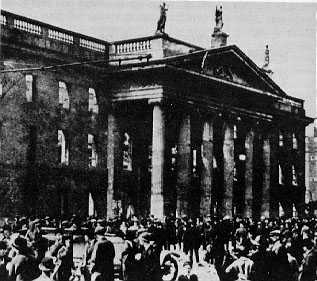
General Post Office, Dublin
"Ireland is too great to be unconnected with us, and too near us to be dependant on a foreign state, and too little to be independent."  C.T. Grenville to the Duke of Rutland, December 3, 1784 (H.M.C. 14 report app. 1, p. 155)  This statement sums up the attitude of Great Britain toward Ireland from the twelfth century to the twentieth. The passage of the National Service Act in January 1916 which threatened conscription in Ireland was one of the causes of  the Easter Rising.  The 1916 Rising represented the first major demonstration of force since the United Irishmen Rising of 1798.  The insurrections of 1803, 1848 and 1867 had been small in comparison.  (E. A. Benian.  The Cambridge History of the British Empire. London, 1959. p.663)

Ireland in World War I 
Germany felt that England would be too busy with Ireland to enter World War I (.George W. Russell.  The Irish Home Rule Convention. New York, 1917, p. 32.)  “One of the immediate causes” of the war was Northern Ireland’s threat to oppose Home Rule by rebellion.  The German Kaiser, as a result of the warlike attitude of the Ulsterites was convinced that England was unable to become involved in a European war.  Germany was convinced that England would be too buys to enter a war or at best would be of slight hindrance to Germany. (Tom Ireland. Ireland Past & Present. New York, 1942)  Ulster’s open flaunting of the laws that prohibited no arms to be sent to Ireland, and the open drilling of the Ulster Volunteers threatening a civil war in Ireland, led Germany to believe that England was weak and would not interfere if she attacked France or Russia. 
Germany also believed that the large numbers of Irish in the British army would revolt over the disturbances at home.  John Redmon appealed to the people of Ireland as a whole to remain loyal to England.  He hoped that a untied front on the part of the Irish might result in a peaceful union following the war.  This probably would have worked had the leaders of Ulster cooperated withy Redmon, for during the fighting in Europe, many northern and southern Irish became friendly.  Unfortunately, the leaders of Ulster would not put aside their private interests for the common good or Ireland, and the generous acts of the Irish Nationalists were to no avail. 
Discrimination by the English War Office were extremely noticeable in that the Protestants were permitted to form their own Irish companies but the Catholics were not. John Redmon volunteered the services of the Irish Volunteers to England.  Most of the members did fight for England, but a small minority followed strict Sinn Fein policy and refused to fight.  This group was in favor of neutrality.  They joined with the Labour Citizen Army and together formed an effective anti-British fighting force.  Eamon DeValera was part of this group.  (Tom Ireland. Ireland Past & Present. New York, 1942, pp 325-326.)
Sinn Fein 
The Gaelic League was founded in 1893 for the purpose of re-establishing the Irish language and culture.  The political outgrowth of the League was culminated in 1899 with the founding of the Sinn Fein movement, (We  Ourselves), by Arthur Griffith.  This was an organization that supported withdrawing Irish members from the British Parliament and setting up and Irish Parliament along with abandoning constitutional methods of bringing about the repeal of the 18000 Act of Union.  Arthur Griffith’s plan was to follow the Hungarian example of 1861.  The plan called for a boycott of the British army and navy.  No Irish members were to be sent to London and an extra legal Irish Parliament to be established in Dublin.  A court system would be set up, English goods boycotted and a general program of non-cooperation with the English was to be instituted.
During 1910-1913, the Sinn Fein movement seemed dormant and was without a dynamic leader. (Elie Halevy. The Rule of Democracy (1905-1914). New York, 1961. p. 538.)  Other Irish organizations were growing.  The Irish socialist leader, Larkin had obtained many new ideas from the Industrial  Workers of the World in the United States.  The Irish Republican Brotherhood was revived by James Connolly. 
According to the author of the Irish Home Rule Convention, the Sinn Feiners placed Home Rule and other various Irish problems above a victory for the allied powers. George W. Russell.  The Irish Home Rule Convention. New York, 1917, p. 19.)   A German ship landed on the Irish coast on Good Friday evening 1916 bringing arms and ammunition with Sir Roger Casement as leader.  There was a plan for a general rebellion during the Easter season.Lawrence M. Larson.  A History of England & the British Commonwealth, New York, 1932, p. 834)  Casement was captured by the British and taken to London for trial.  He was later hanged.  Martial law was declared in Dublin City and county.  The suspension of the right of a British subject to be tried by a civil court was seen as a sign of the seriousness of the situation.  Some of the Irish Nationalists in America were said to have known of the intentions of the Easter rising a few weeks before it took place. 
Easter 1916 Rising 
The Gaelic American stated President Wilson knew of Casement’s intentions to land arms in Ireland and warned the British government.  (New York Times, April 27, 1916, pp. 1 & 4.) The Irish Republican Brotherhood had decided at the early stages of the was that a rebellion must occur at some time during the war.  Professor MacNeill, the nominal leader of the group had arranged for a p;arade to be held on Easter Sunday.  He later found out the parade was to be the base of the rebellion and cancelled the event.  By this time, the promised aid from Germany had fallen through.  In spite of MacNeill’s order, a few Irish decided to go ahead with the rising.  James Connolly and Patrick Pearse were the leaders of the 1,000 man force.  On April 24, 1916, the Monday after Easter,  the small group took over several buildings in Dublin.  Despite the great odds against them, the Irish patriots held out for about a week.  
At this same time, Eamon DeValera had his big opportunity to come forth as one of the new leader of the Irish Nationalist movement.  He was able to conduct his part of the uprising with great skill.  Seven leaders of the rising proclaimed an Irish Republic.  All seven of the signers were executed along with eight others.  DeValera, the only battalion commander not killed, was saved because Redmon proclaimed him an American citizen.  DeValera’s mother was an American, and he was born in New York City.  His death sentence was communed to life imprisonment along with that of William T. Cosgrave.  The British did not want to execute and American citizen and risk alienating the United States. (Ireland, pp. 328-334) 
John Redmon condemned the uprising and stated that too mujch encouragement had come from the Irish-Americans.  (New York Times, April 29, 1916, pp. 1-3.)   The Easter 1916 rising provided a “blood sacrifice” for an Ireland that had becomeap;athetic. (Edmund Curtis.  A History of Ireland. New York, 1961. p. 406)  The rising was not supported by public opinion in Ireland.  Afterward, general incompetence on the part of the British government, and the arrests of thousands of men, some of who were taken to England, only served to arouse hatred for the English among the population.  The men who were executed were regarded as martyrs.  If the situation had been handled wisely by the British, the Irish radical cause and the Sinn Fein movement could have received a severe setback.   A quote from page 28 of the Irish Home Rule Convention by George Russell, “A muddling nation trying to govern one of the cleverest nations in the World.”  (Russell, p.28.)  
 As an aftermath of the rising about 50,000 British soldiers were stationed in Ireland which deprived England much needed men and equipment.  Recruitment in Ireland practically stopped making a net loss to the firing line of 100,000 men.  (Russell, p.32.)

  Professor MacNeill, the nominal leader of the Irish Republican Brotherhood, had arranged for a parade to be held on Easter Sunday.  He later found out the parade was to be the base of the rising and cancelled the event.
The Easter Rising planned by the Irish Republican Brotherhood was virtually confined to Dublin. This was the opening act of the Irish War for Independence.  Moreover, confusion was caused by a rash of conflicting orders sent out to the Irish Volunteers – the main strike force - from their headquarters and the decision taken by the rebel leaders to postpone their action arranged for Easter Sunday 23rd April, until the next day.
At about 11.00 am on Easter Monday, Patrick Pearse and the Volunteers, along with James Connolly and the Irish Citizen Army, assembled at various prearranged meeting points in Dublin, and before noon set out to occupy a number of imposing buildings in the inner city area. These had been selected to command the main routes into the capital, and also because of their strategic position in relation to the major military barracks. They included the General Post Office, the Four Courts, Jacob’s Factory, Boland’s Bakery, the South Dublin Union, St. Stephen’s Green and later the College of Surgeons. Photos  There was little fighting on the first day since British intelligence had failed hopelessly, the properties targeted were taken virtually without resistance and immediately the rebels set about making them defensible. The GPO was the nerve center of the rebellion. It served as the rebels’ headquarters and the seat of the provisional government which they declared. Five of its members served there – Pearse, Clarke, Connolly, MacDermott and Plunkett.
The British military onslaught, which the rebels had anticipated, did not at first materialize. When the Rising began the authorities had just 400 troops to confront roughly 1,000 insurgents. Their immediate priorities were therefore to amass reinforcements, gather information on volunteer strength and locations and protect strategic positions, including the seat of government, Dublin Castle, which had initially been virtually undefended.  On Tuesday, a British force of 4,500 men with artillery attacked and secured the Castle. Photos
"As the week progressed, the fighting in some areas did become intense, characterized by prolonged, fiercely contested hand to hand street battles. Military casualties were highest at Mount Street Bridge. There, newly arrived troops made successive, tactically inept, frontal attacks on determined and disciplined volunteers occupying several strongly fortified outposts. They lost 234 men, dead or wounded while just 5 rebels died. In some instances, lapses in military discipline occurred. Soldiers were alleged to have killed 15 unarmed men in North King Street near the Four Courts during intense gun battles there on 28th and 29th April. The pacifist Francis Sheehy-Skeffington was the best- known civilian victim of the insurrection. He was arrested in Dublin on 25th April, taken to Portobello Barracks and shot by firing squad next morning without trial.
Overall the British authorities responded competently to the Rising. Reinforcements were speedily drafted into the capital and by Friday 28th April, the 1,600 rebels (more had joined during the week) were facing 18-20,000 soldiers. From Thursday the GPO was entirely cut off from other rebel garrisons. Next day it came under a ferocious artillery attack which also devastated much of central Dublin. Having learnt the lessons of Mount Street Bridge, the troops did not attempt a mass infantry attack. Their strategy was effective. It compelled the insurgent leaders, based at the Post Office, first to evacuate the building and later to accept the only terms on offer – unconditional surrender. Their decision was then made known to and accepted sometimes reluctantly, by all the rebel garrisons still fighting both in the capital and in the provinces." http://www.bbc.co.uk/
In total, the Rising cost 450 persons killed, 2,614 injured, and 9 missing, almost all in Dublin. The only significant action elsewhere was at Ashbourne, 10 miles north of Dublin. Military casualties were 116 dead, 368 wounded and 9 missing, and the Irish and Dublin police forces had 16 killed and 29 wounded. A total of 254 civilians died; the high figures were largely because much of the fighting had occurred in or near densely populated areas. It is widely accepted that 64 rebels lost their lives. Their casualties were low because in the capital they were the defending force. Moreover, they fought with discipline and skill until, acting under instruction from their leaders, they surrendered their strongholds rather than fight to the last volunteer. The few other insurgents in Co. Meath, Galway and Wexford joined in the surrender.
Sir John Maxwell, the British Commander-in-Chief caused sixteen of the Irish to be court-martialed and shot.  The execution of these men was an attempt to murder of the Provisional Government of Ireland.  Patrick Pearse was the first to be singled out for execution, he was not allowed to see his mother or brother before he was executed on May 3, 1916. One of Pearse's most famous speeches was his eulogy at the funeral of O'Donnovan Rossa who died in 1915.