Popular Posts

Popular Posts

Pages

Total Pageviews

Thursday, October 27, 2011

Significance of Diwali.


Deepavali has much significance; from Ramayana we get the return of faith & goodwill after the absence for a period of time. Narkasura’s story gives us the significance of victory of good over evil & the removal of the spiritual darkness. The lights/lamps also signify victory of good over the evil within every human being. 


A wonderful significant spiritual meaning of Deepavali is the awareness of the Inner Light in a human being. A very central feature in the Hindu Philosophy is the existence of the Atma, which is a pure, infinite & eternal part of any human; it has no death or birth, & can never die. Deepavali is the celebration of this Inner Light is us, which has the power to outshine all inner & outer darkness like obstacles, ignorance, & awakens the individual person to their true spiritual nature. 


With the realisation of a human that he is part of an unchanging, universal, infinite, pure, & transcendental truth, he achieves universal compassion, unconditional love, & the awareness that everything is connected. This brings a joy, peace or happiness which nothing else can. 


The custom of lighting diyas, signify a welcome to prosperity in the form of Lakshmi, and the fireworks are supposed to scare away evil spirits. 


Yes it was a festival started by Hindus, yes Jains, Sikhs, & even Buddhists (in Nepal), who were all part of Hinduism before they changed into different religions, celebrate Deepavali. 


But it is also true that many people in India celebrate Deepavali regardless of their faith or religion. There is no bar on who can celebrate Deepavali. People from any religion, caste, creed, age & gender can celebrate it, because it has more of a spiritual meaning than a religious meaning, & for most people, including Hindus, today it has more spiritual significance. 


So whether you are Christian, Muslim, Orthodox, Jewish, Parsi, or anything, you are free to celebrate this great festival, thereby celebrating the inner you. There is no rule that you have to pray or worship a Hindu god or goddess, you can pray or worship your own god. But do light the lamp of brightness inside yourself. 


Wednesday, October 26, 2011

Temples for Pandavas.

Pancha Pandava Temples


Pancha Pandava Temples are five Mahavishnu temples consecrated by the Pandavas

Route Map for Pancha Pandava Temples

Pancha Pandava Temples are five Mahavishnu temples consecrated by the Pandavas
It is believed that witnessing the poojas and praying in all the five temples on stilpulated times on the same day is very auspicious.


Pandavas


Image of Pandavas
 
 
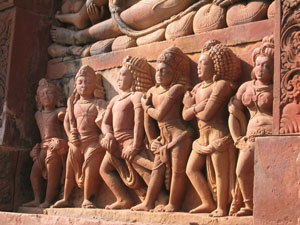
Pandavas are described in the Indian epic ‘Mahabharatha’. Pandavas includes five brothers Yudhishtira, Bhima, Arjuna, Nakula and Sahadeva. They are the sons of ‘Pandu’, by his two wives, ’Kunthi’ and ‘Madhri’. The word ‘Pandavas’ means the sons of ‘Pandu’. Yudhishtira, Bhima and Arjuna are the sons of Kunthi. Remaining are the sons of Madhri. It is described in Mahabharatha, that five brothers were married to ‘Draupathi’, a true Krishna devotee. Lord Krishna was closely related to Pandavas during Kurukshethra war by giving advices and help at right times. Friendship of Lord Krishna and Lord Arjuna is well known in that epic. Pandu has a brother named Dridhrashtra, who was blind by birth. The main enemies of Pandavas were Kauravas. Kauravas were 100 in numbers, the sons of Dridhrashtra . After the death of Pandu, Pandavas and Kauravas started quarrel for the kingdom. The kingdom was supposed to handover to Yudhishtira, the eldest son of Pandu. But Duryodhana, the eldest son of Kauravas did not like it and often trouble the Pandavas. Kauravas played dirty game against Pandavas and succeeded of pushing them away from the country. The battle of Kurukshethra was happened dispute of the kingdom.
Yudhishtira is the begotten son of ‘Yamadharma’ and known as Dharma puthra. Arjuna is the son of Indra. Bhima is the son of Pavanan. And Nakul and Sahadev are the sons of Aswini Kumars.
 

Tuesday, October 25, 2011

17 Facts about the feet


Yusuf M thegreatyusuf@gmail.com via yahoogroups.com to bcc: worldmalayalic.
show details 9:23 AM (21 hours ago)

Old city of Hyderabad

12.JPG

Monday, October 24, 2011

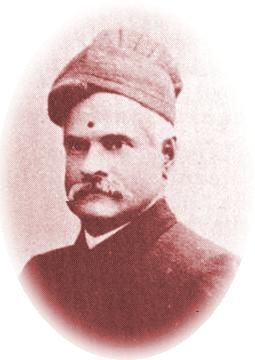
Raja Ravi Varma


Raja Ravi Varma, Great artist of Kerala

Raja Ravi Varma (1848-1906) - A Prince Among Painters and A Painter Among Princes


Raja Ravi Varma (1848-1906) was born in Kilimanoor Palace as the son of Umamba Thampuratti and Ezhumavil Neelakandan Bhattathiripad. At the age of seven years he started drawing on the palace walls using charcoal. His uncle Raja Raja Varma noticed the talent of the child and gave preliminary lessons on painting. At the age of 14, Ayilyam Thirunal Maharaja took him to Travancore Palace and he was taught water painting by the palace painter Rama Swamy Naidu. After 3 years Theodor Jenson, a British painter taught him oil painting.Most of his oil paintings are based on Hindu epic stories and characters. In 1873 he won the First Prize at the Madras Painting Exhibition. He became a world famous Indian painter after winning in 1873 Vienna Exhibition.
Many of his oil paintings are classic and his unique Indian style has later influenced artists and designers worldwide. Here we have displayed pictures of some of the classic oil paintings and oleographs of Raja Ravi Varma.
Raja Ravi Varma

Oil Paintings of Raja Ravi Varma
Following are some of the oil paintings of Raja Ravi Varma.

1. The Milkmaid2. The Maharashtrian Lady3. The Suckling Child4. Expectation5. Pleasing6. Sakunthala7. Sri Krishna as Envoy8. Yesoda With Krishna9. Jatayu Vadha10. Syrendri
11. Harischandra In Distress12. Sakunthala13. Sri Rama Vanquishing The Sea14. Galaxy of Musicians15. There Comes Papa16. Lady In The Moon Light17. Mother And Child18. Sri Krishna Liberating His Parents19. Sakunthala Pathralekhan20. Lady With Veena
21. In Contemplation22. Lady In Her Dressing Room23. Lady With Swarbat24. Hamsa Damayanthi25. Swan Messenger26. Prem Patra27. Lady in Prison28. Gypsies29. Jatayu Vadham30. A Portrait
31. Malayalee Lady32. A Portrait33. Mrs. Ramanadha Rao34. Alms35. Droupathi and Simhika36. Lady with Flower Garland37. A Portrait38. Santhanu and Matsyagandhi39. Ammakovil Thampuran40. Radha and Madhava
41. Bharani Thirunal Rani Parvathi Bayi42. Sri Rama Breaking the Bow43. Droupathi in Virata's Palace44. Mohini and Rugmangada45. Puddukotta Durbar46. Victory of Meghanada47. Birth of Sakunthala48. Lady Going for Pooja49. Krishna Drishta50. Historic Meeting
51. Sakuntala52. Bhishma Oath53. Maharashtrian Beauty54. Saraswathi55. Vishwamitra and Menaka56. Kadambari57. The Lady with a Mirror58. Lakshmi59. The Miser60. Lady at Ball Game
61. Goddess Durga62. Arjuna and Subhadra63. Kamsa Maya64. Birth of Krishna65. Shantanu and Ganga66. Maharaja Moolam Thirunal67. Yasoda Adorning Krishna68. Looking into the Mirror69. Keechaka and Sairandhri70. Nala and Damayanthi
71. Lady Giving Alms72. Rai Pannalal Mehta73. Menaka and Sakunthala74. A Student75. Malabar Lady76. Prince Fateh Singh Rao77. Fresh from Bath78. Radha Waiting for Krishna79. Maharani Chimanbai80. Bharata
81. Nobleman from Central India82. Ladies in the Moonlight83. At the Bath84. Princess Tharabai85. Yasodha and Krishna86. Maharaja Sayaji Rao87. Lady on the Bridge88. Sir T. Madhava Rao89. Lady Juggler90. Maharaja Fateh Singh
91. Sleeping Beauty92. Damayanthi93. Lord Govindadas Krishnadas94. Woman with Veena95. Lady Resting on the Pillow96. Lady Playing the Veena97. Maharani Chimanbai98. Lady Holding a Fruit99. Stolen Interview100. Reclining Woman
101. Sairandhri102. Damayanthi Vanavas103. Lord Ampthill104. Decking the Bride105. The Reaper106. Maharana Prathap Singh107. Reverie108. Disappointing News109. Introducing Radha to Krishna110. Sreerama Crossing Sarayu River
111. Portrait of Gentleman112. Maharana Amar Singh113. Harischandra and Tharamathi114. Judith115. Maharana Jai Singh116. Sita taken by Goddess Earth117. Thara Varini118. Young Woman119. Maharana Raj Singh120. Portrait of a Lady
121. Sri Krishna as Envoy - 2122. Sreerama meets Seetha123. Royal Aunt124. Thanjavore Madhava Rao125. Lady in the Moon Light - 2126. Persian Damsel127. Colonel W.D. Bordie Ketchen128. Goddess Saraswathi - 2129. Bharatanatyam (Dance Pose)130. Shakunthala writing Letter
131. A Girl Holding Hookah and Broom132. Dambadas Ramachandra Thondaiman Bahadur133. Malayalee Lady134. Rajput Soldier135. Kerala Varma Valiya Koil Thampuran136. Sairandhri137. H.B. Grig Esq.138. Horses139. Lady near the Wall140. Princess Putla Raje


Oleographs of Raja Ravi Varma
Following are some of the oleographs of Raja Ravi Varma.

1. Saraswathi2. Hamsa Damayanthi3. Lakshmi4. Sakunthala Pathralekhan5. Keechaka and Sairandhri6. Damayanthi Vanavas7. Ganga Vatram8. Shantanu and Matsyagandhi9. Vishwamitra and Menaka10. Vasantika
11. Usha's Dream12. Hamsa Damayanthi13. Vasanthasena14. Mohini15. Urvashi and Purooravas16. Lady Giving Alms17. Shivaji Maharaj18. Radha and Sakhi19. Birth of Sakunthala20. Sakunthala and Sakhis


Lithographic Prints from Ravi Varma Press
Following are some of the lithographic prints originated from Ravi Varma Press.

1. Bharat Milap2. Riddhi Siddhi Ganapathi3. Sreerama Durbar4. Shankar5. Mahishasura Mardini6. Dhruv Narayanan7. Seshasayi8. Panchdev9. Vanavasi Ram10. Dattatreya