 |
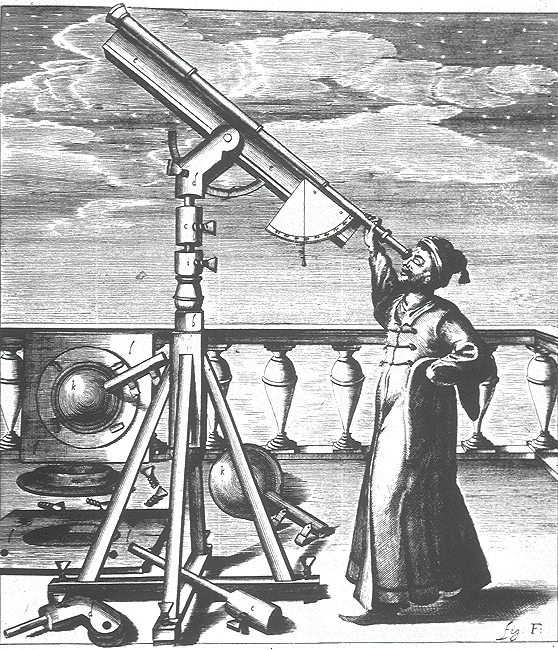
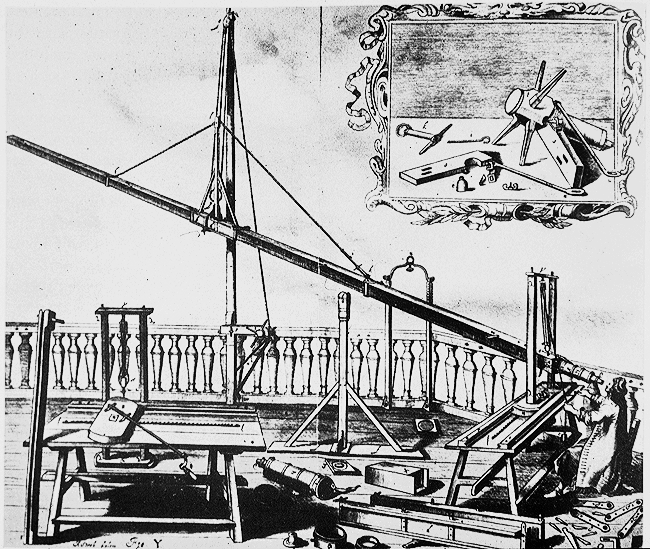
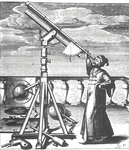
| Johannes Hevelius observing with one of his telescopes [click for larger image] |
The Telescope The telescope was one of the central instruments of what has been called the Scientific Revolution of the seventeenth century. It revealed hitherto unsuspected phenomena in the heavens and had a profound influence on the controversy between followers of the traditional geocentric astronomy and cosmology and those who favored the heliocentric system of Copernicus. It was the first extension of one of man's senses, and demonstrated that ordinary observers could see things that the great Aristotle had not dreamed of. It therefore helped shift authority in the observation of nature from men to instruments. In short, it was the prototype of modern scientific instruments. But the telescope was not the invention of scientists; rather, it was the product of craftsmen. For that reason, much of its origin is inaccessible to us since craftsmen were by and large illiterate and therefore historically often invisible. Although the magnifying and diminishing properties of convex and concave transparent objects was known in Antiquity, lenses as we know them were introduced in the West [1] at the end of the thirteenth century. Glass of reasonable quality had become relatively cheap and in the major glass-making centers of Venice and Florence techniques for grinding and polishing glass had reached a high state of development. Now one of the perennial problems faced by aging scholars could be solved. With age, the eye progressively loses its power to accommodate, that is to change its focus from faraway objects to nearby ones. This condition, known aspresbyopia, becomes noticeable for most people in their forties, when they can no longer focus on letters held at a comfortable distance from the eye. Magnifying glasses became common in the thirteenth century, but these are cumbersome, especially when one is writing. Craftsmen in Venice began making small disks of glass, convex on both sides, that could be worn in a frame--spectacles. Because these little disks were shaped like lentils, they became known as "lentils of glass," or (from the Latin) lenses. The earliest illustrations of spectacles date from about 1350, and spectacles soon came to be symbols of learning.
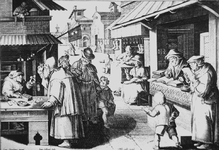 |
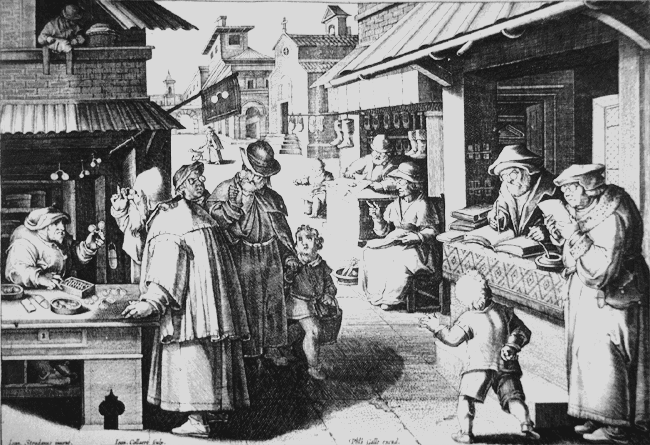
| The Spectacle Vendor by Johannes Stradanus, engraved by Johannes Collaert, 1582 [click for larger image] |
These spectacles were, then, reading glasses. When one had trouble reading, one went to a spectacle-maker's shop or a peddler of spectacles (see figs. 2 and 3) and found a suitable pair by trial and error. They were, by and large, glasses for the old. spectacles for the young, concave lenses[2] that correct the refractive error known as myopia, were first made (again in Italy) in the middle of the fifteenth century. So by about 1450 the ingredients for making a telescope were there. The telescopic effect can be achieved by several combinations of concave and convex mirrors and lenses. Why was the telescope not invented in the fifteenth century? There is no good answer to this question, except perhaps that lenses and mirrors of the appropriate strengths were not available until later. In the literature of white magic, so popular in the sixteenth century, there are several tantalizing references to devices that would allow one to see one's enemies or count coins from a great distance. But these allusions were cast in obscure language and were accompanied by fantastic claims; the telescope, when it came, was a very humble and simple device. It is possible that in the 1570s Leonard and Thomas Digges in England actually made an instrument consisting of a convex lens and a mirror, but if this proves to be the case, it was an experimental setup that was never translated into a mass-produced device.[3]
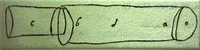 |
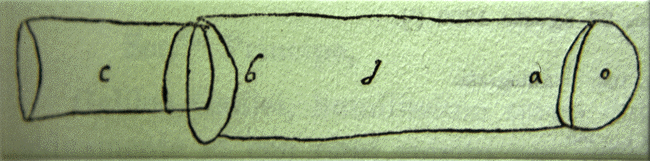
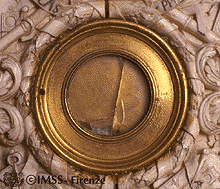
The earliest known illlustration of a telescope. Giovanpattista della Porta included this sketch in a letter written in August 1609
[click for larger image] |
The telescope was unveiled in the Netherlands. In October 1608, the States General (the national government) in The Hague discussed the patent applications first of Hans Lipperhey of Middelburg, and then of Jacob Metius of Alkmaar, on a device for "seeing faraway things as though nearby." It consisted of a convex and concave lens in a tube, and the combination magnified three or four times.[4] The gentlemen found the device too easy to copy to award the patent, but it voted a small award to Metius and employed Lipperhey to make several binocular versions, for which he was paid handsomely. It appears that another citizen of Middelburg, Sacharias Janssen had a telescope at about the same time but was at the Frankfurt Fair where he tried to sell it.
|
Galileo's telescopes
[click here for larger image] |
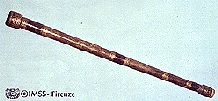
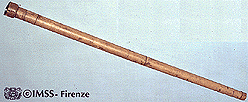
The news of this new invention spread rapidly through Europe, and the device itself quickly followed. By April 1609 three-powered spyglasses could be bought in spectacle-maker's shops on the Pont Neuf in Paris, and four months later there were several in Italy. (fig. 4) We know that Thomas Harriot observed the Moon with a six-powered instrument early in August 1609. But it was Galileo who made the instrument famous. He constructed his first three-powered spyglass in June or July 1609, presented an eight-powered instrument to the Venetian Senate in August, and turned a twenty-powered instrument to the heavens in October or November. With this instrument (fig. 5) he observed the Moon, discovered four satellites of Jupiter, and resolved nebular patches into stars. He published Sidereus Nuncius in March 1610. Verifying Galileo's discoveries was initially difficult. In the spring of 1610 no one had telescopes of sufficient quality and power to see the satellites of Jupiter, although many had weaker instruments with which they could see some of the lunar detail Galileo had described in Sidereus Nuncius. Galileo's lead was one of practice, not theory, and it took about six months before others could make or obtain instruments good enough to see Jupiter's moons. With the verification of the phases of Venus by others, in the first half of 1611, Galileo's lead in telescope-making had more or less evaporated. The next discovery, that of sunspots, was made by several observers, including Galileo, independently.
 |
| ??? |
A typical Galilean telescope with which Jupiter's moons could be observed was configured as follows. It had a plano-convex objective (the lens toward the object) with a focal length of about 30-40 inches., and a plano-concave ocular with a focal length of about 2 inches. The ocular was in a little tube that could be adjusted for focusing. The objective lens was stopped down to an aperture of 0.5 to 1 inch. , and the field of view was about 15 arc-minutes (about 15 inches in 100 yards). The instrument's magnification was 15-20. The glass was full of little bubbles and had a greenish tinge (caused by the iron content of the glass); the shape of the lenses was reasonable good near their centers but poor near the periphery (hence the restricted aperture); the polish was rather poor. The limiting factor of this type of instrument was its small field of view--about 15 arc-minutes--which meant that only a quarter of the full Moon could be accommodated in the field. Over the next several decades, lens-grinding and polishing techniques improved gradually, as a specialized craft of telescope makers slowly developed. But although Galilean telescopes of higher magnifications were certainly made, they were almost useless because of the concomitant shrinking of the field. As mentioned above, a the telescopic effect can be achieved with different combinations of lenses and mirrors. As early as 1611, in his Dioptrice,Johannes Kepler had shown that a telescope could also be made by combining a convex objective and a convex ocular. He pointed out that such a combination would produce an inverted image but showed that the addition of yet a third convex lens would make the image erect again. This suggestion was not immediately taken up by astronomers, however, and it was not until Christoph Scheiner published his Rosa Ursina in 1630 that this form of telescope began to spread. In his study of sunspots, Scheiner had experimented with telescopes with convex oculars in order to make the image of the Sun projected through the telescope erect.[5] But when he happened to view an object directly through such an instrument, he found that, although the image was inverted, it was much brighter and the field of view much larger than in a Galilean telescope. Since for astronomical observations an inverted image is no problem, the advantages of what became known as the astronomical telescope led to its general acceptance in the astronomical community by the middle of the century. The Galilean telescope could be used for terrestrial and celestial purposes interchangeably. This was not true for the astronomical telescope with its inverted image. Astronomers eschewed the third convex lens (the erector lens) necessary for re-inverting the image because the more lenses the more optical defects multiplied. In the second half of the seventeenth century, therefore, the Galilean telescope was replaced for terrestrial purposes by the "terrestrial telescope," which had four convex lenses: objective, ocular, erector lens, and a field lens (which enlarged the field of view even further).
|
| Hevelius's 60- and 140-foot telescopes (Machina Coelestis, 1673) [click for larger image] |
With the acceptance of the astronomical telescope, the limit on magnification caused by the small field of view of the Galilean telescope was temporarily lifted, and a "telescope race" developed. Because of optical defects, the curvature of lenses had to be minimized, and therefore (since the magnification of a simple telescope is given roughly by the ratio of the focal lengths of the objective and ocular) increased magnification had to be achieved by increasing the focal length of the objective. Beginning in the 1640s, the length of telescopes began to increase. From the typical Galilean telescope of 5 or 6 feet in length, astronomical telescopes rose to lengths of 15 or 20 feet by the middle of the century. A typical astronomical telescope is the one made by Christiaan Huygens, in 1656. It was 23 feet long; its objective had an aperture of several inches, it magnified about 100 times, and its field of view was 17 arc-minutes.
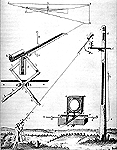 |
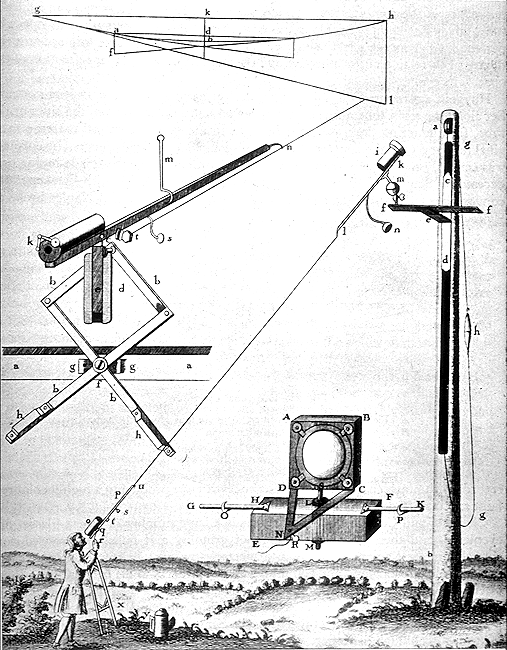
| Aerial telescope (Christiaan Huygensm Astroscopium Compendiaria,1684) [click for larger image] |
Telescopes had now again reached the point where further increases in magnification would restrict the field of view of the instrument too much. This time another optical device, the field lens came to the rescue. Adding a third convex lens--of appropriate focal length, and in the right place--increased the field significantly, thus allowing higher magnifications. The telescope race therefore continued unabated and lengths increased exponentially. By the early 1670s, Johannes Hevelius had built a 140-foot telescope. But such long telescopes were useless for observation: it was almost impossible to keep the lenses aligned and any wind would make the instrument flutter. After about 1675, therefore, astronomers did away with the telescope tube. The objective was mounted on a building or pole by means of a ball-joint and aimed by means of a string; the image was found by trial and error; and the compound eyepiece (field lens and ocular), on a little stand, was then positioned to receive the image cast by the objective. Such instruments were called "aerial telescopes." Although some discoveries were made with these very long instruments, this form of telescope had reached its limits. By the beginning of the eighteenth century very long telescopes were rarely mounted any more, and further increases of power came, beginning in the 1730s, from a new form of telescope, the reflecting telescope. Since it was known that the telescopic effect could be achieved using a variety of combinations of lenses and mirrors, a number of scientists speculated on combinations involving mirrors. Much of this speculation was fueled by the increasingly refined theoretical study of the telescope. In his Dioptrique, appended to his Discourse on Method of 1637, René Descartes addressed the problem of spherical aberration, already pointed out by others. In a thin spherical lens, not all rays from infinity--incident parallel to the optical axis--are united at one point. Those farther from the optical axis come to a focus closer to the back of the lens than those nearer the optical axis. Descartes had either learned the sine law of refraction from Willebrord Snell (Snell's Law)[6] or had discovered it independently, and this allowed him to quantify spherical aberration. In order to eliminate it, he showed, lens curvature had to be either plano-hyperboloidal or spherico-ellipsoidal. His demonstration led many to attempt to make plano-hyperboloidal objectives, an effort which was doomed to failure by the state of the art of lens-grinding. Others began considering the virtues of a concave paraboloidal mirror as primary receptor: it had been known since Antiquity that such a mirror would bring parallel incident rays to a focus at one point.
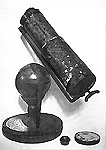 |
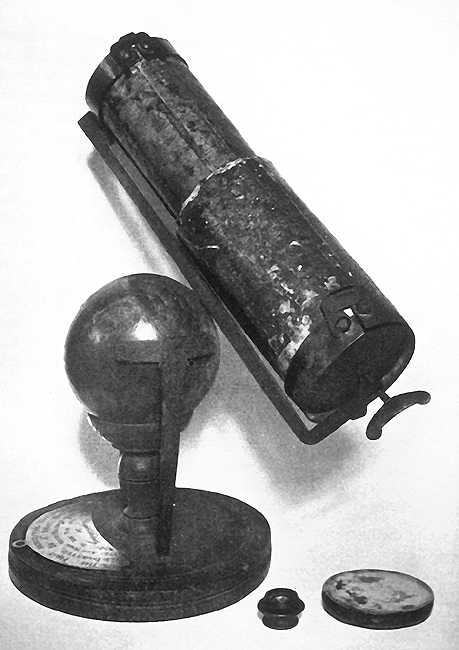
Newton's reflecting telescope (1671)
[click for larger image] |
A second theoretical development came in 1672, when Isaac Newton published his celebrated paper on light and colors. Newton showed that white light is a mixture of colored light of different refrangibility: every color had its own degree of refraction. The result was that any curved lens would decompose white light into the colors of the spectrum, each of which comes to a focus at a different point on the optical axis. This effect, which became known as chromatic aberration, resulted in a central image of, e.g., a planet, being surrounded by circles of different colors. Newton had developed his theory of light several years before publishing his paper, when he had turned his mind to the improvement of the telescope, and he had despaired of ever ridding the objective of this defect. He therefore decided to try a mirror, but unlike his predecessors he was able to put his idea into practice. He cast a two-inch mirror blank of speculum metal (basically copper with some tin) and ground it into spherical curvature. He placed it in the bottom of a tube and caught the reflected rays on a 45� secondary mirror which reflected the image into a convex ocular lens outside the tube (see fig. 12). He sent this little instrument to the Royal Society, where it caused a sensation; it was the first working reflecting telescope. But the effort ended there. Others were unable to grind mirrors of regular curvature, and to add to the problem, the mirror tarnished and had to be repolished every few months, with the attending danger of damage to the curvature.
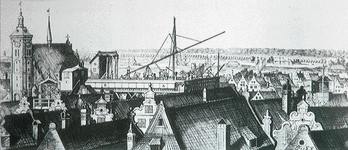 |
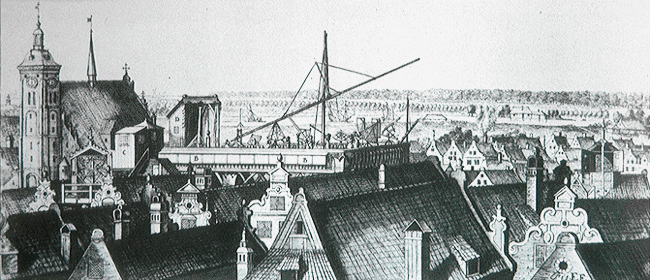
Hevelius's rooftop observatory, (Machina Coelestis, 1673)
[click for larger image] |
The reflecting telescope therefore remained a curiosity for decades. In second and third decades of the eighteenth century, however, the reflecting telescope became a reality in the hands of first James Hadley and then others. By the middle of the century, reflecting telescopes with primary mirrors up to six inches in diameter had been made. It was found that for large aperture ratios (the ratio of focal length of the primary to its aperture, as the f-ratio in modern cameras for instance), f/10 or more, the difference between spherical and paraboloidal mirrors was negligible in the performance of the telescope. In the second half of the eighteenth century, in the hands of James Short and then William Herschel, the reflecting telescope with parabolically ground mirrors came into its own. |