Popular Posts

Popular Posts

Pages

Total Pageviews

Wednesday, April 18, 2012

Inventions that changed history.Prining.

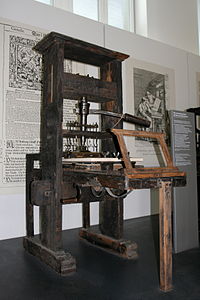
Printing press


In the 1440s, Johann Gutenberg came out with an invention called the printing press. Previously, books were copied down mainly by monks in monastaries, which made them quite rare. Gutenberg’s invention in effect brought the written word to the masses.


In many ways, this brought on a complete revolution. A lasting effect was on the scientific community. Suddenly, scientists working in different locations could popularize their findings with their peers, opening the doors to the scientific revolution. No longer would each scientist have to reinvent the wheel, but instead could build on the research of his peers and predecessors.


It also gave a greater degree of accountability to authors. Since previously each individual page was copied by hand, a text written by one author could vary from book to book. You could never be sure that you were reading the same version as someone else. It also led to greater education for the masses, since now books were more widely available.


Gutenberg may not have set out to revolutionize the way that language was used, but ended up doing just that.


      Johannes Gensfleisch zur Laden zum Gutenberg


Born c. 1398


Mainz, Electorate of Mainz


Died February 3, 1468 (aged 70)


Mainz, Electorate of Mainz


Cause of death Natural Causes


Occupation Engraver, Inventor, and Printer, Go;dsmith


Religion Catholic


Spouse Else Wirick zum GutenburgPrinting press in Munich 1811


Tuesday, April 17, 2012

Invention of the plough.

The Plow


Compared to some of the gleaming, electronic inventions that fill our lives today, the plow doesn't seem very exciting. It's a simple cutting tool used to carve a furrow into the soil, churning it up to expose nutrients and prepare it for planting. Yet the plow is probably the one invention that made all others possible.


No one knows who invented the plow, or exactly when it came to be. It probably developed independently in a number of regions, and there is evidence of its use in prehistoric eras. Prior to the plow, humans were subsistence farmers or hunter/gatherers. Their lives were devoted solely to finding enough food to survive from one season to the next. Growing food added some stability to life, but doing it by hand was labor intensive and took a long time. The plow changed all that.


Plows made the work easier and faster. Improvements in the plow's design made farming so efficient that people could harvest far more food than they needed to survive. They could trade the surplus for goods or services. And if you could get food by trading, then you could devote your day-to-day existence to something other than growing food, such as producing the goods and services that were suddenly in demand.


The ability to trade and store materials drove the invention of written language, number systems, fortifications and militaries. As populations gathered to engage in these activities, cities grew. It's not a stretch to say that the plow is responsible for the creation of human civilization.

Monday, April 16, 2012

THE PILL

The Birthday of the Pill


For most women, the birth control pill is a part of life, but this tiny pill has a large role in history.


Some believe it was more liberating to women than the right to vote.


The pill gave women control over their reproductive systems leading to new careers and the march toward gender equality. First introduced in 1960, the Pill turns 52 this year thanks to a few tenacious individuals.


The driving force was a nurse named Margaret Sanger. In 1916 she founded the first birth control clinic in the U-S and was often jailed and prosecuted.


She wasn’t deterred and in 1942 founded the Planned Parenthood Federation.


Yet forty years later, Sanger was frustrated there remained no oral contraceptive for women. At the age of 72 she met Gregory Pincus, an American biologist who believed hormones could be key to making an effective pill and agreed to help Sanger.


At the time a chemist named Carl Djerassi in Mexico City had just created an orally effective synthetic form of progesterone. Once Pincus knew, he worked to confirm that a progesterone pill was able to prevent ovulation in rabbits and rats.


But Pincus needed more money to continue his research so Margaret Sanger once again set to work. After Sanger talked to her friend, Katherine McCormick, the heir to the vast McCormick fortune then wrote a 40-thousand dollar check which enabled Pincus to develop the Pill.


In a clinical trial with fifty women, Pincus used a protocol of 21 days of pills and 7 days off to allow for menstruation which is how the Pill is still administered today.


None of the 50 women ovulated while on the drug and in 1960 the Pill was approved for the mass market. Today women take the pill for granted… which when you consider it perhaps was the goal.


Sunday, April 15, 2012

Inventions that changed history.Super glue.

Krazy Glue and/or Super Glue


The story goes that in 1942, Dr. Harry Coover was working for Eastman Kodak, a company renowned for cameras and camera-related things. His job was to find a plastic that could be used as a clear gunsight, since this was smack in the middle of WWII and everybody knew where the money was.


Coover got frustrated because the material, called cyanoacrylate, was just too damned sticky. Rather than noticing he accidentally made one of the most versatile adhesives of all time, he threw it away in a huff and continued sweating over gunsights for a war that would be ended, ironically, by two bombs with blast radiuses so big that they didn't even require sights at all.


Years later, Coover would re-discover his invention, we prefer to think due to him noticing that old container of cyanoacrylate was still stuck to the bottom of his trash can and couldn't be removed by any means.


In 1958, after finally convincing his bosses that at the very least, there was enormous comedic potential in the prospect of a man getting his hand permanently stuck to his junk; Kodak released the glue with the catchy name "Eastman 910."


Somebody then decided to actually pay the marketing guys to do something, and they decided the best way to convince people to buy this new product was to suspend a car over a public street with a crane, supposedly held up only with the ol' 910.


Reactions resulted in the product being coined "Krazy Glue"; a product so crazy that it requires intentional misspelling. The early slogan, "Remember, you can only use it once before it completely solidifies in the tube!" was quickly dropped and it remains a top-selling product to this day.


Read more: 5 Accidental Inventions That Changed The World
Cracked.com http://www.cracked.com/article_17134_5-accidental-inventions-that-changed-world.html#ixzz1s3nfSOlb

Saturday, April 14, 2012

Inventions that changed hidtory

Since time immemorial, thousands of inventions by man have gone on to transform the world. Here is a list of 50 (in alphabetical order) that may have played a bigger part than most:

Abacus- 190 AD

Use of the abacus, with its beads in a rack, was first documented in China in about 190 AD. The Chinese version was the speediest way to do sums for centuries and, in the right hands, can still outpace electronic calculators.

Fridge- 1834

Jacob Perkins was the first to describe how pipes filled with volatile chemicals whose molecules evaporated very easily could keep food cool.


Gun- 14th century

Gunpowder led to the creation of the cannon in the 13th century. The biggest step that led to the modern gun was Smith and Wesson's metal-cased cartridge, first fired in 1857.

Internal combustion engine- 1859

Credit for the first working internal combustion engine goes to the Belgian inventor Étienne Lenoir, who converted a steam engine in 1859. It spawned the billions of engines that have been built since.


Laser- 1960

Physicist Theodore Maiman built the first working laser in 1960. His device was based around a ruby crystal that emitted light "brighter than the centre of the sun".


Light bulb- 1848

Joseph Swan in fact developed a bulb before Edison, but the pair later joined forces and today share credit for creating the gadget we perhaps take for granted more than any other.

Locks- 2000 BC

Egyptians were the first to put things under lock and key about 4,000 years ago .

Microchip- 1958


US engineer Jack Kilby built the world's first monolithic integrated circuit, or microchip that changed the world of computing.

Mobile phone- 1947

The first mobile phone service was introduced by Bell Laboratories in Missouri in 1947.

Paper- 105 AD

The Chinese began using bark, bamboo fibres, hemp and flax to mill the first reams almost 2,000 years ago, but it took centuries for paper to envelop the world.


PC- 1977

Steve Jobs, whose Apple II, launched in 1977, was the first consumer PC to resemble the machines that went on to transform our lives.

Printing press- 1454

The Chinese were the world's first printers – they practised block printing as early as 500 AD – but a German goldsmith called Johannes Gutenberg was the first to construct a press.

Radio- 1895

Alexander Popov, a Russian, and the Italian-Irish inventor Guglielmo Marconi, separately sent and received the first radio waves. Marconi sent the first transatlantic radio message (three dots for the letter 'S') in 1901.

Telephone- 1876

Elisha Gray and Alexander Graham Bell raced to make the first working phone in the 1870s, Bell winning in a photo-finish.

Television- 1925

Scotsman John Logie Baird first demonstrated TV to the public in 1925.

The internet- 1969


Friday, April 13, 2012

ca. 8000 B.C. Agriculture invented in the area of the Fertile Crescent


The Beginning of Settled Agriculture


8,000 to 6,500 BC


While it is often described as the "Agricultural Revolution," the development of settled societies took several millennia after the first discovery of agriculture. Moreover, this process occurred at different times in different parts of the world based on the domestication of different plants. If one is going to speak in term of revolution, one might better speak in terms of "agricultural revolutions."


c. 10,000 BC: Beginnings of Settled Agriculture


10,000 BC: First agricultural villages


10,000 BC: Invention of the bow and arrow


10,000 BC: Dogs and reindeer are domesticated


10,000 BC: Beginnings of settled agriculture


10,000 BC: Earliest pottery (Japan)


c. 8,000 to 6,500 BC: Settled Agriculture in Mesopotamia


c. 7,000: Beginning of Settled Agricultural Revolution


c. 6,500-5,650 BC: Catal Hulyuk


c. 6,000 BC - c. 2,000 BC: Settled Agriculture in Africa


6,000 BC: Beginning of Settled Agriculture in the Nile River Valley


2,000 BC: Beginning of Settled Agriculture in the Niger River Valley


200 BC: Height of Nok culture


c. 6,000 to 3,000: Settled Agriculture in India


c. 5,000 to 3,000 BC: Settled Agriculture in China


10,000 to 4,000 BC: Painted Pottery Bowl (China)


5,0000 to 2,700 BC: Yangshao culture


3,5000 to 2,000 BC: Longsham culture


6, 000 BC: Village of Ban Po in China


c. 4,000 to 1,000 BC: Settled Agriculture in Europe


ca. 4000 BC: The Culture of Vra


ca. 2000 BC: Stonehenge


c. 3,000 BC to AD 700: Settled Agriculture in the Americas


c. 500 BC to AD 400: Adena and Hopewell Cultures


MA;ADAPTATIONS DUE TO THE AGRICULTURAL REVOLUTION.


In a Nutshell…


-The First Agricultural Revolution


*Simple farming with cultivation, subsistence and sustainable farming, and


shifting cultivation.


*Goes along with the first cities (first urban revolution)


-The Second Agricultural Revolution


*Coincided with the Industrial Revolution


*Farming became mechanized and commercial with the development of new


inventions and technology (tractor, seed drill)


*Goes along with the second stage of the demographic transition


*Goes along with the second urban revolution (massive expansion of cities and urban societies)


-The Third Agricultural Revolution


*More advanced technology is used for farming and to increase farming yields


and/or outputs from the same amount of land—efficient use of land


*Development of genetically engineered crops (GE) or genetically modified


organisms (GMOs)


Thursday, April 12, 2012

Biggest Massacres in Mankind Past !!!..which I have not heard of!

1. Nankin Massacre


The Nanking Massacre is also known as the Rape of Nanking where hundreds of thousands of civilians were brutally murdered and raped in the city of Nanking which was the former capital city of the Republic of China. The massacre went on for a period of six weeks where the soldiers of Imperial Japanese Army entered the city of Nanking and start killing people of China. The Nanking Massacre is considered to be the worst massacre in human history because more than 80 thousand men and women were killed, tortured and raped in a period of six weeks.


2. Babi Yar Massacre


The Babi Yar massacre happened in the year 1941 when more than 33 thousand Jews were killed in a single operation that was led by the military governor, Major General Friedrich Eberhardt, the Police Commander of Army Group South Friedrich Jeckeln and C Commander Otto Rasch. The operation was carried out by combined forces like SS, SD and SiPo. Babi Yar is a ravine just outside Kiev which is the capital of Ukraine. However, Nazi forces soon captured Kiev and were looking out for Jews who were hiding in Babi Yar. The Babi Yar massacre is largest single mass killing massacre in the world.

3. St. Bartholomew’s Day Massacre
Also popular known as Massacre de la Saint-Barthelemy this event took place in 1572 in Paris. The massacre began two days after the attempted assassination of Admiral Gaspard de Coligny, who was the military and political leader of Huguenots. Soon after that a group of assassinations along with Roman Catholic mob began to start killing people all over Paris and the massacre spread to other urban areas and countryside as well. It is estimated that around 30 thousand people were killed in this massacre.

Wednesday, April 11, 2012

COKE

Coca-Cola was invented by Dr. John Stith Pemberton in Atlanta, USA. The name was designed Pembertonovým bookseller Frank Robinson . Robinson was not only a good bookseller, but also had excellent handwriting. To date, logo, consisting of 2 main ingredients - cocaine and walnut extracts wheels - he just created.


It was first soft drink to the public sold for 5 cents in a pharmacy in Atlanta Willis Venable 8th května 1886th


Initially sold nine drinks a day. In the first year and sold Coca -Cola for $ 50 , which is not equaled the cost (especially advertising) , which was 70 $. The first year was a loss.


By 1905, to give as a tonic drink containing extracts of cocaine and nut wheels.


At the end of 90 the 19th century. Coca-Cola to become one of jejpopulárnějších soft drinks. When in 1888 the head of Coca-Cola Company received a pharmacist , Asa Griggs Chandler , as sales increased cacolové juice to more than 4000% (1890-1900). The main success of the sale was ad: Coca-Cola was sold throughout the United States and Canada. Around the same time, the company began selling juice filling independent companies that bought her term license. The first was in 1894 Biedenharn Candy Company in Mississippi , which was owned by Joseph A. Biedenharn . This principle applies today. In 1903, when production stopped using cocaine controversial. After Chandler verified death in 1929 the family sold the "Coca-Cola "for 25 million $ a group of businessmen led by Ernest Woodruff . He was president of the company from 1923 until 1955. The current shape of the bottle was patented in 1960, however, is essentially identical to the shape of the bottle from 1915 , designed specifically for Coca-Cola . Previous 2 types of bottles have a classic cylindrical shape.


Currently consumes more than 1 billion drinks a day that even though they are from the dravotního terms for its use raised objections.


Tuesday, April 10, 2012

The Hindu : Sport / Tennis : Serena bags 40th title

The Hindu : Sport / Tennis : Serena bags 40th title
I cannot say Serena is not talented, but I doubt whether she can match up to Martina Navratilova or Steffi Graf or Billie Jean King.
Rajan

History pf Medicine and Sorgery in India and Egypt.

THE HISTORY OF MEDICINE IN EGYPT:

When the medicine of ancient Egypt is examined, the picture becomes clearer. The first physician to emerge is Imhotep, chief minister to King Djoser in the 3rd millennium bce, who designed one of the earliest pyramids, the Step Pyramid at Ṣaqqārah, and who was later regarded as the Egyptian god of medicine and identified with the Greek god Asclepius. Surer knowledge comes from the study of Egyptian papyri, especially the Ebers and Edwin Smith papyri discovered in the 19th century. The former is a list of remedies, with appropriate spells or incantations, while the latter is a surgical treatise on the treatment of wounds and other injuries.


Contrary to what might be expected, the widespread practice of embalming the dead body did not stimulate study of human anatomy. The preservation of mummies has, however, revealed some of the diseases suffered at that time, including arthritis, tuberculosis of the bone, gout, tooth decay, bladder stones, and gallstones; there is evidence too of the parasitic disease schistosomiasis, which remains a scourge still. There seems to have been no syphilis or rickets.


The search for information on ancient medicine leads naturally from the papyri of Egypt to Hebrew literature. Though the Bible contains little on the medical practices of ancient Israel, it is a mine of information on social and personal hygiene. The Jews were indeed pioneers in matters of public health.
 
THE HISTORY OF HEALTH AND MEDICINE IN INDIA.
The period of Vedic medicine lasted until about 800 bce. The Vedas are rich in magical practices for the treatment of diseases and in charms for the expulsion of the demons traditionally supposed to cause diseases. The chief conditions mentioned are fever (takman), cough, consumption, diarrhea, dropsy, abscesses, seizures, tumours, and skin diseases (including leprosy). The herbs recommended for treatment are numerous.


The golden age of Indian medicine, from 800 bce until about 1000 ce, was marked especially by the production of the medical treatises known as the Charaka-samhita and Sushruta-samhita, attributed respectively to Charaka, a physician, and Sushruta, a surgeon. Estimates place the Charaka-samhita in its present form as dating from the 1st century ce, although there were earlier versions. The Sushruta-samhita probably originated in the last centuries bce and had become fixed in its present form by the 7th century ce. Of somewhat lesser importance are the treatises attributed to Vagbhata. All later writings on Indian medicine were based on these works.


Because Hindus were prohibited by their religion from cutting the dead body, their knowledge of anatomy was limited. The Sushruta-samhita recommends that a body be placed in a basket and sunk in a river for seven days. On its removal the parts could be easily separated without cutting. As a result of these crude methods, the emphasis in Hindu anatomy was given first to the bones and then to the muscles, ligaments, and joints. The nerves, blood vessels, and internal organs were very imperfectly known.


The Hindus believed that the body contains three elementary substances, microcosmic representatives of the three divine universal forces, which they called spirit (air), phlegm, and bile (comparable to the humours of the Greeks). Health depends on the normal balance of these three elementary substances. The seven primary constituents of the body—blood, flesh, fat, bone, marrow, chyle, and semen—are produced by the action of the elementary substances. Semen was thought to be produced from all parts of the body and not from any individual part or organ.


Both Charaka and Sushruta state the existence of a large number of diseases (Sushruta says 1,120). Rough classifications of diseases are given. In all texts, “fever,” of which numerous types are described, is regarded as important. Phthisis (wasting disease, especially pulmonary tuberculosis) was apparently prevalent, and the Hindu physicians knew the symptoms of cases likely to terminate fatally. Smallpox was common, and it is probable that smallpox inoculation was practiced.


Hindu physicians employed all five senses in diagnosis. Hearing was used to distinguish the nature of the breathing, alteration in voice, and the grinding sound produced by the rubbing together of broken ends of bones. They appear to have had a good clinical sense, and their discourses on prognosis contain acute references to symptoms that have grave import. Magical beliefs still persisted, however, until late in the classical period; thus, the prognosis could be affected by such fortuitous factors as the cleanliness of the messenger sent to fetch the physician, the nature of his conveyance, or the types of persons the physician met on his journey to the patient.


Dietetic treatment was important and preceded any medicinal treatment. Fats were much used, internally and externally. The most important methods of active treatment were referred to as the “five procedures”: the administration of emetics, purgatives, water enemas, oil enemas, and sneezing powders. Inhalations were frequently administered, as were leeching, cupping, and bleeding.


The Indian materia medica was extensive and consisted mainly of vegetable drugs, all of which were from indigenous plants. Charaka knew 500 medicinal plants, and Sushruta knew 760. But animal remedies (such as the milk of various animals, bones, gallstones) and minerals (sulfur, arsenic, lead, copper sulfate, gold) were also employed. The physicians collected and prepared their own vegetable drugs. Among those that eventually appeared in Western pharmacopoeias were cardamom and cinnamon.


As a result of the strict religious beliefs of the Hindus, hygienic measures were important in treatment. Two meals a day were decreed, with indications of the nature of the diet, the amount of water to be drunk before and after the meal, and the use of condiments. Bathing and care of the skin were carefully prescribed, as were cleansing of the teeth with twigs from named trees, anointing of the body with oil, and the use of eyewashes.


In surgery, ancient Hindu medicine reached its zenith. Operations performed by Hindu surgeons included excision of tumours, incision and draining of abscesses, punctures to release fluid in the abdomen, extraction of foreign bodies, repair of anal fistulas, splinting of fractures, amputations, cesarean sections, and stitching of wounds.


A broad array of surgical instruments were used. According to Sushruta, the surgeon should be equipped with 20 sharp and 101 blunt instruments of various descriptions. The instruments were largely of steel. Alcohol seems to have been used as a narcotic during operations, and bleeding was stopped by hot oils and tar.


In two types of operations especially, the Hindus were outstanding. Stone in the bladder (vesical calculus) was common in ancient India, and the surgeons frequently removed the stones by lateral lithotomy. They also introduced plastic surgery. Amputation of the nose was one of the prescribed punishments for adultery, and repair was carried out by cutting from the patient’s cheek or forehead a piece of tissue of the required size and shape and applying it to the stump of the nose. The results appear to have been tolerably satisfactory, and the modern operation is certainly derived indirectly from this ancient source. Hindu surgeons also operated on cataracts by couching, or displacing the lens to improve vision.