Popular Posts

Popular Posts

Pages

Total Pageviews

Wednesday, August 10, 2011

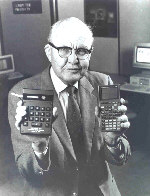
Jack Kilby, Jerry Merryman and James von Tassel... The portable calculator (1967)


Jack St.Clair.

Jerry Merryman.

James von Tassel
There are few living men whose insights and professional accomplishments have changed the world. Jack Kilby is one of these men. His invention of the monolithic integrated circuit - the microchip - some 30 years ago at Texas  Instruments (TI) laid the conceptual and technical foundation for the entire field of modern microelectronics. It was this breakthrough that made possible the sophisticated high-speed computers and large-capacity semiconductor memories of today's information age. 

Jerry D. Merryman

Jerry D. Merryman joined TI in 1963 and remained with the company for 30 years. He was one of three team members responsible for the invention of the handheld electronic calculator, and served as project manager and logic designer for the two-year project.

Monday, August 8, 2011

Stephanie Kwolek Invented kevlar (1966)..the bullet proof fabric


Kevlar - Stephanie Kwolek
By Mary Bellis
Stephanie Kwolek’s research with high performance chemical compounds for the DuPont Company led to the development of a synthetic material called Kevlar which is five times stronger than the same weight of steel. Kevlar, patented by Kwolek in 1966, does not rust nor corrode and is extremely lightweight. Many police officers owe their lives to Stephanie Kwolek, for Kevlar is the material used in bullet proof vests. Other applications of the compound include underwater cables, brake linings, space vehicles, boats, parachutes, skis, and building materials.
Stephanie Kwolek was born in New Kensington, Pennsylvania in 1923. Upon graduating in 1946 from the Carnegie Institute of Technology (now Carnegie-Mellon University) with a bachelor’s degree, Stephanie Kwolek went to work as a chemist at the DuPont Company. She would ultimately obtain 28 patents during her 40-year tenure as a research scientist. In 1995, Stephanie Kwolek was inducted into the National Inventors Hall of Fame.
How Does Body Armor Work?
When a handgun bullet strikes body armor, it is caught in a "web" of very strong fibers. These fibers absorb and disperse the impact energy that is transmitted to the vest from the bullet, causing the bullet to deform or "mushroom." Additional energy is absorbed by each successive layer of material in the vest, until such time as the bullet has been stopped.
Because the fibers work together both in the individual layer and with other layers of material in the vest, a large area of the garment becomes involved in preventing the bullet from penetrating. This also helps in dissipating the forces which can cause nonpenetrating injuries (what is commonly referred to as "blunt trauma") to internal organs. Unfortunately, at this time no material exists that would allow a vest to be constructed from a single ply of material.

Thursday, August 4, 2011

Percy LeBaron Spencer Invented the microwave oven (1946)


The Microwave Oven Cooks Food Quickly
by Microwave Radiation

PERCY SPENCER 24jan1950


Patent Name: Method of Treating Foodstuffs
Patent Number: 2,495,429
Patent Date: 24 January 1950
Inventor: Percy L. Spencer, of West Newton, Massachusetts
What It Does: Cooks food quickly by microwave radiation.
Melted Chocolate to Microwave - Technology Review, January/February 1999 1jan99
Percy L. Spencer, of West Newton, Massachusetts
Background: In 1946, Percy Spencer, a self-taught electronics wizard who never graduated grammar school, received U.S. patent 2,408,235 for the development of a high-efficiency magnetron. Magnetron tubes employ heated cathodes to generate electrons that are affected by electro-magnetic energy and reduced microwave radiation. Microwave radiation is used both in radar and in the "method of treating foodstuffs" that Spencer invented and patented four years later.
While working for the Raytheon Manufacturing Company, Spencer was running tests on one of the new magnetron tubes when he noticed the candy bar in his pocket began to melt. In playing his natural inventor instincts, he decided to play some uncooked popcorn in front of the magnetron tube. To his delight, the Colonels began popping. (This is still a favorite application of microwave technology.)
Engineers at Raytheon went to work on Spencer's discovery. The first commercial microwave oven was introduced in 1947. It was 750 pounds and 5 1/2 feet tall. Twenty years in many modifications later, the first countertop, domestic microwave oven hit the market. By 1975, microwaves were selling faster than conventional gas range ovens.
  1. Electron-discharging cathodes (14) housed within oscillators are joined by conductors (20, 21).
  2. These conductors are interned connected by another conductor (22), a center tap on a winding (17) of the transformer (18).
  3. Coaxial transmission lines (24, 25) alternately deliver hyper-frequency energy to a wave guide (23).
  4. The wave guide is directed at a piece of food on the speed-adjustable conveyor (28).

Wednesday, August 3, 2011

Douglas Engelbart Invented the computer mouse (1964)


Inventors of the Modern Computer
The History of the Computer Mouse and the Prototype for Windows - Douglas Engelbart.
By Mary Bellis
"It would be wonderful if I can inspire others, who are struggling to realize their dreams, to say 'if this country kid could do it, let me keep slogging away'." - Douglas Engelbart
Douglas Engelbart changed the way computers worked, from specialized machinery that only a trained scientist could use, to a user-friendly tool that almost anyone can use. He invented or contributed to several interactive, user-friendly devices: the computer mouse, windows, computer videoteleconferencing, hypermedia, groupware, email, the Internetand more.

Tuesday, August 2, 2011

Wilson Greatbatch Invented the first heart pacemaker (1960)


1996 Lemelson-MIT Lifetime Achievement Award Winner.
Wilson Greatbatch
Photo by Robert Lewis
 
In an attempt to record the sound of a heartbeat, Dr. Wilson Greatbatch inadvertently created something far more crucial—a device that emitted electricity pulses to the heart. It was this discovery that led to the implantable cardiac pacemaker and distinguished Greatbatch as having created one of the most significant inventions of the 20th century. In 1996, he was honored with the Lemelson-MIT Lifetime Achievement Award.
Greatbatch first learned of heart block—a condition in which a nerve fails to send electrical impulses to make the heart work—while talking with two surgeons visiting Cornell University in the early 1950s. At the time, combating heart block was done with a painful electric shock delivered via bulky external equipment. Greatbatch was convinced he could invent a smaller, implantable device.
Then, quite by accident, Greatbatch's "eureka moment" happened in 1958. Transistors had recently become available, and Greatbatch was building an oscillator with one transistor to record heartbeat sounds. He incorporated the wrong transistor, which produced a pulse that mimicked the rhythm of a heart. "I stared at the thing in disbelief, thinking this was exactly the properties of a pacemaker," said Greatbatch.
Greatbatch licensed his invention to Medtronic, Inc., and the first pacemaker was implanted in a human in 1960. He upgraded his device with a lithium iodine battery for durability in 1970, and his invention has been saving lives ever since.
Greatbatch has shown a commitment to educating children through inspirational speeches at schools and museums. He also established the Eleanor and Wilson Greatbatch Foundation to donate money to schools and other causes.
Still inventing, Greatbatch acquired three patents with scientist John Sanford in the 1980s and 1990s for methods of inhibiting the replication of AIDS and another similar virus in cats.
Greatbatch was born in 1919 in Buffalo, NY. U.S. Naval service in World War II enabled him to receive a bachelor's degree in engineering from Cornell University as a GI Bill student (1950). He received a master's in electrical engineering from the University of Buffalo (1957), succeeded by four honorary degrees. Greatbatch, who holds over 220 patents, is a member of the National Inventors Hall of Fame and the National Academy of Engineering, among others. 

Monday, August 1, 2011

Jack Kilby Made the first microchip - the start of miniaturisation of technology (1958)


It seems that the integrated circuit was destined to be invented. Two separate inventors, unaware of each other's activities, invented almost identical integrated circuits or ICs at nearly the same time.
Jack Kilby, an engineer with a background in ceramic-based silk screen circuit boards and transistor-based hearing aids, started working for Texas Instruments in 1958. A year earlier, research engineer Robert Noyce had co-founded the Fairchild Semiconductor Corporation. From 1958 to 1959, both electrical engineers were working on an answer to the same dilemma: how to make more of less.

Why the Integrated Circuit Was Needed

In designing a complex electronic machine like a computer it was always necessary to increase the number of components involved in order to make technical advances. The monolithic (formed from a single crystal) integrated circuit placed the previously separated transistors, resistors, capacitors and all the connecting wiring onto a single crystal (or 'chip') made of semiconductor material. Kilby used germanium and Noyce used silicon for the semiconductor material.

Patents for the Integrated Circuit

In 1959 both parties applied for patents. Jack Kilby and Texas Instruments received U.S. patent #3,138,743 for miniaturized electronic circuits. Robert Noyce and the Fairchild Semiconductor Corporation received U.S. patent #2,981,877 for a silicon based integrated circuit. The two companies wisely decided to cross license their technologies after several years of legal battles, creating a global market now worth about $1 trillion a year.
Commercial Release
In 1961 the first commercially available integrated circuits came from the Fairchild Semiconductor Corporation. All computers then started to be made using chips instead of the individual transistors and their accompanying parts. Texas Instruments first used the chips in Air Force computers and the Minuteman Missile in 1962. They later used the chips to produce the first electronic portable calculators. The original IC had only one transistor, three resistors and one capacitor and was the size of an adult's pinkie finger. Today an IC smaller than a penny can hold 125 million transistors.
Jack Kilby holds patents on over sixty inventions and is also well known as the inventor of the portable calculator (1967). In 1970 he was awarded the National Medal of Science.Robert Noyce, with sixteen patents to his name, founded Intel, the company responsible for the invention of the microprocessor, in 1968. But for both men the invention of the integrated circuit stands historically as one of the most important innovations of mankind. Almost all modern products use chip technology.

Sunday, July 31, 2011

Jonas Salk Made the vaccine for polio (1955)..Humility Personified


Jonas Salk - Medical Pioneer
 
Even the disease's name scares everyone today: Cancer. But in the 1950's the scary disease was Polio. It paralyzed or killed children. People kept hoping someone would find a way to stop it. Dr. Salk worked every day for years to discover a vaccine to prevent polio, and he succeeded. But instead of bragging and taking lots of money for his work, he displayed HUMILITY and kept working as a doctor to find cures for other diseases, including cancer and AIDS.
Quotes:
    "If humankind would accept and acknowledge this responsibility and become creatively engaged in the process of evolution, consciously as well as unconsciously, a new reality would emerge, and a new age could be born."
    "Hope lies in dreams, in imagination, and in the courage of those who dare to make dreams into reality. "
    "Intuition will tell the thinking mind where to look next. "
    "The reward for work well done is the opportunity to do more. "
Jonas Salk picture
Oct 28, 1914 - Jun 23, 1995
virtue: humility Virtue: Humility
What could you say to someone who praises you for doing a good job?


Saturday, July 30, 2011

Sir Christopher Cockerell Invented the hovercraft

Hovercraft

By Mary Bellis
A hovercraft is a vehicle supported on a cushion of air supplied by a powered fan mounted on the craft.
Hovercraft SK-5The hovercraft was invented by Christopher Cockerell in 1956. The theory behind one of the most successful inventions of the 20th century, the Hovercraft, was originally tested in 1955 using an empty KiteKat cat food tin inside a coffee tin, an industrial air blower and a pair of kitchen scales. Sir Christopher Cockerell developed the first practical hovercraft designs, these led to the first hovercraft to be produced commercially, the SRN1.
Christopher Cockerell's idea was to build a vehicle that would move over the water's surface, floating on a layer of air. This would reduce friction between the water and vehicle. To test his hypothesis, he put one a smaller can inside a larger can and used a hairdryer to blow air into them. The downward thrust produced was greater when one can was inside the other rather than air just being blown into one can.

Friday, July 29, 2011

Djerassi...Discovered the contaceptive pill.


View Image

Djerassi was born in the Austrian capital of Vienna, the son of a Bulgarian physician and an Austrian mother. As both parents were Jewish, Djerassi emigrated to America in 1939. He was educated at Kenyon College, Ohio, and at the University of Wisconsin, where he completed his PhD in 1945, the same year in which he became an American citizen. From 1945 to 1949 he worked for the pharmaceutical company CIBA in Summit, New Jersey, as a research chemist. In 1949 Djerassi decided to join a new pharmaceutical company, Syntex, in Mexico City, to work on the extraction of cortisone from plants. At that time it was being produced from cattle bile at a cost of 200 dollars a gram.

Despite competition from other leading laboratories, Syntex were the first to extract cortisone (C21H28O5) from a vegetable source, namely diosgenin (C27H42O3), a steroid derived from a variety of wild Mexican yam.

Following their initial success Djerassi and his team turned their attention to the steroid hormone progesterone. Known as ‘nature's contraceptive’, the hormone inhibits ovulation. Why, then, could it not be taken as a simple, natural contraceptive? The difficulty was that taken orally it lost most of its activity. Further, as hormones were extracted from such animal sources as human urine, bull's testicles, and sow's ovaries where they occur in small amounts, they tended to be very expensive. The first step was to produce progesterone synthetically. This was achieved at Syntex by Djerassi and others in the early 1950s, the price of progesterone dropped dramatically and it became available in large quantities.

Chemists were inhibited by the belief that steroid hormones were structure-specific; change the structure, the claim went, and the potency is lost. Djerassi was aware, however, that Max Ehrenstein had destroyed this myth a decade earlier and that it was at least conceivable that progesterone could be changed into an oral form without necessarily changing its potency.

Progesterone (C21H30O2) contains four rings of carbon atoms. Following some hints in the literature Djerassi thought that the removal of the methyl group at position 19, thus forming 19-norprogesterone, would increase its potency. His hunch proved to be sound. He was also aware that an acetylene bond introduced into position 17 of the male hormone testosterone increased its oral activity, although known as ‘ethisterone’, it had found no use.

Djerassi's crucial step was to propose that ethisterone's potency could be enhanced, as with progesterone, by removing a methyl group. By October 1951 he had produced testosterone minus a methyl group, but with an added acetylene group. The precise result was 19-nor-17a-ethinyltestosterone, which proved to be a highly active oral progestational hormone. A patent was filed in November 1951. After the appropriate testing it received Federal approval in 1962 under the name Ortho-Novum. Djerassi received one dollar for the patent, a standard payment by a pharmaceutical company to its staff.

In 1951 Djerassi left Syntex for Wayne State University, Detroit, where he remained until 1959 when he was appointed professor of chemistry at Stanford. He continued to work for Syntex, as vice-president in charge of research (1957–69) and as president of research from (1969–72).

He has also served since 1968 with Zoecon, a company partly owned by Syntex and specializing in pest control by using natural juvenile hormones that prevent insects maturing and breeding. In 1977 Zoecon was taken over by Occidental Petroleum and was then sold in 1982 to Sandoz, a Swiss pharmaceutical company. Djerassi has remained as chairman of the board.

Djerassi's business interests have had little impact on his productivity, with over 600 papers to his credit. He has also published a novel (Cantor's Dilemma), a collection of verse, and his autobiography, The Pill, Pigmy Chimps, and Degas' Horse (1992).




Thursday, July 28, 2011

George deMestral/ Invented velcro (1948)


The Invention of VELCRO ® - George de Mestral

velcro
Microscopic view of VELCRO
One lovely summer day in 1948, a Swiss amateur-mountaineer and inventor decided to take his dog for a nature hike. The man and his faithful companion both returned home covered with burrs, the plant seed-sacs that cling to animal fur in order to travel to fertile new planting grounds. The man neglected his matted dog, and with a burning curiosity ran to his microscope and inspected one of the many burrs stuck to his pants. He saw all the small hooks that enabled the seed-bearing burr to cling so viciously to the tiny loops in the fabric of his pants. George de Mestral raised his head from the microscope and smiled thinking, "I will design a unique, two-sided fastener, one side with stiff hooks like the burrs and the other side with soft loops like the fabric of my pants. I will call my invention 'velcro' a combination of the word velour and crochet. It will rival thezipper in its ability to fasten."
Mestral's idea met with resistance and even laughter, but the inventor 'stuck' by his invention. Together with a weaver from a textile plant in France, Mestal perfected his hook and loop fastener. By trial and error, he realized that nylon when sewn under infrared light, formed tough hooks for the burr side of the fastener. This finished the design, patented in 1955. The inventor formed Velcro Industries to manufacture his invention. Mestral was selling over sixty million yards of Velcro per year. Today it is a multi-million dollar industry.
Not bad for an invention based on Mother Nature.