


Symbols of 14 religons.
Popular Posts
-
HIPPOCRATES Father of Medicine in the Western World. As we saw from the postings on Sushruta and Charakan, medicne and surgery was quite ...
-
DEAR ALL, SWAMI VIVEKANANDA JAYANTHI, JANUARY 12 2011 Swami Vivekananda was born in Calcutta (Now Kolkata) Monday in a traditional family...
-
Sangam Age in Tamil Kingdoms The history of the Tamil country becomes clear only from the Sangam period. The word Sangam means an assoc...
-
Ernest Rutherford Discovers the Structure of an Atom. 1911 Ernest Rutherford in academic garb. Courtesy Edgar Fahs Smith Mem...
-
The Rani of Jhansi Regiment was the Women's Regiment of the Indian National Army, the armed force formed by Indian nationalists in 1942 ...
-
 Serendip...WHAT? T he Kingdom of Serendip Once upon a time there was an oriental and exotic Kingdom called Serendip, the memory of whic...
 -
Arikamedu Pondicherry This is a historic site which has revealed ancient Roman artifacts that are evidence of the thriving trade that exist...
-
History of Medicine The historic contribution of Sushruta ,(600-500BC) circa the ancient surgeon of India, is well recognised for his i...
-
 FATHERS OF SURGERY AND MEDICINE 4200 BC -- CAPT AJIT VADAKAYIL FATHER OF SURGERY -- ACHARYA SUSHRUTA FATHER OF MEDICINE -- ACHARYA CHA...
 -
 Brihdeshwar Temple has been declared as world heritage site in 1987 AD. The temple is located in the rice bowl district of Tamil Nadu, Than...
Popular Posts
-
HIPPOCRATES Father of Medicine in the Western World. As we saw from the postings on Sushruta and Charakan, medicne and surgery was quite ...
-
DEAR ALL, SWAMI VIVEKANANDA JAYANTHI, JANUARY 12 2011 Swami Vivekananda was born in Calcutta (Now Kolkata) Monday in a traditional family...
-
Sangam Age in Tamil Kingdoms The history of the Tamil country becomes clear only from the Sangam period. The word Sangam means an assoc...
-
Ernest Rutherford Discovers the Structure of an Atom. 1911 Ernest Rutherford in academic garb. Courtesy Edgar Fahs Smith Mem...
-
The Rani of Jhansi Regiment was the Women's Regiment of the Indian National Army, the armed force formed by Indian nationalists in 1942 ...
-
Serendip...WHAT? T he Kingdom of Serendip Once upon a time there was an oriental and exotic Kingdom called Serendip, the memory of whic...
-
Arikamedu Pondicherry This is a historic site which has revealed ancient Roman artifacts that are evidence of the thriving trade that exist...
-
History of Medicine The historic contribution of Sushruta ,(600-500BC) circa the ancient surgeon of India, is well recognised for his i...
-
FATHERS OF SURGERY AND MEDICINE 4200 BC -- CAPT AJIT VADAKAYIL FATHER OF SURGERY -- ACHARYA SUSHRUTA FATHER OF MEDICINE -- ACHARYA CHA...
-
Brihdeshwar Temple has been declared as world heritage site in 1987 AD. The temple is located in the rice bowl district of Tamil Nadu, Than...
Tuesday, May 3, 2011


Left or Right side of the Road?
The terms right-hand traffic and left-hand traffic refer to regulations requiring all bidirectional traffic to keep either to the right or the left side of the road, respectively. This is so fundamental to traffic flow that it is sometimes referred to as the rule of the road. This basic rule eases traffic flow and reduces the risk of head-on collisions. Though originally most traffic drove on the left worldwide, today about 66.1% of the world's people live in right-hand traffic countries and 33.9% in left-hand traffic countries. About 72% of the world's total road distance carries traffic on the right, and 28% on the left.

Blue ...Left sided drive. Red...Right sided.
Left-hand traffic
A sign on Australia's Great Ocean Road reminding foreign motorists to keep left.All traffic is generally required to keep left unless overtaking.
Oncoming traffic is seen coming from the right.
Right-turning traffic must cross oncoming traffic.
Most traffic signs facing motorists are on the left side of the road.
Traffic on roundabouts (traffic circles or rotaries) goes clockwise.
Pedestrians crossing a two-way road look first for traffic from their right.
The lane designated for normal driving and turning left is on the left
Most dual carriageway (divided highway) exits are on the left
Other vehicles are overtaken (passed) on the right, though in some circumstances overtaking on the left is permitted.
Most vehicles have the driving seat on the right.
A left turn at a red light may be allowed after stopping.
On roads without a footpath pedestrians may be advised to walk on the right.
Right-hand traffic
All traffic is generally required to keep right unless overtaking.
Oncoming traffic is seen coming from the left.
Left-turning traffic must cross oncoming traffic.
Most traffic signs facing motorists are on the right side of the road.
Traffic on roundabouts (traffic circles or rotaries) goes anticlockwise.
Pedestrians crossing a two-way road look first for traffic from their left.
The lane designated for normal driving and turning right is on the right.
Most dual carriageway (divided highway) exits are on the right
Other vehicles are generally overtaken (passed) on the left, though in some circumstances overtaking on the right is permitted.
Most vehicles have the driving seat on the left.
A right turn at a red light may be allowed after stopping.
On roads without a footpath pedestrians may be advised to walk on the left.
History. In 1998, archaeologists found a well-preserved track leading to a Roman quarry near Swindon, England. The grooves in the road on the left side (viewed facing down the track away from the quarry) were much deeper than those on the right side. These grooves suggest that the Romans drove on the left, at least in this particular location, since carts would exit the quarry heavily loaded, and enter it empty.
Some historians, such as C. Northcote Parkinson, believed that ancient travellers on horseback generally rode on the left side of the road. As more people are right-handed, a horseman would thus be able to hold the reins with his left hand and keep his right hand free—to offer in friendship to passing riders or to defend himself with a sword, if necessary.
In the late 18th century, the shift from left to right that took place in countries such as the United States was based on teamsters' use of large freight wagons pulled by several pairs of horses. The wagons had no driver's seat, so a postilion sat on the left rear horse and held his whip in his right hand. Seated on the left, the driver preferred that other wagons pass him on the left so that he could be sure to keep clear of the wheels of oncoming wagons. He did that by driving on the right side of the road.
Monday, May 2, 2011
Sunday, May 1, 2011
Swiss Banks and their secrecy.
Bank secrecy (or bank privacy) is a legal principle in some jurisdictions under which banks are not allowed to provide to authorities personal and account information about their customers unless certain conditions apply (for example, a criminal complaint has been filed[1]). In some cases, additional privacy is provided to beneficial owners through the use of numbered bank accounts or otherwise. Bank secrecy is prevalent in certain countries, such as Switzerland, Singapore, Lebanon and Luxembourg, as well as offshore banks and other tax havens under voluntary or statutory privacy provisions.
Created by the Swiss Banking Act of 1934, which led to the famous Swiss bank, the principle of bank secrecy is always considered one of the main aspects of private banking. It has also been accused by NGOs and governments of being one of the main instruments of underground economy and organized crime, in particular following the class action suit against the Vatican Bank in the 1990s, the Clearstream scandal and the terrorist attacks of September 11, 2001. Former bank employees from banks in Switzerland (UBS, Julius Baer) and Liechtenstein (LGT Group) have testified that their former institutions helped clients evade billions of dollars in taxes by routing money through offshore havens in the Caribbean and Switzerland. One of these, Rudolf M. Elmer, wrote, "It is a global problem...Offshore tax evasion is the biggest theft among societies and neighbor states in this world"The Swiss Parliament ratified on June 17, 2010 an agreement between the Swiss and the United States governments allowing UBS to transmit to the US authorities information concerning 4,450 American clients of UBS suspected of tax evasion.
Saturday, April 30, 2011
PAPER
Paper is a thin material mainly used for writing upon, printing upon, drawing or for packaging. It is produced by pressing together moist fibers, typically cellulose pulp derived from wood, rags or grasses, and drying them into flexible sheets.
Paper is a versatile material with many uses. Whilst the most common is for writing and printing upon, it is also widely used as a packaging material, in many cleaning products, in a number of industrial and construction processes, and even as a food ingredient – particularly in Asian cultures.
Paper spread from China through the Islamic world to medieval Europe in the 13th century, where the first water-powered paper mills were built.[3] In the 19th century, industrial manufacture greatly lowered its cost, enabling mass exchange of information and contributing to significant cultural shifts. In 1844, Canadian inventor Charles Fenerty and German F.G. Keller independently developed processes for pulping wood fibers.[4] This ended the nearly 2000-year exclusive use of pulped rags.

Microscopiv picture of paper under fluoroscent light.
USES OF PAPER:
For representing value: paper money, bank note, cheque, security (see Security paper), voucher and ticket
For storing information: book, notebook, magazine, newspaper, art, zine, letter
For personal use: diary, note to remind oneself, etc.; for temporary personal use: scratch paper
For communication: between individuals and/or groups of people.
For packaging: corrugated box, paper bag, envelope, wrapping tissue, Charta emporetica and wallpaper
For cleaning: toilet paper, handkerchiefs, paper towels, facial tissue and cat litter
For construction: papier-mâché, origami, paper planes, quilling, Paper honeycomb, used as a core material in composite materials, paper engineering, construction paper and paper clothing
For other uses: emery paper, sandpaper, blotting paper, litmus paper, universal indicator paper, paper chromatography, electrical insulation paper (see also dielectrics and permittivity) and filter paper
Friday, April 29, 2011
Revolvers
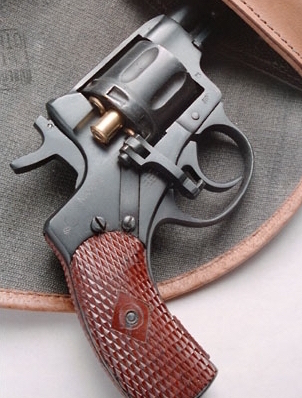
A revolver is a repeating firearm that has a cylinder containing multiple chambers and at least one barrel for firing, with the modern revolver being invented by Samuel Colt. As the user cocks the hammer, the cylinder revolves to align the next chamber and round with the hammer and barrel, which gives this type of firearm its name. The hammer-cocking happens either directly (via the shooter pulling it back) or indirectly (via the first portion of the trigger pull in double-action revolvers.) In modern revolvers, the revolving cylinder typically chambers five or six rounds, but some models hold 10 rounds or more. Revolvers are most often handguns, but other weapons may also have the design of a revolver. These include some models of grenade launchers, shotguns, and some rifles.

Details of a Schmidt M1882, showing the hammer, chambers for the ammunition in the cylinder, and the mechanism to rotate the cylinder. Revolver of the Gendarmerie of Vaud, on display at Morges castle museum.
Thursday, April 28, 2011
Perfumes
Perfume (English: /ˈpɝː.fjuːm/, French parfum pronounced: [paʁ.fœ̃]) is a mixture of fragrant essential oils and aroma compounds, fixatives, and solvents used to give the human body, animals, objects, and living spaces a pleasant scent.[1] The odoriferous compounds that make up a perfume can be manufactured synthetically or extracted from plant or animal sources.
Perfumes have been known to exist in some of the earliest human civilizations either through ancient texts or from archaeological digs. Modern perfumery began in the late 19th century with the commercial synthesis of aroma compounds such as vanillin or coumarin, which allowed for the composition of perfumes with smells previously unattainable solely from natural aromatics alone.
Basic framework Perfume oils usually contain tens to hundreds of ingredients and these are typically organized in a perfume for the specific role they will play. These ingredients can be roughly grouped into four groups:
Primary scents: Can consist of one or a few main ingredients for a certain concept, such as "rose". Alternatively, multiple ingredients can be used together to create an "abstract" primary scent that does not bear a resemblance to a natural ingredient. For instance, jasmine and rose scents are commonly blends for abstract floral fragrances. Cola flavourant is a good example of an abstract primary scent.
Modifiers: These ingredients alter the primary scent to give the perfume a certain desired character: for instance, fruit esters may be included in a floral primary to create a fruity floral; calone and citrus scents can be added to create a "fresher" floral. The cherry scent in cherry cola can be considered a modifier.
Blenders: A large group of ingredients that smooth out the transitions of a perfume between different "layers" or bases. These themselves can be used as a major component of the primary scent. Common blending ingredients include linalool and hydroxycitronellal.
Fixatives: Used to support the primary scent by bolstering it. Many resins, wood scents, and amber bases are used as fixatives.
The top, middle, and base notes of a fragrance may have separate primary scents and supporting ingredients. The perfume's fragrance oils are then blended with ethyl alcohol and water, aged in tanks for several weeks and filtered through processing equipment to, respectively allow the perfume ingredients in the mixture to stabilize and to remove any sediment and particles before the solution can be filled into the perfume bottles
Perfumes have been known to exist in some of the earliest human civilizations either through ancient texts or from archaeological digs. Modern perfumery began in the late 19th century with the commercial synthesis of aroma compounds such as vanillin or coumarin, which allowed for the composition of perfumes with smells previously unattainable solely from natural aromatics alone.
Basic framework Perfume oils usually contain tens to hundreds of ingredients and these are typically organized in a perfume for the specific role they will play. These ingredients can be roughly grouped into four groups:
Primary scents: Can consist of one or a few main ingredients for a certain concept, such as "rose". Alternatively, multiple ingredients can be used together to create an "abstract" primary scent that does not bear a resemblance to a natural ingredient. For instance, jasmine and rose scents are commonly blends for abstract floral fragrances. Cola flavourant is a good example of an abstract primary scent.
Modifiers: These ingredients alter the primary scent to give the perfume a certain desired character: for instance, fruit esters may be included in a floral primary to create a fruity floral; calone and citrus scents can be added to create a "fresher" floral. The cherry scent in cherry cola can be considered a modifier.
Blenders: A large group of ingredients that smooth out the transitions of a perfume between different "layers" or bases. These themselves can be used as a major component of the primary scent. Common blending ingredients include linalool and hydroxycitronellal.
Fixatives: Used to support the primary scent by bolstering it. Many resins, wood scents, and amber bases are used as fixatives.
The top, middle, and base notes of a fragrance may have separate primary scents and supporting ingredients. The perfume's fragrance oils are then blended with ethyl alcohol and water, aged in tanks for several weeks and filtered through processing equipment to, respectively allow the perfume ingredients in the mixture to stabilize and to remove any sediment and particles before the solution can be filled into the perfume bottles
Wednesday, April 27, 2011
April 25; World Malaria Day
World Malaria Day - which was instituted by the World Health Assembly at its 60th session in May 2007 - is a day that recognises the global effort to provide effective control of malaria. The day is commemorated every year on April 25 to create awareness about an ancient disease and the devastating impact it has on the lives of more than 3 billion people.
Malaria is a parasitic disease characterised by high fever, chills and rigors accompanied by headache, nausea and vomiting, muscle pain and anaemia. The disease is a major health problem in India as in most of the tropics and subtropics.
Avoid mosquito bites by wearing protective clothing over the arms and legs, using mosquito nets and screens, and insect repellents (cream, lotion, spray or vaporizer).
Anti-malarial drugs can be prescribed for visitors to areas where malaria is prevalent. Treatment should begin two weeks before entering the area, and continued for 4 weeks after leaving the area.
Sleep in rooms that are properly screened with gauze over the windows and doors. There should be no holes in the gauze and no unscreened entry points to the room. Air-conditioned rooms are good, too.
Wear light colours while going out afternoon as light colours are less attractive to mosquitoes.
Use bednets when sleeping in areas infested with mosquitoes.
Use insecticides and flying insect sprays to reduce the number of mosquitoes in areas where you will be spending a significant amount of time.
When possible, avoid camping or spending prolonged amounts of time in areas where standing water is present.
Keep pots and pans emptied of water. Open vessels for drinking water should be covered. Mosquitoes use areas of standing water to lay their eggs.
If you know you will be traveling in areas where malaria is prevalent, ask your doctor for antimalarial drugs.
Pregnant women should avoid travelling to malarious regions as it increases the risk of abortion, premature birth, still-birth and maternal death.
Ronald RossThe Nobel Prize in Physiology or Medicine 1902 was awarded to Ronald Ross "for his work on malaria, by which he has shown how it enters the organism and thereby has laid the foundation for successful research on this disease and methods of combating it".
Ronald RossThe Nobel Prize in Physiology or Medicine 1902 was awarded to Ronald Ross "for his work on malaria, by which he has shown how it enters the organism and thereby has laid the foundation for successful research on this disease and methods of combating it".

Tuesday, April 26, 2011
Safety razors Main article: Safety razor
Safety razorsMain article: Safety razor.
A modern double-edged safety razorThe first safety razor protected the skin from all but the very edge of the blade and was invented in the late 19th century by a Frenchman, Jean-Jacques Perret, who was inspired by the joiner's plane. In 1875 it was marketed by the Kampfe Brothers as "the best available shaving method on the market that won’t cut a user, like straight steel razors."
In 1901, the American inventor King Camp Gillette, with the assistance of William Nickerson, invented a safety razor with disposable blades. Gillette realized that a profit could be made by selling an inexpensive razor with disposable blades. This has been called the Razor and blades business model, or a "loss leader", and has become a very common practice for a wide variety of products.
There are also safety razors that are made of inexpensive materials that are meant to be wholly disposable. One such device was patented in the late 1950s by American entertainer and inventor Paul Winchell.
Electric razors
Rotary razor: The electric razor (also known as the electric dry shaver) has a rotating or oscillating blade. The electric razor usually does not require the use of shaving cream, soap, or water. The razor may be powered by a small DC motor, which is either powered by batteries or mains electricity. Many modern ones are powered using rechargeable batteries. Alternatively, an electro-mechanical oscillator driven by an AC-energized solenoid may be used. Some very early mechanical shavers had no electric motor and had to be powered by hand, for example by pulling a cord to drive a flywheel.
The first electric razor was patented in 1928 by the American manufacturer Col. Jacob Schick. The Remington Rand Corporation developed the electric razor further, first producing the Remington brand of razor in 1937. Another important inventor was Prof. Alexandre Horowitz, from Philips Laboratories in the Netherlands, who invented the very successful concept of the revolving (rotary) electric razor. It has a shaving head consisting of cutters that cut off the hair entering the head of the razor at skin level. The major manufacturers introduce new improvements to the hair cutting mechanism of their products each few years. Each manufacturer sells several different generations of cutting mechanism at the same time, and for each generation, several models with different features and accessories to reach various price points. The improvements to the cutting mechanisms tend to 'trickle-down' to lower priced models over time.
Early versions of electric razors were meant to be used on dry skin only. Many recent electric razors have been designed to allow for wet/dry use, which also allows them to be cleaned using running water or an included cleaning machine, reducing cleaning effort. Some patience is necessary when starting to use a razor of this type, as the skin usually takes some time to adjust to the way that the electric razor lifts and cuts the hairs. Moisturizers designed specifically for electric shaving are available.
Radio active Carbon 14 dating of objects
Radiocarbon dating (sometimes simply known as carbon dating) is a radiometric dating method that uses the naturally occurring radioisotope carbon-14 (14C) to estimate the age of carbonaceous materials up to about 58,000 to 62,000 years. Raw, i.e. uncalibrated, radiocarbon ages are usually reported in radiocarbon years "Before Present" (BP), "Present" being defined as 1950. Such raw ages can be calibrated to give calendar dates. One of the most frequent uses of radiocarbon dating is to estimate the age of organic remains from archaeological sites. When plants fix atmospheric carbon dioxide (CO2) into organic material during photosynthesis they incorporate a quantity of 14C that approximately matches the level of this isotope in the atmosphere (a small difference occurs because of isotope fractionation, but this is corrected after laboratory analysis). After plants die or they are consumed by other organisms (for example, by humans or other animals) the 14C fraction of this organic material declines at a fixed exponential rate due to the radioactive decay of 14C. Comparing the remaining 14C fraction of a sample to that expected from atmospheric 14C allows the age of the sample to be estimated.
The technique of radiocarbon dating was developed by Willard Libby and his colleagues at the University of Chicago in 1949. Emilio Segrè asserted in his autobiography that Enrico Fermi suggested the concept to Libby in a seminar at Chicago that year. Libby estimated that the steady state radioactivity concentration of exchangeable carbon-14 would be about 14 disintegrations per minute (dpm) per gram. In 1960, he was awarded the Nobel Prize in chemistry for this work. He first demonstrated the accuracy of radiocarbon dating by accurately estimating the age of wood from an ancient Egyptian royal barge for which the age was known from historical documents.
Subscribe to:
Posts (Atom)