Popular Posts

Popular Posts

Pages

Total Pageviews

Sunday, April 17, 2011

The Theory of Evolution...Simplified and with diagrams and photos

I have called this principle, by which each slight variation, if useful, is preserved, by the term Natural Selection. (Charles Darwin)
Ignorance more frequently begets confidence than does knowledge: it is those who know little, not those who know much, who so positively assert that this or that problem will never be solved by science. (Charles Darwin, Introduction to The Descent of Man, 1871).
Brief Summary
Darwin's theory of evolution is based on five key observations and inferences drawn from them. These observations and inferences have been summarized by the great biologist Ernst Mayr as follows:

1) Species have great fertility. They make more offspring than can grow to adulthood.

2) Populations remain roughly the same size, with modest fluctuations.

3) Food resources are limited, but are relatively constant most of the time.

From these three observations it may be inferred that in such an environment there will be a struggle for survival among individuals.

4) In sexually reproducing species, generally no two individuals are identical. Variation is rampant.

5) Much of this variation is heritable.

From this it may be inferred: In a world of stable populations where each individual must struggle to survive, those with the "best" characteristics will be more likely to survive, and those desirable traits will be passed to their offspring. These advantageous characteristics are inherited by following generations, becoming dominant among the population through time. This is natural selection. It may be further inferred that natural selection, if carried far enough, makes changes in a population, eventually leading to new species. These observations have been amply demonstrated in biology, and even fossils demonstrate the veracity of these observations.

To summarise Darwin's Theory of Evolution;

1. Variation: There is Variation in Every Population.

2. Competition: Organisms Compete for limited resources.

3. Offspring: Organisms produce more Offspring than can survive.

4. Genetics: Organisms pass Genetic traits on to their offspring.

5. Natural Selection: Those organisms with the Most Beneficial Traits

are more likely to Survive and Reproduce.


Darwin imagined it might be possible that all life is descended from an original species from ancient times. DNA evidence supports this idea.

Probably all organic beings which have ever lived on this earth have descended from some one primordial life form. There is grandeur in this view of life that, whilst this planet has gone cycling on according to the fixed law of gravity, from so simple a beginning endless forms most beautiful and most wonderful have been, and are being evolved. (Charles Darwin, The Origin of Species)
Charles Darwin

Saturday, April 16, 2011

Darwin's Theory of Evolution


File:Charles Darwin aged 51 crop.jpgCharles Darwin
IN THE BEGINNING Evolution For Children And Beginners

[Keep in mind, this is the simplified version of evolution and big bang to introduce the concept. Links below will help you expand upon the subject.]
"Evolution" is what has always been and continues today. The way a certain creature develops offspring which is slightly different from the parents in order to assure survival is evolution.

Evolution simply means to develop from one way to a slightly different version of the original.
Evolution helped us get to be who we are today.

The universe is a big, endless area. Outside of the earth, there is no exact time or no direction. Time and direction is an idea made by people.

The universe is always changing. Many atoms, molecules and gases have always been. Some of these elements floating around are very big and others very small. These elements always are changing.

The beginning is like a kernel of popcorn. The popcorn is hard and small. When it gets really hot it explodes into a big, white, fluffy treat which no longer looks like the kernel.

One element knocks into another element very quickly and starts to change both elements. Sometimes they come together as one. Other times they break up into other new elements. Other elements expand upon itself and just grows.

One theory called "big bang" states that in the big vacuum of this universe, one element no bigger than a speck of dust became superheated and caused an explosion which caused it to expand. When they did, the pieces began to change and grow and continues to spread out.

These elements eventually created this section of our universe, our galaxy. Outside of our universe may be other universes made up of many galaxies. The galaxy in which we live is called the "Milky Way".

A galaxy is a bunch of stars, dust and gases as well as huge rocks, metals and other solid materials held together by a force of gravity. The center force of gravity in our galaxy is the sun.

The sun is a big star filled with dust and gases and is a mass of many elements which is on fire. All the planets are spinning around the sun because of this force of gravity.

THE EARTH'S BEGINNINGS.

When our galaxy was formed, many planets started to get sucked by the gravity force of the sun. The gravity of the sun helps each planet rotate around it. Many of the planets are spinning while they spin around the sun.

Each planet has its own gravity force. The Earth has its own gravity pressure which is different from other planets. It is because of gravity that keeps all life inside of our planet.

A heavy gravity force would make it hard to move. A light gravity force would make it hard to move as well. A steady force of gravity will keep things in place long enough to grow and develop.

Our planet, Earth spins while it spins around the sun. This lets one side of the Earth see light coming from the sun. The other side of the Earth is not facing the sun and sees darkness. This makes day and night on our planet. Each planet has in it a set of gases that it makes and is different for each planet. Some gases are just right to create living elements as we know them.

If a planet is close to the sun, everything on that planet will be really hot. If a planet is too far from the sun, everything on that planet will be really cold. The Earth is not too near or far from the sun and has gases that are able to support life forms we know. It is the reason why there is so much life on Earth. But how did life start?

In the beginning on Earth was filled with liquid, vapor and solid gases as well as mineral elements. The atmosphere around the Earth developed from the vapor gases. The liquid gases formed the water. The solid gases and minerals became parts of the land.

Vapor gases are light. Solid and liquid gases are heavy. These forms are always changing. Water can be all elements - solid, liquid and gas. Water is a vapor in the sky. When the vapor molecules get heavy, they become liquid and fall down from the sky. This makes rain. If the water gets too cold, it freezes and turns into ice or snow.

Water goes in a cycle from the clouds as rain. It falls on the ground as ponds, rivers, lakes, oceans and streams. There is so much water on the surface of the Earth that does not evaporate quickly. The water that evaporates turns to a vapor which goes back towards the sky. The water left over helps support life near the ground.

It is from this ground water where life began many millions of years ago. Water consists of elements of hydrogen and oxygen molecules. Every living thing has water inside. This is because originally all living things were first developed in the water.

When you leave water in a pool without bleach, what happens? For a few days it's nice and clear. Then after awhile green slime starts to grow on top and clings to the sides of the pool. If you did nothing to that pool, by the end of the summer it would look like a green swamp.

Water has tiny one cell organisms living in it. These beings are simple and barely visible. They have a unique life cycle. While they don't die, they were always making copies of themselves. Pretty soon, there were a lot of these single celled things living in the water.

All living things need to feed themselves in order to survive. These cells would have killed themselves if they did not change. There were too many cells in the water and if these cells did not change, they would all starve.

Some one cell creatures became two celled creatures. Some developed more cells. The creatures with more cells fed on the ones with less cells. The ones with less cells then had plenty eat, except now they were also food for the other creatures.

Over a few million years, the battle of these cells grew larger and large as they could have been seen without a microscope. Many of these cells became the model for many of the water animals we see today. Other of these cells changed in order to eat the food that was forming on the solid land. Some of these cells came out of the water and developed wings for many different reasons. These changes were not overnight, but took billions of years for single cells to become the earliest versions of bigger living creatures we know today.

It is because of those changes we have flying creatures, swimming creatures and land creatures.

THE THEORY OF EVOLUTION.

What is evolution? Evolution has happened, evolution is happening and evolution will continue to happen!All life forms have come from other life forms. All living things are related to each other. All life on Earth has a common origin.

One life form can mutate or change into another version of the same life form. Some changes are to survive which is called natural selection. Others are due to the enviornment. These changes help life to continue and get stronger. The weaker life forms die off and the new ones take over.

Mutation changes the genetic code of the cells called DNA. Life forms that are more complex than the original one celled creatures all have a genetic code. This code tells their cells what to become.

A person will have a genetic code that will tell some cells to become eyes or ears or skin or any part of the body inside and out. A person will have a completely different code from any other life form.

It is when two living beings come together that the DNA cells come together. Just like the big bang. These cells join and become one cell that grows and divides into more cells. Eventually that cell becomes a life form according to what the DNA cells dictate.

Some people have the wrong idea about evolution. Due to the term "Theory of Evolution" some assume it is only a theory that has not been proven. They believe there is no proof of a transitional fossil known as a missing link. They believe that there has never been a real observation to prove that things can evolve. They also mistakenly believe that evolution says that life originated, and evolution proceeds, by random chance and violates the 2nd law of thermodynamics.

Evolution has actually been proven within the past century. Due to chemical changes and pesticides, many insects have changed their DNA code in order to become able to survive what would have poisoned and killed them.

Many diseases have been cured due to medicines such as antibiotics. After awhile, the germs, which are living celled beings, would have become totally extinct if they did not change. These germs became stronger versions of the old germs and the DNA structure changed.

These are examples of evolution that has happened rather quickly. If such changes can be made in such a short time, it is also believable that major changes can happen over a much longer period of time.

The changes are not as big as some people think. A frog will not change into a cow. A monkey will not change into a man. Instead, the change is rather gradual. While primates such as monkeys, chimps, and apes may have similar DNA traits to man, people are merely their cousins on the evolution chart. Man did not come from apes, but developed from similar living sources which became separate creatures.

Some people try to claim that the DNA information carried by living things lets them create order. However, order from disorder is common in nonliving systems, too like snowflakes, sand dunes, tornadoes, and lightning. In any nontrivial system with lots of energy flowing through it, you are almost certain to find order arising somewhere in the system.
As far as missing links, there are many transitional fossils that either have been destroyed over time or have yet to be found. That does not mean that because some fossil proofs are not around that evolution did not occur.

There are in fact many examples of transitional fossils. What some people fail to understand is the evolution is very gradual. These transitional fossils found will have very minor changes and may have many other living forms changed from the original.

There's nothing in the theory of evolution which says an living form can have only one line of descendents, or that it has to go extinct when a line of descendents evolves.

The theory of evolution does not says that life originated, and evolution proceeds by random chance. Chance certainly plays a large part in evolution, but natural selection and mutation is the very opposite of choatic chance.

Chance, in the form of mutations, provides genetic variation. Natural selection sorts out variations to see which will survive and which will not.

When the environment changes, or organisms move to a different environments, different variations are selected, leading eventually to different species. Harmful mutations usually die out quickly, so they don't interfere with the process of beneficial mutations multiplying.

Abiogenesis (the origin of the first life) is not due purely to chance. Atoms and molecules arrange themselves not purely randomly, but according to their chemical properties. To calculation of the odds of abiogenesis is impossible without recognizing the wide range of materials that the first cells might have formed from and the many different forms that the first organism might have taken.

Carbon atoms are sure to form spontaneously, and these complex molecules can influence each other to create even more complex molecules. Once a molecule forms that is self-replicating, natural selection will guide the formation to become more efficient replicators. The first self-replicating object didn't need to be as complex as a modern cell or even a strand of DNA.

The theory of evolution doesn't depend on how the first life began. The truth or falsity of any theory of abiogenesis wouldn't affect evolution in the least. Like so many other words, it has more than one meaning. Its strict biological definition is "a change in frequencies over time." By that definition, evolution is an indisputable fact.

Most people seem to associate the word "evolution" mainly with common descent, the theory that all life arose from one common ancestor. Many people believe that there is enough evidence to call this a fact, too.

Calling the theory of evolution only a theory is true, but the idea it tries to convey is completely wrong. Scientific theories differ from scientific laws only in that laws can be expressed more exactly. Being a theory implies self-consistency, agreement with observations, and usefulness. The argument rests on a confusion between what "theory" means in informal usage and in a scientific context.

A theory, in the scientific sense, is "a coherent group of general propositions used as principles of explanation for a class of phenomena". The term does not imply lack of certainty.

Nothing in the real world has ever been rigorously proved, or ever will be. Proof, in the mathematical sense, is possible only if you have the luxury of defining the universe you're operating in. In the real world, we must deal with levels of certainty based on observed evidence. The more and better evidence we have for something, the more certainty we assign to it; when there is enough evidence, we label the something a fact, even though it still isn't 100% certain.


Friday, April 15, 2011

The significance of Vishu

The significance of Vishu.

FOR MALAYALIS the world over, April 14 is auspicious. They celebrate Vishu. But there is a widespread misconception that Vishu is the harbinger of the Kerala New Year.

But why this ignorance? There could be many reasons. Mostly indifference, one could say. Also, it coincides with the Tamil and Bengali New Year Day.

So what does Vishu signify? On the day, the Sun leaves Meena Rasi and enters Meda Rasi, it is Vishu Sankraman and Vishu is celebrated the next day. This is near vernal equinox, one of the two occasions of the year when day and night are of equal length, owing to the Sun crossing the Equator.

Vishu Kani and Vishu Kaineetam are the highlights of the celebrations. One the eve of Vishu, a mirror, rice, dal, specified vegetables and fruits, ornaments and coins are arranged in the puja room. In the early hours, the senior most member of the family wakes up and lights the traditional lamp in the Kani. He then wakes up the others and leads them one by one with their eyes closed to the Kani. Then they open their eyes to the light and prostrate before the deity. The oldest member then hands out Vishu Kaineetam, which is one fourth of an anna or three paise. Fireworks add to the happy atmosphere.

As Vishu is different from the Kerala New Year, here are some facts about the Malayali era. Kolla Varsham, as the Era is called, was recognised as the official year in many parts of Kerala till the Indian Constitution cane into force on January 26, 1950. Panchangams of Kerala are still based on this eara. The year begins with the month Chingom (Avani in Tamil calendar) and ends with Karkidagom (Tamil Adi). Before Kolla Varsham came into existence, Kali Abdam is said to have prevailed in the State.
S. BALAKRISHNAN


Thursday, April 14, 2011

Dr.B.R.Ambedkar Day 14 April..Father of our Constituition


Dr. B.R. Ambedkar, the man behind the drafting and formation of the Indian Constitution, was not only a learned scholar and an eminent jurist but also a revolutionary against social evils like untouchability and caste system.

Born on 14 April 1891 in Mhow, Madhya Pradesh, Bhimrao Ramji Ambedkar was the fourteenth child of his parents
He was the victim of religious untouchability by birth. 
Education of B.R. Ambedkar
Though B.R. Ambedkar was born in a family that was deprived socially as well as economically, he had great interest in education. There were special schools run by the Government for educating children of Army personnel and Ambedkar was lucky to get admission in one of those schools. His higher education continued in Elphinstone College. Political Science and Economics were the subjects in which he graduated from the Bombay University in 1912. He acquired a job in Baroda and it was the Maharaja of Baroda, who awarded him a scholarship to go for higher education to the United States of America.

Social Reforms and Political Life of B.R. Ambedkar.
Untouchability and caste system were the two social evils that had haunted Dr. B.R. Ambedkar.
 He had criticized the Indian National Congress as well as the British Raj for not being able to curb the problem of caste discrimination and untouchability. His staunch stance against the orthodox authorities in India made him quite unpopular with the politicians of those times. There were no considerable changes that were evident in the social system of India. Gandhiji had rather started a fast unto death campaign when Ambedkar demanded separate electorates for the backward classes in society.


B.R. Ambedkar and Drafting of the Indian Constitution

The most important thing for which Dr. Bhimrao Ramji Ambedkar is known all throughout India is that he was designer and formulator of the Indian Constitution.His stint in Indian politics too did not last for a long time. His resignation from the Cabinet came in the year 1951. He contested for the Lok Sabha elections as an independent candidate in 1952 but was unfortunately defeated. However, he became a member of the Rajya Sabha the same year.With passage of time, Ambedkar's interest from politics started to shift and he aligned himself to Buddhism.

Dr. B.R. Ambedkar was a scholarly person and had written several books that dealt with myriad topics ranging from politics to Buddhism, from castes in India to important political figures in India.


Wednesday, April 13, 2011

CURRENCY QUIZ

"I'm France, the land of Eiffel Tower and Zizou Zidane. My currency is:"
Choose one of the following:
franc
euro
pound
dollar

2):"I'm the United Kingdom, the land of Big Ben and Beckham. My currency is:"
Choose one of the following:
pound
euro
kroner
yuan

3): I'm the United States, the land of Walt Disney and the Grand Canyon. My currency is:"
Choose one of the following:
euro
yen
peso
dollar
4):"I'm Argentina, the land of Maradona and the Pampas grasslands. My currency is:"

Choose one of the following:
dinar
dollar
peso
real
5):
"I'm Brazil, the land of Ronaldinho and the Amazon rain forest. My currency is:"
Choose one of the following:
real
pound
euro
franc
6):"I'm China, the land of the Great Wall and the fastest train in the world, the Maglev. My currency is:"
Choose one of the following:
yen
rupiah
yuan
dollar


Tuesday, April 12, 2011

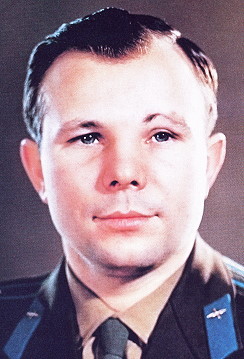
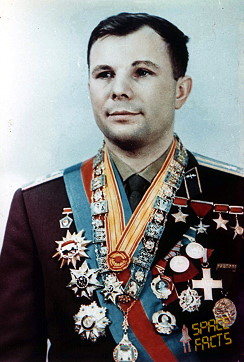
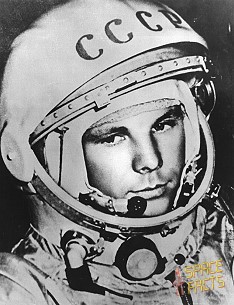
Yuri Gagarin 's historic space flight

On a sunny morning 50 years ago, the 27-year-old carpenter's son turned Soviet cosmonaut, Yuri Gagarin, stunned the world. Blasting off from the Baikonur cosmodrome in Kazakhstan, Gagarin became the first human to travel into space. His journey aboard the Vostok spacecraft was unquestionably one of the great achievements of the 20th century and a landmark in human history. Coming as it did during the height of Cold War, Gagarin's success appeared to establish his country's supremacy in space technology. Just four months later, another Soviet cosmonaut, Gherman Titov, spent more than 25 hours in space and completed 17 orbits of the earth. America's muted response saw Alan Shepard carrying out a sub-orbital flight lasting just 15 minutes in May 1961. The United States could redeem some pride only in February 1962 when John Glenn completed three orbits in space. Just a month after Gagarin's historic space voyage, President John F. Kennedy declared that the U.S. would put a man on the Moon by the end of the decade. The space race was on — and it was a race that America won hands down. In July 1969, Neil Armstrong and Edwin Aldrin became the first men to set foot on another world. Ten more of their compatriots too left their footprints on the Moon.

But the U.S. Congress and the American public were not willing to continue funding further manned space exploration on the same scale. The U.S. space agency then turned to building the world's first reusable spacecraft that could take humans and cargo into orbit. The first space shuttle, Columbia, flew in 1981, followed by four of its siblings, Challenger, Discovery, Atlantis, and Endeavour. America's dominance in space has continued unabated after the Soviet Union's break-up. But with space programmes becoming more demanding, many major space initiatives are now joint endeavours involving many countries. The launch of the Hubble space telescope in 1990, a joint venture between the U.S.'s National Aeronautics and Space Administration (NASA) and the European Space Agency was the first such initiative. The International Space Station (ISS) involving 16 countries, including the U.S. and Russia, is another excellent example. Even India's Chandrayaan-1 carried payloads from other countries. After NASA mothballs its shuttle programme this year, Russia's Soyuz spacecraft will be the only way that astronauts can travel to the ISS. The interest in manned spaceflight appears to be flagging in both the U.S. and Russia. It is, however, on the rise in China and India. Fifty years after man first ventured beyond the confines of Planet Earth, it is perhaps time for the spacefaring nations of the world to come together on a bold programme of manned space exploration.

Yuri GagarinYuri Gagarin


Yuri Gagarin


What job do I have?

I wear a hard hat to protect me from falling pieces. I spray a hose to help a burning house. What job do I have?

Chef


Firefighter


Pilot


Athlete

2. I go to school every day. I help children learn different things such as math, science, history, and geography. What job do I have?

Teacher


Police Officer


Firefighter


Magician

3. I listen to your heartbeat when you come in for a check-up. I give you medicine when you are sick. What job do I have?

Baker


Police Officer


Doctor


Teacher

4. I usually drive around in a car with flashing lights on top. I help protect people who are in trouble and try to enforce the law. What job do I have?

Zoo Keeper


Doctor


Miner


Police Officer

5. I can usually be found at the store. You cannot bring your groceries home without paying me first. What job do I have?

Firefighter


Cashier


Baker


Waiter/Waitress

6. I wear a helmet with a light on top. I usually work in underground caves in search of things like coal or gold. What job do I have?

Baker


Miner


Chef


Athlete

7. I am responsible for driving a train down the tracks to bring people and supplies from one place to another. What job do I have?

Conductor/Engineer


Teacher


Baker


Miner

8. My store always smells fresh and delicious. I make bread, cookies, and muffins for families to eat. What job do I have?

Baker


Librarian


Farmer


Pilot

9. I help feed our population. I use tractors and tools to help me grow wheat, vegetables, and raise animals. What job do I have?

Waiter/Waitress


Pilot


Miner


Farmer


10. I take your order for breakfast, lunch, or supper. Once the chef makes the food, I bring it out to you. What job do I have?

Pilot


Teacher


Waiter/Waitress


Farmer

For answers go to this site...
http://www.funtrivia.com/playquiz/quiz2484801c73008.html

Sunday, April 10, 2011

Quiz for Children...Festivals of India.( Site for more quizzes)

<http://www.pitara.com/activities/quiz/online.asp?QName=occasions&QNum=1>

Why is Ram Navami celebrated?

Choose one of the following:
1):It marks the birth of Lord Rama
2):It marks the return of Lord Rama after exile
3):It marks the beginning of the harvest season
4)It marks the marriage of Lord Rama
Q:2)
Which festival is also popularly called the "Festival of lights"?
Choose one of the following:
Onam
Deepawali
Dussehra
Guru Nanak Jayanti
3):
India Quiz : Holi's Here!
The festival of Holi marks the end of winter and the beginning of –
Choose one of the following:
Spring
Summer
Autumn
Monsoon
3)Q:
When was Christmas first celebrated?

Choose one of the following:
The year after Jesus was crucified
Around 100 AD
4th Century
1935
4):
Where did the Christmas tree tradition originate?


Choose one of the following:
Germany
Israel
New England
Scandinavia
5)Q:
Montreal lies on the junction of two rivers. One of them is the St Lawrence. Which is the other?
Choose one of the following:
Ottawa
Mississippi
Nile
Missouri


Ayurveda - Ayurveda Healing the Mind


by Prabhath P


Ayurveda seeks to remove the root causes of mental illness in a holistic way. Its focus is on prevention through correct diet, exercise, meditation and cultivation of the right attitude. It offers a complex array of therapeutic techniques and natural medicines to restore balance and harmony.

In an increasingly insecure and chaotic world, many people are finding conventional psychiatry and psychology inadequate for healing the mind marred by constant stress.


Concepts of Mental Health in Ayurveda


The ancient system of ayurveda (science of life) offers a holistic approach to mental health that integrates the mind, body and soul. Sushruta, the ancient exponent of ayurveda, defines health as svasthya-a state of total biological equilibrium, where the sensory, mental, emotional and spiritual elements are harmoniously balanced. Ayurvedic theory of health is based on tridosha (primary life forces or biological humours). The five elements (panchabhuta) combine in pairs to constitute the three doshas-vata (ether and air), pitta (water and fire) and kapha (water and earth). The combination of these doshas inherited at birth indicates an individual's unique constitution. The dynamic balance of tridoshas creates health.


The three gunas (sattva, rajas, tamas) are connected to tridosha in ayurveda. According to S. K. Ramachandra Rao, Ayurveda Academy, Bangalore, "The three gunas together are responsible for the existential, experiential, evaluative and transactional dimensions, each of which may serve as a motivational source of stress." The ideal state of mind is sattvic, marked by equanimity. An agitated mind is in the rajasic state, while the lethargic and gloomy mind is in the grips of tamas.


The accumulation of toxins in the body is termed ama. Psychologically, ama arises from holding on to negative emotions and undigested experiences. According to Dr. Deepak Chopra, who has popularized ayurveda worldwide, "The guiding principle of ayurveda is that the mind exerts the deepest influence on the body, and freedom from sickness depends upon contacting our own awareness, bringing it into balance and extending that balance to the body."
Elements of Ayurvedic Psychology


Charaka in his treatise Charaka Samhita, describes eight essential psychological factors that are negatively affected in various ways in all psychiatric disorders. The psychopathological condition is a function of these factors, which are manas (mind), buddhi, smriti (memory), sajna jnana (orientation and responsiveness), bhakti (devotion), shila (habits), cheshta (psychomotor activity) and achara (conduct). Compared to other major ayurvedic texts like Sushruta Samhita, and Ashtanga Hrdayam, Charaka Samhita gives more emphasis to the view of life as a self-aware field of pure consciousness and natural intelligence where the knower and the known are one.


Primary psychological conditions caused purely by mental disorders are kama (lust), krodha (anger), lobh (greed), moha (delusion), irshya (jealousy), mana (pride), mada (euphoria), shoka (sorrow, grief), chinta (anxiety), udvega (neurosis), bhaya (fear), harsha (happiness). The psychiatric conditions caused by a combination of physical and mental (psycho-physical) disorders are unmada (psychosis), apasmara (convulsive disorder), apatantraka (hysteria), atattvabhinvesha (obsession), bhrama (illusion, vertigo), tandra (drowsiness), klama (neurasthenia), mada-murchha-sanyasa (loss of sensory perception leading to coma), madatyaya (alcoholism), gadodvega (hypochondriasis).


Ayurvedic Treatment Methods

The focus is on prevention of illness, promotion of health and longevity for which Charaka and Susruta recommended a life-style consisting of dinacharya (daily) and ritucharya (seasonal activities), involving diet (ahara tatva), vyayam (exercise), meditation and virtuous qualities (sadvrutta). Maharishi Ayurveda prescribes the ayurvedic daily routine, beginning with abhyanga (oil massage), which removes toxins and stimulates the flow of natural intelligence in the body. Transcendental Medit-ation that dissolves deep-rooted stress and promotes harmony, creativity and clarity of mind through bliss consciousness, is an essential component of this routine. A proper diet in tune with the ayurvedic body type is also important.


Ayurvedic Medicines for Mental Health


In the words of Dr. Marc Halpern, "Ayurveda classifies herbs with a stabilizing effect on the mind as 'medhya rasayanas'. These herbs promote the intellect and deeply nourish the neurological tissues. They are nervine tonics... Ayurveda favors the use of combinations of herbs that meet the specific needs of each patient as no two patients present exactly the same condition"


These medicines act as specific molecular nutrients for the brain, promoting better mental health that leads to the alleviation of behavioral disorders. The medhya rasayanas enhance biological nourishment of the brain, producing tranquility of mind, concentration and improved memory. Ashwagandha and shankha pushpi have a secondary mild sedative effect. Others like calamus have a mild stimulating effect.


For more informaion contact:

Contact


Government Ayurveda Mental Hospital,

Kerala, 676 501. Ph: 0483- 274 2285


Dr. E. Surendran, MD, PhD,

Department of Kayachikitsa,

V.P.S.V Ayurveda College, Kottakkal, Kerala.

Email: aswins@sancharnet.in


National Institute of Mental Health and Neurosciences (NIMHANS), Bangalore.

http://www.nimhans.kar.nic.in/


When the body, mind or spirit are out of balance with the larger environment, illness strikes. Healing, therefore, is the process of re-engineering the natural balance of the self.


Wellness or good health is that state of vibrant equipoise between the individual and the universe. A state in which the body, mind and spirit are free and fully expressive

ayurveda facts


Saturday, April 9, 2011

Fathers of Medicine and Surgery'..CAPT AJIT VADAKAYIL

FATHERS OF SURGERY AND MEDICINE 4200 BC -- CAPT AJIT VADAKAYIL


FATHER OF SURGERY -- ACHARYA SUSHRUTA


FATHER OF MEDICINE -- ACHARYA CHARAKA.


Wheeler Wilcox: “India – The land of Vedas, the remarkable works contain not only religious ideas for a perfect life, but also facts which science has proved true. Electricity, radium, electronics, airship, all were known to the seers who founded the Vedas.

Sir W. Hunter, British Surgeon: “The surgery of the ancient Indian physicians was bold and skilful. A special branch of surgery was dedicated to rhinoplasty or operations for improving deformed ears, noses and forming new ones, which European surgeons have now borrowed.”


Today the white man has printed all over the place that a Greeko Hippocratus is the father of Medicine and another Greeko Hirophilus is the father of surgery-- both operating in 400 BC.

Well no matter what Vatican tries or Max Mueller or Macaulay tries-- truth can never be buried. It is the Internet age now. The age of peer reviewed medical magazines is dead. There were never ever witch doctors or shamans in India like the rest of the planet.
(This is a debatable point as all systems of medicine and surgery  are costly in India and even now; ie 2011 ptients do go to witch doctors)  This is my opinion.

The reason why Emperor Vikramaditya ruled in great harmony from Jerusalem to Urals to Vietnam in 7000 BC , is because he GAVE Medicine and Surgery. Even those days people had the commonsense to know that without health you are nobody. And India had those medicines in unlimited quantity--sustained by soil and climate.

Only India had the thousands of amazing herbs, botanical plants and colloidal minerals , by which the science of medicine works. The whole world knows this. There were no such plants or minerals in Egypt or Greece or elsewhere.

Even today 6000 years later, the science of Ayurveda is the same, with hardly any revisions . All the west knows about Ayurveda is what a pseudo Indian Deepak Chopra tell them on TV in fancy English.(No comment as I have not seen this show).

As early as 3000 BC, the Egyptian Pharoahs send word to the Dhanwantari hospitals in Kerala, when he wanted some medicinal herb or a physician sent urgently. The Pharoah used his marathon carrier pigeons with stopovers at Socotra and Laccadives. Some of the herbs were transplanted from Kerala at Socotra, and they are still there.

Both Sushruta and Charaka wrote their medical treatises in 4200 BC on the banks of the river Saraswati. In 4100 BC warrior sage Parashurama came to Kerala and annointed 108 idols of Ayurveda god Dhanwantari on the way. The Dhanwantari temple near Guruvayur , where all Kerala Arurvedic college doctors go after receiving their degree is to worship this 6000 year old idol. Dhanwantari is an avatar of Vishnu and the father of Ayurveda.

Sushruta was the son of Maharshi Vishwamitra. He wrote the SUSHRUTA SAMAHITA , which is the world's first book on the practise of Shalya ( Surgery ) in Sanskrit.


The English translation itself runs into 1800 pages. The original Sanskrit text contains 184 chapters . It deals with every facet of surgery including from Caesarian surgery, amputations, brain surgery, cataract surgery, piles, hernia, fibroids --right up to plastic surgery. His books deals with first aid, anti-toxins and child care too.

The present world may find this difficult to believe, but his surgical instrument diagrams are available in these books.


Vedic Indians never felt the need to patent knowledge, like greedy Yank pretender Edison . Edison had more patents for the mangy phonograph than the total number of fixed or movable parts it contained, out of which 6 are for the wooden cabinet! How pathetic! Knowledge to ancient Indians was like a song, which did NOT have to be recorded and patented for financial gain. It was for the audience to enjoy.

The drugs used by Sushruta were both of plant and animal origin. Animal origin means vaccination which Edward Jenner re-invented later in 1800 AD--or 5800 years later.

For a microscope they used a water drop as a spherical lens – to project all bacteria inside using a coherent narrow light beam beam as a HUGE shadows show on a screen behind.

Genetic defects and aberrations DNA blueprint, and its quantum healing using carrier sound mantras were known .


Sushruta made it compulsory for his surgeons in his school to have licences. It was compulsory to experiment on real human cadavers. He allowed lower caste Hindus into his school ( unlike Charaka )-- so that the higher castes who were squeamish to handle dead bodies could be exempted. Suturing would be done with compatible animal organic threads, which did NOT require removal. . Even today , 6000 years later , the Ayurveda stalwarts in Kerala Dhanwantari colleges are NOT from Brahmins or higher castes. Sushruta used alcohol and opium for anesthesia.


Sustruta's surgery texts were known to the Arabs, who traded with Kerala . Arabs did not steal the work. It was given to them free. The Europeans ( Greeks and Italians )stole the knowledge from the Arabs,and patented it for themselves in Latin.


Charaka was the author of the Charaka Samhita, which contained 120 chapters in Sanskrit. It deals extensively with diagnosis, as any idiot could do a cure once diagnosed.


He dealt with almost all present day illnesses. He knew the anatomy of the human body from the expertise of Sustruta. Charaka did not deal with cadavers and animal based medicines. He was purely onto Plants and herbs--thousands of them . He had terrific quantum botanical medicines and broad and narrow spectrum antibiotics.

Charaka believed in prevention and gave great importance to diet, hydration of body with low surface tension water/ veg juices , yoga and sleep ..

Today, these two great Vedic Maharshis cum seers , are hardly known by the ordinary Indian. The White west are happy in their contention that in 400 BC, the Greeks discovered Medicine and Surgery.

Both Charaka and Sushruta derived from Vedic wisdom of the Vedas written in 5000 BC. It speaks about chakras . DNA is referred to a Tvatsa in the Rig Veda--the blue print of double helix coiled serpents ,which gives shape to all living creatures and that which cannot be destroyed. The Yin-Yang cycle model of the universe is referred to a Tamas/ Rajas/ Sattva or Shiva's trident ( creator/ preserver/ destroyer ). The wave-particle duality is mentioned in Vedanta. Atharva veda gives the code for photosynthesis and talks in great detail about the cells. It must be remembered that Vedas are just a written form . The knowledge existed in the form of Sanskrit verses, which was handed down verbally from 9000 BC to 5000 BC by sages with amazing memories, and 12 strand DNA.

The Maharshis ( or Rishi among Rishis ) had 13 strand DNA , with the extra spiritual gene conferred by star dust or cosmic rays, which alter DNA and consciousness.-- which gave them teleportaion powers via wormholes , telepathy powers ,transmutation powers, antigravity powers and long life.. On Dec 21st 2012, it is expected that such cosmic rays will again bathe planet earth , after a gap of 12000 years. It must be noted that Astrology has survived in India for 12000 years. My own marriage happened after my parents matched 78 horoscopes of prospective girls, for the perfect match ( this is usual in India ).


And within 60 years of Independence and graduation form a lowborn, useless, smelly, black skinned coolie--Indians have put their flag on the moon. And computer programming and brainy codes are like breathing for the Indians.
As per the Bible and Vatican the cosmos and world was created on 23rd Oct 4004, at exactly 9 AM-- then how can Rig Veda be written in 5000 BC--pray? prithee?

CAPT AJIT VADAKAYIL

Friday, April 8, 2011

HIPPOCRATES....Father of Medicine

HIPPOCRATES
Father of Medicine in the Western World. As we saw from the postings on Sushruta and Charakan,  medicne and surgery was quite highly advanced in India.
Born in 460 B.C. - Died in 377 B.C.

Hippocrates (hih POK ruh teez) lived 400 years before the birth of Christ. He is known as the father of medicine because many of the things he discovered are still practiced today.

During the time when Hippocrates lived, people were very superstitious. * They believed there were four fluids in the body which matched four elements; earth, air, fire and water. They would carry sick people to the temple because they thought the god of medicine, Aesculapius (es kyoo LAY pe us) could heal them. They would chant magic words over the patient to try and heal them.
This practise still continues in places where MEDICARE is not available.

Hippocrates had observed many patients and carefully recorded their symptoms and the way their illnesses developed. He would look at the color of the skin, and how the eyes looked. He would look for fevers and chills. He described many illnesses including pneumonia, * tetanus, * tuberculosis, * arthritis, * mumps, * and malaria * .
YOU WILL OBSERVE THE SIMILARITIES BETWEEN THE TEACHINGS OF  HIPPOCRATE AND CHARAKA.

He told his students to carefully observe their patients and to learn from the things they had observed. He said the human body could heal itself and could return itself to good health. The patient was given something to relieve pain, but nothing else was done.

He told his patients they should eat a moderate amount of food; not too much and not too little. A moderate amount of exercise was recommended. Patients were encouraged to walk for exercise. (Life style changes, as we call it today).
Ancient Greek surgical instruments Doctors were told to make sure their hands were clean before they treated patients. He said the operating room should be well lighted and look cheerful.

The Hippocratic (hip uh CRAT ick) Oath was named for him. It included rules of conducts for doctors and even today doctors still honor a form of the oath.

 
Hippocrates was one of the earliest Psychologists.


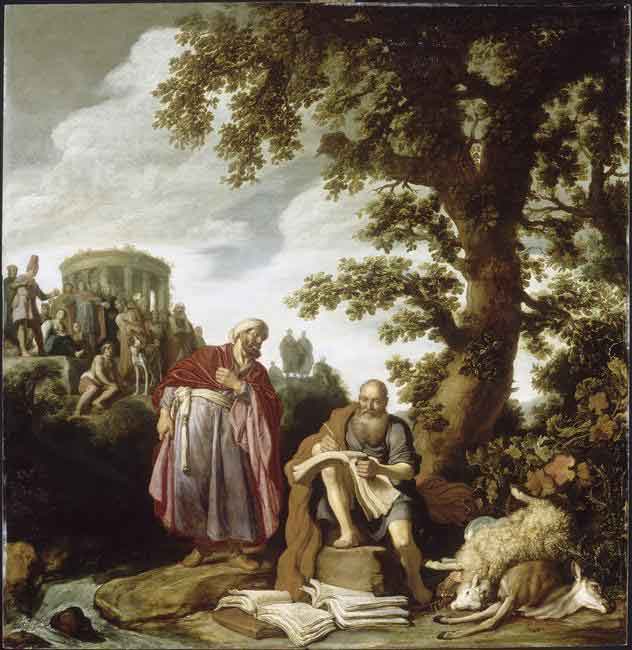
Hippocritus and Democritus.


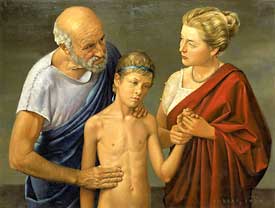
Hippocritus examining a boy.